Father-Son "Connection"

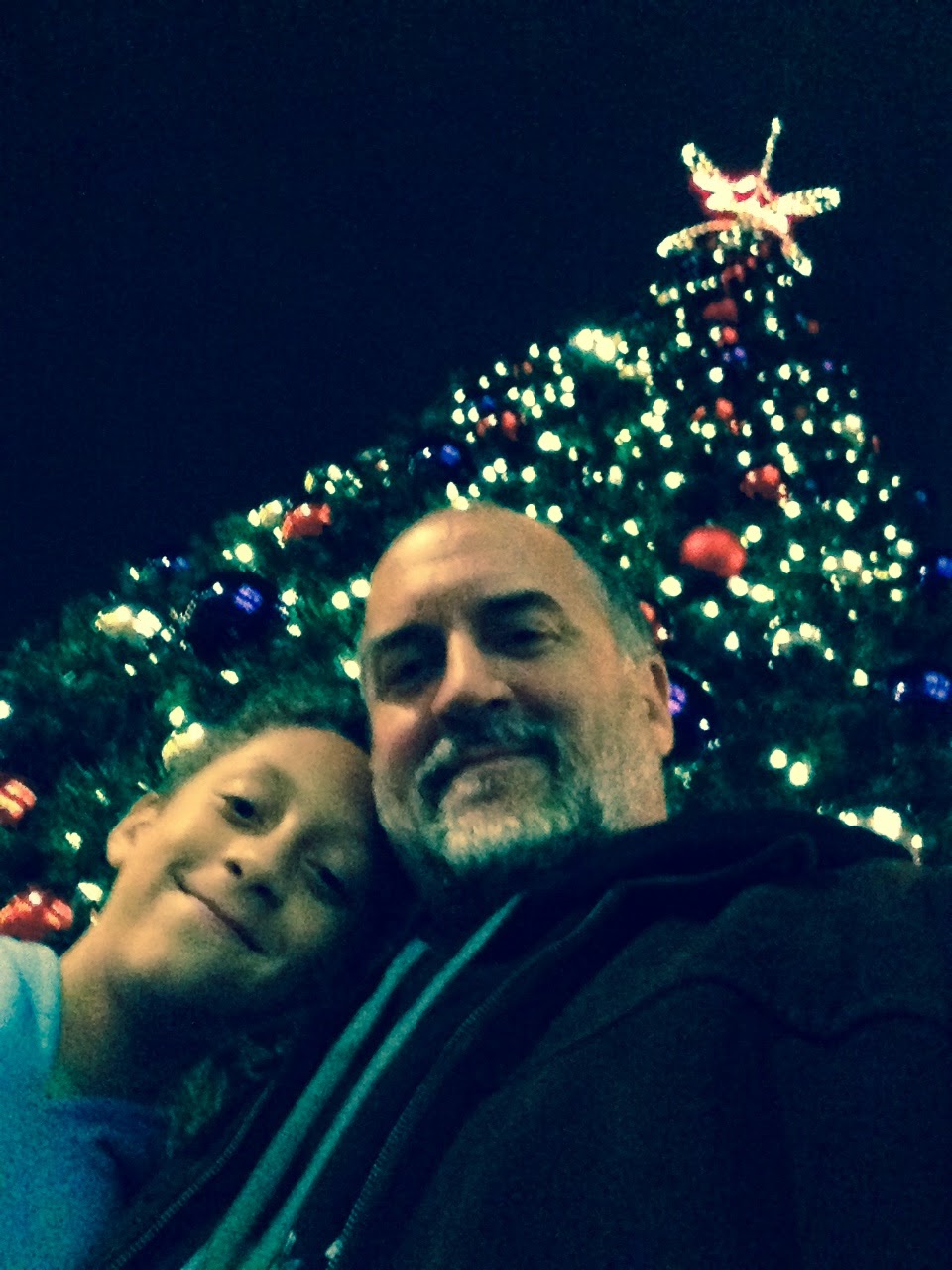
Diego and the author, in a rare “cuddly” moment last Christmas

Today my work took me — as it occasionally does — to my son’s middle school, where members of my AVID team and I were interviewing 8th graders interested in joining our AVID program at the high school next year.  I decided it would be a good idea to run out and get my son some lunch and surprise him in the cafeteria to break bread. Taking my place in the lunchroom a few minutes before the bell, I strategically chose a position where I would be able to see him coming, while avoiding being trampled by a couple hundred 11 and 12 year-olds.

We spotted each other fairly quickly, and he flashed a vague smile, shaking my hand.  I suppose I could have gone for a hug, but I didn’t, as he’s not generally a big hugger, even in the privacy of his home. “Not this room, we eat in the other room,” he said, moving quickly to where he and his friends normally eat.  Pointing to a row of round seats permanently attached to long dining tables, Diego broke it down for me.  “This is my seat, and that one is Alec’s,” he said, motioning to the one I was about to settle onto.  He raised his eyebrow and said, “You can sit here,” motioning to the seat on the opposite side of him.  Obediently, I took the seat he had indicated.

I produced the Subway Sandwich Shop bags and his smile grew a little broader, before he suppressed it.  “Did you get it right this time?” he asked with a grin.  I laughed, (a) because it’s a running joke that I can never remember the exacting specifications of Diego’s sandwich order (turkey, no cheese, lettuce, no tomato, pickles AND cucumber.  Salt, pepper, oil and vinegar.  NO MAYO), and also because my wife had just texted me his sandwich preferences earlier that morning, when I’d let her know of my plans.

He looked up at a sign on the wall that I could not read and said, “Oh good!”

“What?” I asked.

“We can use technology during lunch.  If everyone behaves well enough in the cafeteria, then they let us use our devices the next day.”

“Oh great,” I answered.  I had originally pictured us being like those kids at my school when their parents come in, sitting comfortably, laughing, chatting.  That paradigm clearly did not exist in the 6th grade cafeteria experience.

And that was okay by me.  Again, I could have made a big deal of it and forced him (and myself) to put away the iPhone.  “Talk to me, son!” I could have intoned.  “Be here with me in the moment.”  Or some such whiny-old-mannish complaint.

But then I told myself, Hey, it wasn’t like he was expecting you.  You decided it would be nice to drop in on him with lunch, and I’m sure it was, indeed, nice for him.  On some level.  Two things to consider, though, were that this was his time, and that I was only an interloper.  My experience does not equal his experience.  And my expression of love and joy is not necessarily the same as his expression of love and joy.

In the end, I got to sit with my boy and laugh with him a bit about a new game he was playing on his phone:  something called “aa,” in which one has to deposit spokes onto a spinning wheel, trying always to get to the next level.  I watched Diego and his friend Alec laugh together as they played the game, each on his own iPhone.  I feigned interest, asking them about their strategies for beating the game.  They were politely tolerant of me, though I could tell they were much more content just to be playing together, or at least next to each other……

“Well sir,” I joked with him as I got up, “good talk.  Alec, you take care.”

Both boys shook my hand, and I made my way over to Diego’s assistant principal to say hello and drop dime on a group of boys playing “truth or dare” at the next table.  As I left, I took one look back at my son, still a boy, but on the verge of the next phase, laughing, happy and in his space.

A little sad, I made my way out of the cafeteria, leaving the din of too many children behind me.  “This is as it should be,” I reassured myself.  “This is exactly as it should be.”
Bringing Them Back

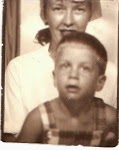
Me and Mom in a Photo Booth, circa 1965

November is “National Novel Writing Month,” and I’ve taken it upon myself to give it a try.  So far I’m desperately behind where I need to be to actually be finished by the 30th, but I’ve got something.  I’m never comfortable writing about my writing while it’s happening, but I will say this:  It’s both wonderful and sad to be bringing back people who have been gone from my life for many years.  The process of writing forces me to have to recall details and moments, to make the characters “come to life.”

In this particular story, I am bringing to life a character based on my mother, another on my father, and an older couple based on my grandparents.  All of these individuals died years ago, and as I flesh out these characters, it brings a host of emotions.  In one way I’m delighted to see them all, and then there’s that sadness, that reminder that they’re gone.  If you’ve ever had a dream in which your departed loved one appears, then you know the regret that comes the moment you wake up.  
By spending time on this novel, I’m prolonging that dream a bit.  It’s difficult to go on, however, knowing it will have to end.  But then, one could easily say the same thing about life.  And yet we go on, and do the best we can, in the hopes we leave some kind of legacy for those who come after us.  
So, for this reason I will continue to work on the novel, continue to bring them all back to life, in the hopes I’ll create something that I can leave behind — something that will live on, long after I am gone.

Another First in This, the Digital Age

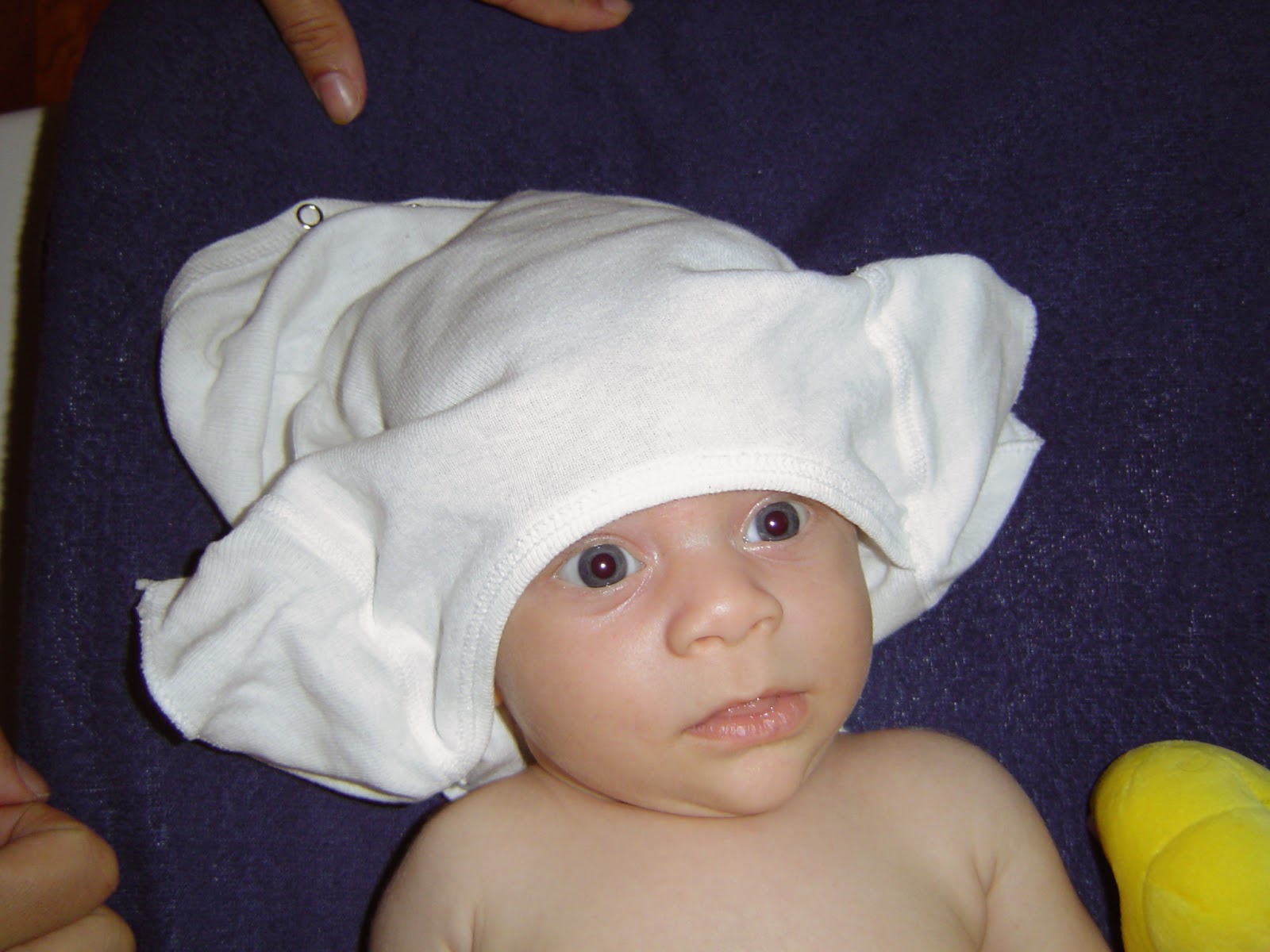
Diego Fuchs at about two months old, in the summer of 2003

It’s about 5:30 pm on a Friday, and I’ve prepared my materials for the meeting with which my day will start this coming Monday.  An Alejandro Escovedo CD is playing in my computer’s disc drive, and other than a lone custodian emptying classroom trashcans down the hallway, I’m the only human being in this part of the enormous Cedar Ridge High School campus.

During football season, this is my quiet time at work.  The students and teachers pile out between 4:10 and 4:45, and I’m actually able to sit, and work my way, undisturbed, through what’s left on my “to-do” list until having to make my way over to the stadium to stand on the sidelines, greet and “watch” our student section and try not to cheer too obviously for our Raiders.

It occurs to me to do something that I’ve never done before.  I begin to script an email to my eldest son, Diego.  I can do this, because we have enrolled our children in the district where I work, and all middle schoolers (Diego is in sixth grade now) are automatically given a student email address, which stays with them throughout the remainder of their school careers.

The workload facing Diego far surpasses anything he’s ever had to deal with before.  He takes Language Arts, World Cultures, Science and Math, along with a journalism elective, art and Physical Education.  It has been tough, but so far he is handling his business, as they say, and maintains a good average.  So I write him this email, whose subject line reads “GOOD JOB!” :

Hi Diego, it’s Dad.


Just wanted to take a moment to let you know that I think you’re doing a great job.  Mami and I both appreciate how hard you have been working, and yes, we are always going to push you to be even better, because we KNOW YOU CAN DO IT!

I don’t think Diego even knows he has an email account, but I’m looking forward to when he reads this, because my message, along with the follow-up sent by his mami are meant to encourage him to continue to work hard, and to know, as Jeanette said in her first email to our child, “we’ve got his back.”  We always have.

And we always will.

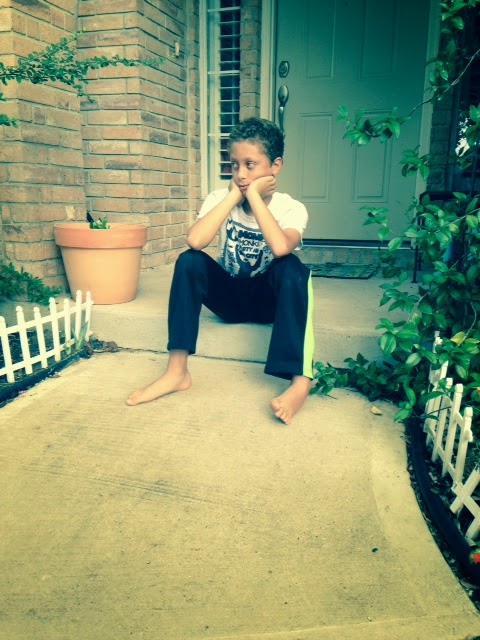
A more recent shot of Diego Fuchs, class of 2021.

Beginning with 'THE END': The Birth of a Manuscript

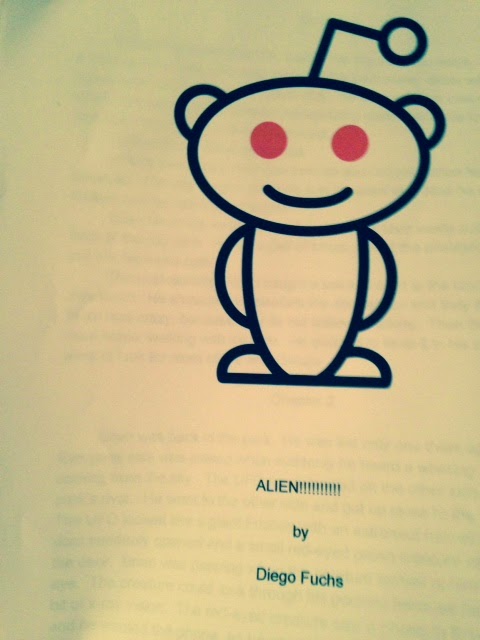
“THE END,” my son Diego said, and I typed the words, thus finishing his first official manuscript, a short story entitled ALIEN!!!!!!!!!!!  Without getting into too much detail, it’s something he wrote for his Language Arts class at Ridgeview Middle School, and it tells the tale of a man named Brian who encounters an alien, Dexter.  It is a cautionary story about what happens when one takes something that belongs to someone else without asking.  I had agreed to be his “scribe,” and to type as he told it.  

The story is maybe 500 words in length or so — about a page and a half long.  The length is irrelevant, however, as is the subject matter, really.  What struck me most in this experience was that moment of completion.  It took a while to get there, yes, as I had to remind Diego at times to slow down and let the story unravel.  He couldn’t wait for the “then-the-alien-appeared” moment, and I had to convince him to set the stage — to describe the place, and put the reader there, so that when it came, that point in the story would be even more powerful.  He bore with me and added the odd detail here and there, and I think he got it when I hit him with my old writing teacher mantra:  “Show, don’t tell.”
“Can I staple it together?” Diego asked excitedly, as the three pages, including the cover, above, came chugging out of the bowels of our printer.  
“Go for it,” I said.
His eyes appeared brighter than I’d seen them in a while, and he had that half smile that told me he was happy but didn’t want to let on.  And then it hit me.  I knew what he was experiencing, because I’ve been there myself.  In the old days, it happened after you yanked that final page out of the typewriter, with a winsome shriek of the roller, and you placed it underneath all those other pages you’d written, with the cover page on top, your byline nicely centered underneath the capitalized title.  You banged that stapler, or clipped that paper clip, or punched those three holes, or however you bound your finished product.  
And then you held it lightly on your fingertips, and you felt the heft of your work.  
I witnessed that moment when my 11 year-old son felt that wondrous feeling for the very first time, and said to me quickly, as though almost hoping I’d miss it, “That was fun.”  Of course I have to tell myself to calm down and not make too much of this.  This doesn’t necessarily mean he’ll become a writer like his old man and his grandparents.  
But who knows?  Maybe it does.  Maybe someday someone will be interviewing him for the New Yorker or the Paris Review and they’ll ask him about when he first knew he wanted to be a writer.  And maybe he’ll think about it for a moment and then he’ll say, “You know, it may have been the moment I held that first completed story in my hands, shortly after writing the words, ‘THE END.'”

Random Hill Thoughts

A couple of random thoughts came to me as I ran and (mostly) walked the hills of West Central Austin last week:

I’m a bit like the man who beats his dog on Friday night, then wakes up on Saturday morning and feeds the dog fillet mignon, cooing to him sweetly.  I’ve got to decide whether I’m going to be good to my body or bad to it.  It’s difficult, and pointless really, to do both.

The calico cat was back on her perch atop a utility access box on the corner of West 7th Street and Blanco.  Every time I came around that corner, panting and sweating, that cat looked at me with what I perceived to be a smirk.  It was almost as if she were shaking her head, thinking, “God, what fools these humans are.  Look at this one, running.  On purpose, and with no dog chasing behind him.”

Another thought, while driving home.

Sunrise on MoPac 

Sometimes, sailing through the 
nascent landscape, as violet
night gives way to fiery morn, 
I shake my head at the sight 
of so many others, just
like me, their headlights tearing
bright shards in the window of
the day.  I’m that time
traveller my father imagined,
dropped suddenly into today,
from a time when horses
were the mode.  Unreal,
I think to myself.
Could so much fantasy
have really become so 
real?

Ancestor Visitation

Last night as Jackson and I sat across the dinner table from one another, my nine year old decided he was going to draw me.  He then began to look back and forth, from his paper, to me, to his paper, and back to me.

“My mother used to say that to draw well it’s necessary to keep your eyes on your subject and off your paper as much as possible.”

“Shhh,” Jackson said.  “I’m trying to concentrate.”

As he concentrated on my face, I felt a giggle start to form.  My brother and I always got the giggles when Mom drew us — her eyes burning with creativity, love and gin.

“Man, I wish you could have met my mother.  The two of you would have really hit it off.”

“I have met her, Daddy.  I’m serious.”  He said it so sincerely that I had to stop what I was writing.

“Right here.”  He pointed to his heart.  “I see her right here.  All the time.”

“You do?” I asked.

“I do,” he answered.

First Kiss

Echoes of the Carole King
record we listened to
earlier that night fill
the silence in my head,
as I reach my hand
across the darkness toward you.

Impulsively, I have flicked off
the light switch in that
funny little outbuilding your
grandfather built to house
a ping pong table.

Now, in the still blackness of
this mild summer evening,
we’re not playing ping pong.
As your mouth raises up to
meet mine, I breathe in the
exquisite aroma of your breath.

Time stops for those
few moments, and NOW I
understand.  Now, in
this most pristine of
moments, I know why
it is that whole
nation-states have risen
and fallen for this
thing called love.

Sitting Down for a Coffee with my Younger Self

I can’t seem to get my
right heel to stop tapping
a rhythm to the jazz
that’s playing in the
old madrilena cafe.  Coltrane,
maybe.  Heavy on tenor
sax.

Looking across this
big room, I’m trying 
to guess which one is
him.  Coltrane is playing,
and the flying notes 
are making a crazed 
prelude to this crazy
meeting.

There he is, there I am.
Oh my God how young am
I? 19 or 20? My
skin looks different.
I catch myself waving
to myself, and pull my
hand down.

There he is.  He just
waved.  Or I just
waved.  Weird.  Oh 
my God, I’m so bald.
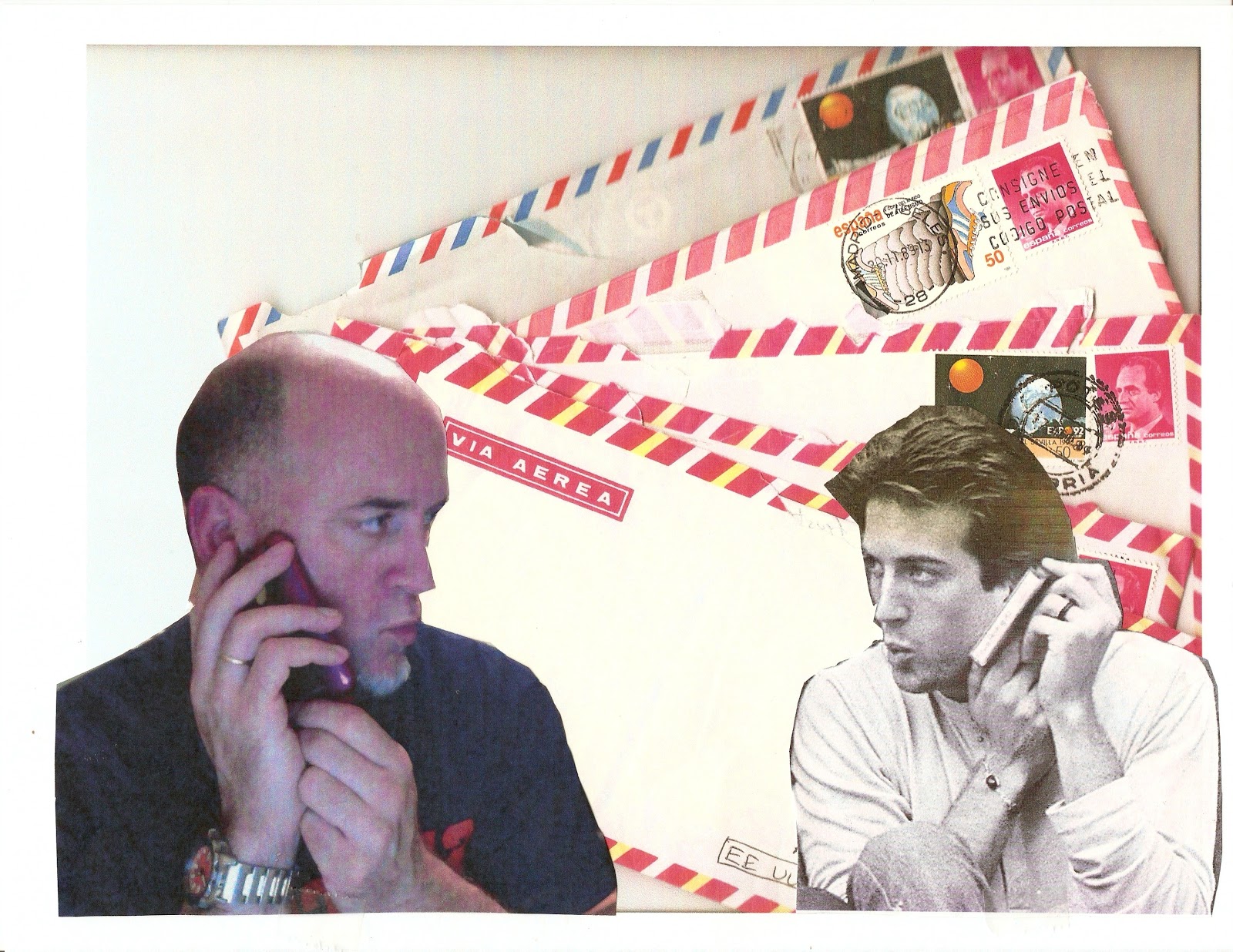
I look like Dad.

“Can I buy you a coffee?”
I ask.  “It seems only
right.”

“Sure.  Thanks.”  I’m
patting my pockets,
aware I have no
money and will need 
to swing by the AmEx 
office by Plaza 
de las Cortes across
the street.

“Cafe con leche?”

“Sure.”

We both look around the
room, in lieu of speaking
for a few minutes.  No
one seems to pay any mind
to us, or to this grand
experiment.  For all they
know, I am the father,
and my younger self is
the son.

“So,” I say to 
break the uncomfortable
silence.  “I go bald.”

“Sad to say, but
yes.  Enjoy that
hair while you
can.”

I run my fingers
through my long,
feathered hair
absently.  My older 
self lets out a
sigh.

“There’s so much advice I
could give you.  About how
to avoid heartache and all
that.”  I stop, because my
younger self doesn’t
appear to be listening.
He’s checking out a girl who
looks to be about his
age, maybe a little
younger, with Audrey Hepburn
bangs and a snaggle-tooth
smile.

My older self is saying 
something that seems
to be making him
emotional, like he’s
about to cry.  I missed
it, however, because I
have locked eyes with an
incredibly sexy woman I’ve
seen here before.  I think 
she works next door as a docent in 
the Circulo de Bellas Artes.
I’m shy about it, but
definitely want to hold
her gaze.

“Be happy,” I say, my
voice breaking.  “Just.
Be.  Happy.”

“It’s okay,” I tell myself,
because I seem so down.
Then I become afraid.
“Why are you so — why am 
I so — why are we so sad?”

“No, no, not sad,” I
answer quickly, because
I can see I’ve frightened
him.  I’m wiping tears
away.  “Just full.  My
heart, our heart, is so
full.  Please enjoy this.
Enjoy every second of
it.  It goes by so
fast.”  Trying to sound
wise, but feeling only
desperate and old.

My older self is 
giving me advice about 
enjoying my life.  Not
sure what he knows, what 
I’ve been through by then.
Not sure I want to know.

“She’s leaving,” I say,
pointing to the snaggle-
tooth docent.
“Why don’t you go talk to her? Find
out her name.”

I get up — too quickly,
probably — patting my
pockets again, as though looking
to throw in some
money for the bill.

“Don’t worry,” I say.
“I’ve got this.”

“Thank you,” I say.
“For the coffee.”

“Sure thing,” I say,
watching as I
move cautiously over
to the girl.

“Hola.  Como te llamas?”
I ask.

"Hill-Seeking" on a Saturday Morning in Austin

It’s still dark at 6 a.m. on a Saturday and there’s no real traffic to speak of.  As I pull into a space on Blanco Street, just north of West 6th, I can make out the forms of about ten people, standing or stretching under the light of a street lamp.  Their water bottles are lined up on the curb at their feet like soldiers, and I take a deep breath, then let it out and join them.

Our guide is A.T. Turner, educator and Crossfit guru, who I’ve known since we worked as Austin ISD School Improvement Facilitators back in 2008-2009.  She greets me warmly with, I think, way too much energy for this time of day.  To my right, I can sense 7th street, as it makes its way east of where I’m walking.  This is the hill we will climb, either walking or running, or some combination of the two, and I just let it sit there in my peripheral vision; I’m not quite ready to look at it directly just yet.

During my warm-up jog I feel my heart and respiration rates begin to rise.  The others in the group nod tired greetings, which I return as we pass one another.  Circling back, someone yells, “Car!” and I turn to acknowledge that I’ve heard them.  The car’s headlights reveal the shadowy shapes of houses, cars, trees and the occasional cat.  Other runners, not of our group, go loping by periodically.

When I get back to the base of the hill, I’m ready.  The younger, fitter folks sprint up the grade, but I’ve set a different goal for myself.  I’ve decided I’m going to set a weekly personal “threshold” in the face of this task.  Last week was my first time, and I told myself I would walk up and down the hill five times.  It got painful, and vaguely nauseating, but I did it, feeling a great sense of accomplishment when I did.

Today I set the intention of fast-walking the entire loop, a block around including the hill, five times.  I am pleased I’ve made this choice — not only due to the above-mentioned good feeling of having done something difficult, but because of what is revealed during this hour of daybreak.  Not only is there a postcard-worthy view of downtown Austin, bursting up in front of me at the crest of the hill, but each time I make the loop I see more details taking shape in the increasing luminescence.  Homes stand sturdy, looking out over the view, their lawns clean and well manicured.

The chirping of crickets has now given way to birds who titter at each other from across huge pecan and oak trees that stand like ancient sentries before these solid houses.  A calico cat eyes me with some hesitant curiosity and stands tall when I make kissing noises at her.  I take a quick break to give her a scratch behind the ear.  She mews loudly, and I apologetically inform her that I have no food to give her.

(When I return on subsequent laps, she is nowhere to be seen.)

Presently, I’m sitting in my favorite local coffee shop, basking in my pride.  Next week, I’ll set a new goal for myself, and as the confidence comes, the fast walk will get faster, eventually becoming a run.

And I’ll take it from there.

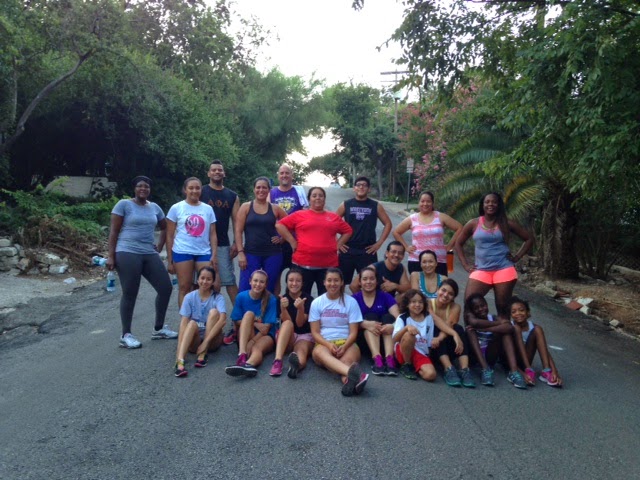
Stalwart “Hillseekers” after a good morning run in Austin

"About My Life": Journal Writing Passed Down to the Next Generation

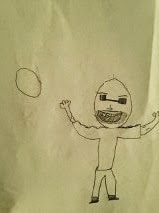
A recent picture of me by my 9 year-old, Jackson.  

“No Jackson!” I heard Diego say, with an urgency that made me brace myself for what came next.  “That’s Daddy’s journal.”

They were in our home office, at one of the desks, where they had been doing well for the past ten minutes or so.  I could hear them in there, engaging in imaginative play, which I love because it requires them to actively use their minds, rather than sitting passively in front of the TV set.

This entreaty by Diego was louder than the banter that had preceded it, so I came in and saw Jackson with a pen, poised to personalize the book where I scribble down random daily thoughts.  Truth be told, I don’t really mind finding Jackson’s work in my journals — within reason.  He tends to draw odd little sketches which I simply write around, and they end up being an interesting adornment to my work, when all is said and done.

“Here, Jackson,” I say, before he can start loudly pleading his innocence, and I reach up high on my shelf and hand him his own blank book.  (I have a few extras lying around, because I’m an optimist.)  He immediately begins work on a fascinating seascape, then asks me to draw him a shark, so that he can put a monkey in its toothy mouth.  Obviously.

“Look, Dee-AY-go!” he says, showing off his new journal to his big brother, and now I’ve got to stave off the older one’s whining about not having one.  I ask if he’d like a blank book of his own.

“Yes!”

He then writes on the first page of his new journal, which he dates and titles “About My Life.”  His first sentence, which I put right up there with “Call me Ishmael,” and “It was the best of times; it was the worst of times” is “My name is Diego Reyes Fuchs and I got a dog in April.”

And with that, a proud Fuchs family tradition continues . . .