Love in the Time of Corona: Update 1

Dear Friends and Family:

An update on the Reyes-Fuchs household.  Dateline:  Austin, Texas…

We’re currently on Day Four of what we once referred to as our Spring Break, a week-long, much-needed respite from school and work, that has now been extended through the end of the month of March.  I’m skeptical as to whether or not we’ll return at all, as the governor has waived state requirements for standardized testing for the remainder of the school year.  As administrators, we’ll need to decide how school will happen in the absence of the actual “schoolhouse.”

(This will illuminate the haves and have-nots of our population, as there are, believe it or not, still those among us who do not, or cannot, access the internet.)

On a more personal note, our family is in good spirits, as we feel the “social distance” growing between ourselves and the rest of the world.  My 14 year old, Jackson, maintains his social connections through his Playstation 4, where friends and cousins chatter into his gaming headphones deep into our Central Texas nights.  They create basketball-star avatar versions of themselves on NBA 2K, talking trash, and, I imagine, spreading misinformation on the coronavirus, faster than the virus itself.

The reality of our situation hit our older son, Diego, 16, yesterday when he and I pulled up in front of the Jungle Movement Academy, where he’s been doing an internship to eventually become a fitness coach, and saw the handprinted sign on the door:  “CLOSED due to Coronavirus.”  (They later called  to reassure him the closure was mandatory, and not due to any cases directly connected to the gym.)  So now Diego, who has become quite dependent on physical movement (which I love, by the way) is watching a lot of anime, drawing in his sketchbook, and stopping from time to time to do some stretching or push-ups.

Jeanette monitors the news on her phone, sharing reports with me as they come in.  Her yoga studio in Austin closed its doors days ago, and I know this affects her, as she has confided in me how much her yoga practice has come to mean to her.  I can feel her doing her best to put on a happy face — she jokes with the boys, making them smile and laugh with her silly persona.  She also keeps us happy by cooking amazing food, like the chili con carne she prepared last night, along with some home-baked cupcakes.

As for me, I’m doing my best to be strong and to stay positive, amidst my fears, which I keep to myself, regarding the potential collapse of the grid.  I wonder about what would happen if this crisis resulted in the lights going out.  I wonder, too, if maybe I shouldn’t have watched so much “Walking Dead”…

Last night I convened an online meeting of the writing group I’ve been a part of for the past five years, thanks to Google Hangouts.  Our usual meeting space, the Brentwood Social House on William Koenig and Arroyo Seco, notified us via email that they were shutting their doors a few days ago.  Being able to meet with my writer buddies felt important in the face of this.

And of course I check my Facebook account almost obsessively, in order to see how the rest of the world is faring.

The one thing I notice the four of us here in Casa Reyes-Fuchs all share is an obvious dependence on technology.  As long as we’ve got that, we’ll maintain our sanity.

As long as the grid holds up….

Night  (The Night Trilogy #1)Night by Elie Wiesel
My rating: 5 of 5 stars

I’m not sure how one “critiques” or even “reviews” this work. Words I normally try to avoid as a writer come screaming to the fore: “devastating,” “heart-wrenching,” and the like. I think it defies being written about because, in its brevity, it says all that needs to be said. The only “review” I can give is to read it yourself. Read the truth, and know that it can happen again, because it HAS happened again — in Cambodia, in Rwanda, and elsewhere.

My personal connection to Wiesel is obvious. My father was born the same year, in 1928. Had his life been only slightly different, he could have been there at Auschwitz and Buchenwald, alongside Wiesel. I can’t read this without picturing that.

I thank Wiesel for telling the story that needs to continue to be told, and I’ll try to heed his words: “There may be times when we are powerless to prevent injustice, but there must never be a time when we fail to protest.”

View all my reviews

Leaving the Atocha Station by Ben Lerner

Leaving the Atocha StationLeaving the Atocha Station by Ben Lerner
My rating: 3 of 5 stars

Mine was a very personal reaction to Lerner’s book, as one of the “white Americans” he references who could easily work illegally in Madrid teaching English. I had my time there long before he did (I’m assuming this is an autobiographical novel); like Adam, Lerner’s protagonist, I was an aspiring young writer who, deep down, doubted himself and had a good deal of difficulty living in the moment.

I applaud Lerner for how much he captures in Leaving the Atocha Station — the particular sights, smells, and sounds that make up the capital. Although I lived there in the late 1980’s, not too far removed from the days of Franco, I returned with my wife and two young sons for a brief visit in 2010, six years after the story of the novel takes place, and I can’t say that the city has changed all that much in the ensuing years.

Learner’s Adam is not the most likable hero. He’s self-absorbed and just plain selfish through much of the book. In the end, however, I understood him. Probably because I saw so much of myself as a young man in him.

View all my reviews

Remembering My "Moongotcha" Uncle Geoffrey Fuchs

No photo description available.
With Rheita and Geoffrey Fuchs in Ontario, Canada, summer of 1991

I received word from my dear cousin, Laura Lubin, that her father, my uncle Geoffrey “Jeff” Fuchs, had died on Friday evening, February 21, at the age of 94.  “It was peaceful and fast.  No struggling,” she shared. 


This post is my remembrance of him.


My uncle, Geoffrey “Jeff” Fuchs and I have always had a special connection.  It’s not like we spent much time together; my father, his kid brother Hanno, was a “homebody,” so the rest of us in his nuclear family were, too.  
But when we did see each other, mostly on holidays or special occasions, (we were in New York, and Jeff’s family made their home in Massachusetts) he and I always made a point to catch up with each other, usually by way of our special inside joke.  When I was a boy, he would take me over to a window, lean down or crouch behind me and say, “Hey Danny, look up there.  Do you see that?”
“See what?” I’d ask, playing along, beginning to giggle and brace myself.
“Right up there.  The moon.”
Then he’d poke at my ribs and grab hold of me, yelling “Gotcha!” much to my delight.
Thus he became my “Moongotcha Uncle Jeff.”  That’s how he would sign off on cards, letters, and, later, emails.  Or he’d use it as a nickname for me, as in, “Hey there, Moongotcha!  How’s it going?”
Corny? I guess.  Silly? For sure.  But it belonged to my uncle and me — the two elder sons in our respective families — and was, therefore, sacred.  I cherish that nonsense word to this day, and will do so for the rest of them.  
Rest in Peace
Geoffrey W. Fuchs
May 3, 1926 – February 21, 2020


The Testaments (The Handmaid's Tale, #2)The Testaments by Margaret Atwood
My rating: 5 of 5 stars

I cannot help but find it significant that I completed reading this brilliant novel on the day we in my country celebrate the birth, and life, of one of our greatest sons, Dr. King. It is our nation’s only officially recognized “National Day of Service,” on which date each of us is urged to think of ways to serve the greater human community.

Atwood is too modest to hold up her book as a service, but it most certainly is. The more cynical among us might prefer to think of this sequel — 35 years in the making — as a “cash grab”; however, I suspect that the Atwood estate was in a pretty good position going into her choice to embark upon this journey.

I won’t re-tell any of the book’s story, not only because I don’t want to spoil the experience for those who haven’t read it yet, but because “The Testaments” is about so much more than just its story. For me, personally, it has energized me in my middle age, much as its predecessor, “The Handmaids Tale,” did for me and so many of my fellow 20-somethings.

This is not so much a review, as it is a thank you note to Ms. Atwood. I admit to being among the anesthetized who would prefer to spend two hours in a hazy wormhole of cute kitten videos on Facebook than watching the news and the daily outpouring of lies our politicians dole out at unprecedented rates.

“The Testaments,” along with “The Handmaid’s Tale,” is one of those rare works that manages to shake its readers by the collar, and remind us that if we do not pay attention to the daily assaults on our freedom, we may very well wake up in chains. She says it more eloquently than I ever could:

“We’re stretched thin, all of us; we vibrate; we quiver, we’re always on the alert. Reign of terror, they used to say, but terror does not exactly reign. Instead it paralyzes. Hence the unnatural quiet.”

My father, the late Hanno Fuchs, encouraged me in a letter years ago, in his sometimes intentionally vague way, to “keep telling the story.” To circle back to Dr. King, via Ms. Atwood, I believe the story he was referring to was the story of Love conquering Hate, and of every man’s, and every woman’s, need to be free.

View all my reviews

Sorry Darling… But You're No Freddie

Image result for rami malek vs freddie mercury
The real Freddie Mercury (left) at Live Aid in 1985 stares down “Bo-Rhap” star Rami Malek

Well, I finally got round to watching last year’s big biopic about Freddie Mercury, “Bohemian Rhapsody,” and I have to say I found it only fair-to-middling.  There’s something about all those wigs and Malek’s prosthetic front teeth that automatically put the film in TV-Movie territory for me.  While I do think Rami Malek did a fine job of mimicry, especially with Freddie’s speaking voice, I never would have called his performance “Oscar-worthy.”  I kept picturing him watching Youtube videos of Freddie talking, Freddie singing, Freddie strutting on the stage, with a mirror next to the monitor, copying over and over and over what he saw and heard.

And there’s merit in the work ethic.  The Academy does appreciate it. Look at Joaquin Phoenix as Johnny Cash, and Jamie Foxx as Ray Charles.

Sure the movie was hyped to an epic degree.  But I honestly don’t believe that’s where my problem with it lies.  There’s just something so unique about Freddie Mercury that I think defies capture.  Maybe it’s his physicality? When you look at Freddie, you see that he carries himself both regally and athletically.  When I watch videos of him I have no trouble picturing him in his previous incarnation — as an amateur youth boxer.

Rami Malek? Not so much.  The one time he “puts up his dukes,” so to speak, in a hackneyed spat with his drummer, it reads as comical.

As Freddie might have put it, “Sorry darling.”

Book Review: There There by Tommy Orange

There ThereThere There by Tommy Orange
My rating: 4 of 5 stars

It takes a skilled writer to ferry his readers on a journey alongside not one but multiple narrators and protagonists. Tommy Orange performs the feat in a way that doesn’t feel showy or take away from the importance of his subject matter. I went back and counted 11 separate chapter headings that had the names of the central character for each as their titles. There is also another, omniscient narrator who opens the book with a prologue, and provides an “interlude” halfway through.

The effect these multiple perspectives have is to remind the reader that we’re looking not at a monolithic “Indian” prototype — (the Indian Head that used to appear on the test pattern at the end of a television’s programming day, back when there was an end) but of a diaspora. What’s left in the wake of the genocide carried out on the native people of what’s now called North America is a plurality of voices, experiences, and types.

All the characters in Tommy Orange’s powerful debut are three-dimensional, and deeply scarred. We witness their struggles against addiction, poverty, and violence, and also toward family, belonging, and love.

If there’s a “message” in this book, it’s aimed at those who suggest that it’s time to move on from the past and stop complaining about the crimes of those who no longer live among us. (Timely, in the face of recent comments by Senate Majority Leader Mitch McConnell)

As Orange says in the interlude:

“When we go to tell our stories, people think we want it to have gone different. People want to say things like ‘sore losers’ and ‘move on already,’ ‘quit playing the blame game.’ But is it a game? Only those who have lost as much as we have see the particularly nasty slice of smile on someone who thinks they’re winning when they say ‘Get over it.’ This is the thing: If you have the option to not think about or even consider history, whether you learned it right or not, or whether it even deserves consideration, that’s how you know you’re on board the ship that serves hors d’oeuvres and fluffs your pillows, while others are out at sea, swimming or drowning, or clinging to little inflatable rafts that they have to take turns keeping inflated, people short of breath, who’ve never even heard of the words hors d’oeuvres or fluff.”

Tommy Orange’s “There There” stayed with me in a similar way that the film “Once Were Warriors,” about contemporary life among the Maoris in New Zealand did. Yes, it’s a tragic tale of the survivors of a Holocaust we rarely discuss, despite its foundational place in our nation’s history. But it’s also a journey with numerous characters who feel like real people that you might meet along the long road of your own quest for family and for love; for life, liberty, and the pursuit of happiness.

View all my reviews

Memorial to a Different Kind of War

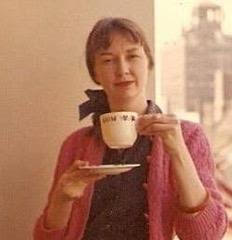
My mother, Carol R. Fuchs, Washington Square Village, New York, ca. 1962
Happy Birthday, Carol Runyan Fuchs.  Today you would’ve turned 88 years old.  Had you made it past 57 when you gave in to cancer — just one year older than I am now.

Appropriate, I suppose, that her birthday lands on Memorial Day this year.  She didn’t die in battle the way one thinks of it when thinking of Memorial Day; however, anyone who has seen a loved one struggle against, and eventually succumb to cancer knows it’s as painful, as traumatic as any war.  Less violent, maybe, but just as heart-wrenching to watch.

And the loss is no less real.

I miss you, Mom.  Thank you for your service to our family, to me personally as the man you helped me to become — the artist, too.  And thank you for continuing to serve your lineage, in the ways I pass your unique influence on to my children.

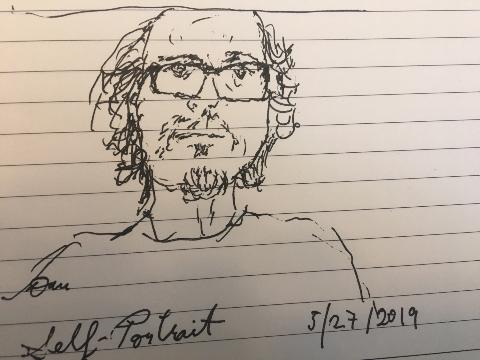
After writing this post in my journal, I was inspired to sketch a self-portrait, something I haven’t done in years.  I know it’s not very good technically speaking.  But in my mind, it’s one of the finest “quick sketches” I’ve ever done.  My mother drew in this style, and I can’t help but believe I was “channeling” her somehow when I sketched it.

InternmentInternment by Samira Ahmed
My rating: 5 of 5 stars

I recall a story my father once told, of his older brother, Geoffrey standing up in the middle of a Hitler Youth “assembly” at their grammar school in Karlsruhe, Germany, some time in the mid 30’s and shouting “Hitler ist ein Arschloch!” All my dad knew about the consequences of a young Jewish boy disparaging the Fuhrer so publicly was that the family was forced to find a new school for Geoffrey and his three young siblings. There were probably threats, maybe violence. But my uncle’s bravery, as just a small boy, to stand up to an entire regime in this way astounds me to this day.

Samira Ahmed’s novel Internment tells a similar story. Ahmed creates a protagonist who is young — seventeen going on eighteen — and, above all, brave. Her humanity shines through in every decision she makes; although she is certainly revolutionary, Layla Amin is her father’s daughter. She has a poet’s sensibility and is driven by a belief in what is good in our hearts as human beings. Ahmed calls on the oft-heard chant of anti-fascist rallies: “The people, united, will never be defeated.”

As an educator, I am so pleased to know that this book is now on the shelves of my school’s library. Ahmed speaks to young readers in a way that calls them to action without treating them as political pawns or symbols of some larger, dogmatic ideal. Through the eyes of an intelligent, strong narrator, Ms. Ahmed reminds her readers that what this country was founded on is what we must always continue to fight for.

This world needs Layla Amins and Geoffrey Fuchses. It also needs Samira Ahmeds. Thank goodness we have her. And thank goodness we have Internment.

Resist.

View all my reviews

Let Us Celebrate the Firstborn

May 16, 2019

It’s my first-born’s birthday today.  Diego Reyes-Fuchs came swimming out into a fancy jacuzzi at the Elizabeth Seton Birthing Center on West Fourteenth Street in Manhattan, New York exactly sixteen years ago.
Diego emerged only after a good ten hours plus of making us wait.  He took his time, and hasn’t changed much since then.  He’s reasonably punctual, like his dad.  (I don’t think he’s ever received a tardy in his school career.)  He’s just . . . “deliberate.”
And that’s pretty much Diego, in a nutshell.  As I said, he hasn’t really changed much in all these years.  If you look at his baby pictures, you’ll see an expression of skepticism, as adults “ooh” and “ahh” around him.  Diego is our Watcher.  His eyes are always wide open, taking in the world that surrounds him.  People describe him as quiet, but he embodies the cliche about still waters.
Like them, Diego Reyes-Fuchs runs deep.