The Mother Side of Things…

Recently, I came down with a virus (thank you, son) that made it virtually impossible to sleep. Normally when this happens, I wallow on my side of the bed, moaning audibly, in the hopes it will rouse Jeanette from sleep, so that she can administer that most Dominican of Cure-Alls: “Viapuru.” — Vick’s Vapor Rub, for those of you not in the know.

On this particular night, her sleep was a fortress, and no amount of my whining was going to breach the ramparts. I could lie there, continuing to sweat a cold sweat, switching soaking sides of my pillow every so often, or I could get up and try to occupy my time.

I opted to go into our family room and read for a while. I turned on the lamp, stretched out on the chaise and flipped on the Kindle to the Raymond Carver biography I’ve been reading. It was at that moment a wave of deja vu overtook me, and I thought, Where have I seen this before? The answer came almost immediately: This was my mother’s little nest — the one I’ve described in short stories (“The Favorite Nurse,” and others), where she would alight with gin and tonic and ashtray at easy arms-length.

I looked at the clock. 3:30 a.m. or so. Yes sir. That would have been about right. She enjoyed waiting until the rest of the household was fast asleep before going into her little “alcove” — an overhang, really, not a separate room at all, but it was all her own. My father lay there in their bed, only a few feet away, snoring loudly. This would prove one of those occasions when my mother’s deafness went from being a deficit to a benefit, and she would simply slip her hearing aid off the back of her ear, and place it gingerly next to her sweating highball glass, allowing her, I imagine now, to work or read or doze in a blissful, buzzing version of silence.

When you sat in her chaise, you were immediately aware of the hanging smell of old cigarette smoke in the upholstery, along with the understanding that it wasn’t your space to be in.

My wife, Jeanette is the one responsible for the creation of our version of Carol’s nook. It is Jeanette’s space, which is not the only difference. Like my father, Jeanette tends to knock off early. Let’s just say it’s highly unusual to find her awake after 10:30 PM. She doesn’t smoke, thankfully; and her forays into the kind of alcohol my mother drank nightly are few and far between. She’s also much more likely to be found there on her chaise reading a book or a magazine than scribing poems about aging parents or aging pets, the way my mother did. But just the same, there’s something deeply pleasant for me when I find my bride there. There’s a familiarity in seeing the matriarch of the family sprawled comfortably in this way, a throw keeping her legs warm, as she patiently accepts the embraces of her family, allowing them this brief interruption of her well-earned solitude.
This is NOT the Canyon

Blogging is not writing — it is not the same as it used to be anyway. It’s the difference between yelling into a canyon at night and waiting for a response, and yelling into a dark room full of people who are poised to yell something back.

In the canyon, you puzzle over whether or not anyone will even hear you.

In the dark room, you anticipate the responses you’ll get, even before you start yelling.

Like it or not, this changes the dynamic. This is not writing, because this is not the canyon. Some may say that there’s comfort in the dark room, that the isolation of the canyon was overwhelming. For me, writing is a solitary act. Once the work is out there, and you’re reading it, then we can start a conversation. For now, I think I prefer the canyon.

He Would Have Made a Great Blogger

At some point in his adult life, my father, the late Hanno Fuchs, began writing down his thoughts and ideas on 3 by 5 index cards. They ranged from random observational tidbits, to ideas for longer pieces about the political state of the planet. If I’m not mistaken, my stepmother, Judy Fuchs, is in possession of some of these notes, along with earlier writings of his, going back to his army days as a psychological propoganda writer (“Psychprop,” as they called it) during the Korean War.

His gift for writing, and for thinking, really, are evident in those early pieces. I’ll reach out to Judy and ask for copies, so that I can look them over once again, in order to get a sense of how my father was thinking about the world when he wrote those notes. In today’s world, the little blue cards might have been “tweets,” and the longer, typewritten pages could have appeared on blogspot.com or some other similar venue.

The thought begs the question, however, of whether or not my father ever intended his notes to be read by anyone other than himself. I have no doubt he craved an audience — he was a writer by trade, after all; but he also knew a lot about the editing and revision process. And anyone I’ve ever known who considers himself or herself a writer cares a great deal about the careful tweaking of a piece. Often they’re quite stingy about when they consider a piece to be “ready” for public consumption. Perhaps he’d cringe at how readily I spit these little First Drafts onto the computer screen for God’s Green Earth to see.

Or maybe he’d just find it to be really fucking cool.

It occurs to me now that, either way, I once again follow in my father’s footsteps. He was navel-gazing long before this guy was even a notion in his formidable mind.

Convincing Oneself: Embracing the "Expert"

A couple of days ago I was introduced to a room full of new colleagues. The person making the introduction was one of those education leaders who is admired and revered for their body of work and long list of deeds done in the service of young people, and those listening had some heavy duty resumes, as well; so I was honored when she spoke to the “expertise” I brought with me to my new position.

Or was I? Was it that I was “honored,” or was I embarrassed? Proud, or mortified? In agreement with her, or afraid of being found out somehow — exposed as the impostor I really am . . .

It’s an interesting dynamic, and I’m not quite sure what to call it exactly. It’s the flipside of humility, I suppose; one is not meant to think too highly of oneself in this life. One takes a compliment with the proverbial grain of salt.

I find myself wondering whether Barack Obama, the first president I can call a “contemporary,” (I graduated from high school only two years after the POTUS did) has ever had this sensation. I tend to have it any time I face any kind of positive scrutiny; I can only imagine what someone of my generation feels when he’s referred to as The Most Powerful Man In The World, or The Man Who Made History. I wonder if, like me, he runs to his wife and says, “You’ll never guess what S0-And-So said about me!”

I’d like to think he’s moved beyond this.

But more interestingly, I wonder whether Mr. Obama ever looks at his reflection in the mirror, as I do mine, and sees the eyes of an insecure 12 year old looking back at him. As much of an expert as my experiences may make me in the field of education and school transformation, that 8th grade kid with the cowlick and the Starsky and Hutch sweater that’s just this side of out of fashion, will always be lurking back there, I think, making me wonder whether it’s me they’re referring to, or some other “expert” . . .

Did You Hear The News?

While driving to work this morning, I heard a report on the radio stating that “long-form” blogging is losing popularity. The preferred form of communication appears to be getting shorter and more “mobilized.”

I guess that’s all I have to say about that.

Making Time For Writing

So here’s an idea: Now that I’m working closer to home, and in a much “calmer” atmosphere (more about that later), perhaps I could do some writing each day in my office, before my other team members show up for the work at hand.

As it’s been, I have been dropping Diego off by 7:20, Jackson before the mandated 7:40, and then arriving at the Education Service Center where I work by 8:00. My colleagues tend to arrive at around 8:30.

What if I sat down, logged in here and wrote for that half hour every morning? It might be the exercise I need to get me going again….

It’s only a half hour, but that’s better than nothing, isn’t it?

The Next Right Word

As I kill time, waiting for George the Mechanic to do his thing, I walk through East Austin on a gray, rainy morning. I’m virtually the only pedestrian around; occasionally I’ll catch sight of a figure in a doorway, taking a drag from a cigarette, or working an instant win lottery ticket with a coin. I do my best to play the part of someone who “belongs” on this side of town, someone who is walking down a rainy street while the rest of the world carries on at work, at a computer, in front of students, under the hood of a car, or wherever.

Due to a lack of sidewalks, the way is, at times, precarious, but I make it safely to Progress Coffee on San Marcos and 5th Street. It’s unashamedly hip and feels like places I’ve been in other university towns — Berkeley, Boston, New York — where scruffy white kids gather to spend their parents’ money on coffee and talk about revolution. I’m imagining now and, I’m sure, basing my conclusions on my own experience as a 20-something Hippie-in-Training and Che-Wannabe.

I dither on my iPhone for a bit, writing with my clumsy thumbs, (will texting create a genetic mutation of tiny-thumbed people?) sending what I believe to be clever quips into the cybersphere, then checking every few minutes for affirmation of my wit. I think back to my days in Madrid and realize suddenly that I was quite lonely there. My partnership with S. was in its end stage, so the connection we’d created in college was coming undone. (It was a slow unravelling, with moments of drama scattered through it — impressive fights that caused onlookers to stop and stare.)

Mostly, though, our breakup felt like a slow distancing, which is what led me to the cafes of that city. I’d drift in and out of places like Cafe Central, a noted jazz venue with tin ceilings, dark wood details, and marble-top tables, and Cafe Bellas Artes, in the lobby of the Fine Arts Institute. I’d go to this last one after stopping at the American Express office where I’d just been wired money by my father.

When I think back on these places, I picture the people there. I made a habit of people-watching — looking up from the journal in which I was scribbling. The ones who come immediately to mind are the old men dressed traditionally in gray tweed suits, v-neck sweaters, and shirts buttoned to the top with no ties. The “boina” topping the look off, of course. I call these gentlemen the tertulieros, referring to the tertulia, a cultural discussion/debate/roundtable. Francisco Franco, the fascist dictator had only died a little over ten years earlier, so it wasn’t unusual to hear the tertulieros start a point with a nostalgic, “Back in the Franco days…”

Others who populated the cafes were young, chain-smoking day-trader types — handsome, beautiful, well-dressed, a Spanish imitation of Brett Easton Ellis’s characters in American Psycho. And of course there were the others like me — spoiled “exbrats” navel-gazing in leather-bound journal books. On the occasions when our people watching intersected, we’d shyly look away from each other’s gazes. This may have happened with a beautiful young woman once or twice, but my situation had pushed me so deep inside myself there was no way I could dig up the necessary self esteem to pursue a chance meeting of the eyes. Instead, I’d return to the page in front of me and begin to look for the next right word yet again….

My Dishwasher Turns Out To Be A Time Machine

There’s a phenomenon I’ve been dealing with for the past several years now, and it’s something I wonder if others experience. It’s happening frequently enough now that it’s a little frightening, frankly.

Every time that I do the dishes (which is often, beacause Jeanette loves to cook and hates to wash dishes), I am transported to my past. As I get into the automatic machinations of rinse, place on rack, rinse, place on rack, I get these little memory flashes — snippets of Bushwick, Brooklyn and my drive over to Bushwick High, where I worked briefly in 2006 with several small high schools housed in that building. I immediately recall the sense of excitement I had in that building, and how promising it felt there. Yes, this was a neighborhood in flux, for sure; you could feel the gentrification pushing in, running parallel to the elevated subway line, the brand new red brick condos displacing the dispossessed. But there, in that building that felt too small for the gangly, play-fighting adolescents who peopled its hallways (had it once been an elementary school, for much smaller children?), there was a palpable sense of pride and enthusiasm. These young people were succeeding in a building that had previously been known for failure for so many years. I often had that feeling when I worked for New Visions, in many buildings; now, for some reason, when I do dishes, I am transported back there.

I also shoot over to Madrid, Spain sometimes, while scouring and scrubbing. Usually it’s my final summer there, 1989, after Susan and I had split up and I was “on my own” there, for the first time, really. I had some “adventures” that summer, some of which I review as I finish pouring the Cascade into the soap compartment. Mostly, it’s the walking I remember from that time — down cobbled streets, into antique cafes with ornate tin ceilings, or brightly lit restaurants where they greet you with “Hola!” and you answer “Una cerveza, por favor!”

Like I said, I’m not sure why this time travel happens; maybe you can help me explain it. Perhaps it’s one of those Oliver Saks-type neurological phenomena, like the guy who bumped his head and woke up able to speak Swedish, even though he’d never heard the language spoken. Not even once.

Or maybe I’m just bored….

"Potential"

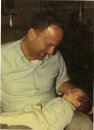
I posted an old photo on Facebook today, one from when I was probably no more than a couple of weeks old. My father, Hanno Fuchs, about 35, looks unshaven and a little rumpled. Maybe it’s been a rough night in their Washington Square Village apartment, where, until recently, he and Carol had been living in relative quiet.

His expression is one of warmth and love, not an unusual one for him to have. He appears to be amused by my toothless smile, as though he had figured out, for the first time, how to make me laugh — with a noise, perhaps, or a sudden bounce on his knee. “Honey, get the camera,” he may have called out to my mother.

The post elicited the kinds of responses you’d expect it to get — variations on “Awww, isn’t that adorable?” But as one of its subjects, I experience this photograph differently. Unlike some, I make no claims to have memories dating back to my infancy (if I’m not mistaken, my earliest memory is of tripping over a hose and deadening my front tooth, around age four); so I have that usual odd sensation one has when looking at an image of one’s precognitive self. On top of that, there’s the pang of seeing my old man and missing him so.

And then there’s this whole notion of “potential” that has popped up as an early theme of this blog. In fact, this image, of a young man and his infant son gazing at each other, works on an iconic level as the embodiment of this idea. As parents, we find ourselves observing our children and wondering what will become of them. We imagine life’s twists and turns that lay ahead for them, and we pray to God the journey will be a merciful one. When they laugh, or express happiness in other ways (my brother Mike tells a lovely story of the time his daughter, Hannah, looked up at him, unprompted, and proclaimed, “I love my life, Daddy”), we want to hold onto that moment, to that emotion; we want to “bottle” it, so that when those inevitable instances of pain befall them, our kids will possess a reservoir of joy and love that will sustain them, and guide them through the rapids, to a calmer place.

I wonder, too, what he wished for me in that instant. My parents were of that class and generation who allowed their children to “make their own paths,” and offered very little in the way of direct guidance. If someone had asked him in that room, at that time, just after that photo was shot, he probably would have said something like, “I just want him to be happy.” Of course that word is a complicated one, with myriad, moveable meanings. He’d say that he’d want me to be whatever I chose to be, and not to let anyone or anything get in the way of my doing that.

Beyond all of this, however, there is a potential I feel I have reached, and I credit my father for helping me to do so. And I’d even go as far as to say that if you look closely at the photograph, you can see that he is already beginning to help me with it in that early moment in my life. As people, we have the unique potential to give love. As I mentioned, my father’s eyes were often filled with love — for me, for my siblings, my mother, but also for humanity as a whole, for the community of people on this planet, trying to make sense of our lives. As his son, I am grateful to have been the beneficiary of my father’s capacity for love on such a grand scale; obviously, this is a potential I wish for my own sons to reach, as well.

The Whole Guilt Thing…

So I guess what I’m getting at is that I had come to embrace the idea of being a writer by seeing myself through the eyes of others. And not just anyone, but people whose opinions I respected — like Ruben Howard, Gayle Saks, Tobias Wolff, Kathleen Kirby, James Savoca, Jem Aswad and Stephanie Oakley, to name a handful. But there was always that cloying, clawing self-doubt, whispering to me about how wrong these good people were about me and my so-called “talents.” I was a poser, according to this whispering presence, and if I had any talent to speak of it was in the area of being an adept impostor.

Don’t get concerned; I’m not saying I heard actual “voices,” per se. But when I’d sit down to the “work” of writing, I invariably experienced this conversation with myself.

Probably the most profound example of my guilt at being a pretender came some time in the late 1990’s, when Toby Wolff came through New York City to promote The Night in Question, a collection of stories. He was doing a reading at a SoHo bookstore, and I took Jeanette there to meet my mentor. When it was our turn at the signing table, he gave me a warm hug, and another to Jeanette, and then immediately asked me, “And how’s your work going?” I was a little stunned by the question, probably because I hadn’t remembered discussing my teaching career, then in its fifth year, in the letters we’d been writing since I graduated. “Um, good. I’m actually teaching This Boy’s Life this semester.” Almost before I got the sentence out, he said, “No, I mean your work.”

I explained that despite a few abortive attempts at some longer pieces I had not been writing much these past couple of years. “Well you’re too good not to do it,” he smiled, and that was the last we talked of it. We had a pleasant Italian dinner at a nearby restaurant, during which Toby filled us in on his two sons and asked Jeanette questions about her own life and work. It was a great evening. But that whispering self-doubt was snickering at me the entire time.

All of this comes down to one simple fact: Like most things in life, writing is about work, which makes Toby’s word choice particularly interesting (and characteristically accurate). There are those of us who allow the circumstances of our lives to prevent us from finding the time to do the work of writing. There are countless “becauses” when I ask myself why I’m not writing. But then there are the people whose work ethic I admire so much; my friend the filmmaker James Savoca comes immediately to mind. He has steadfastly produced work, often making significant sacrifices in the process. Music journalist Jem Aswad,, too. And Toby Wolff, of course.

All of this boils down, I suppose, to the annual New Years resolution: Work, work, WORK. It’s not about what others think or feel. It’s not about whispering self-doubt. It’s about the work.