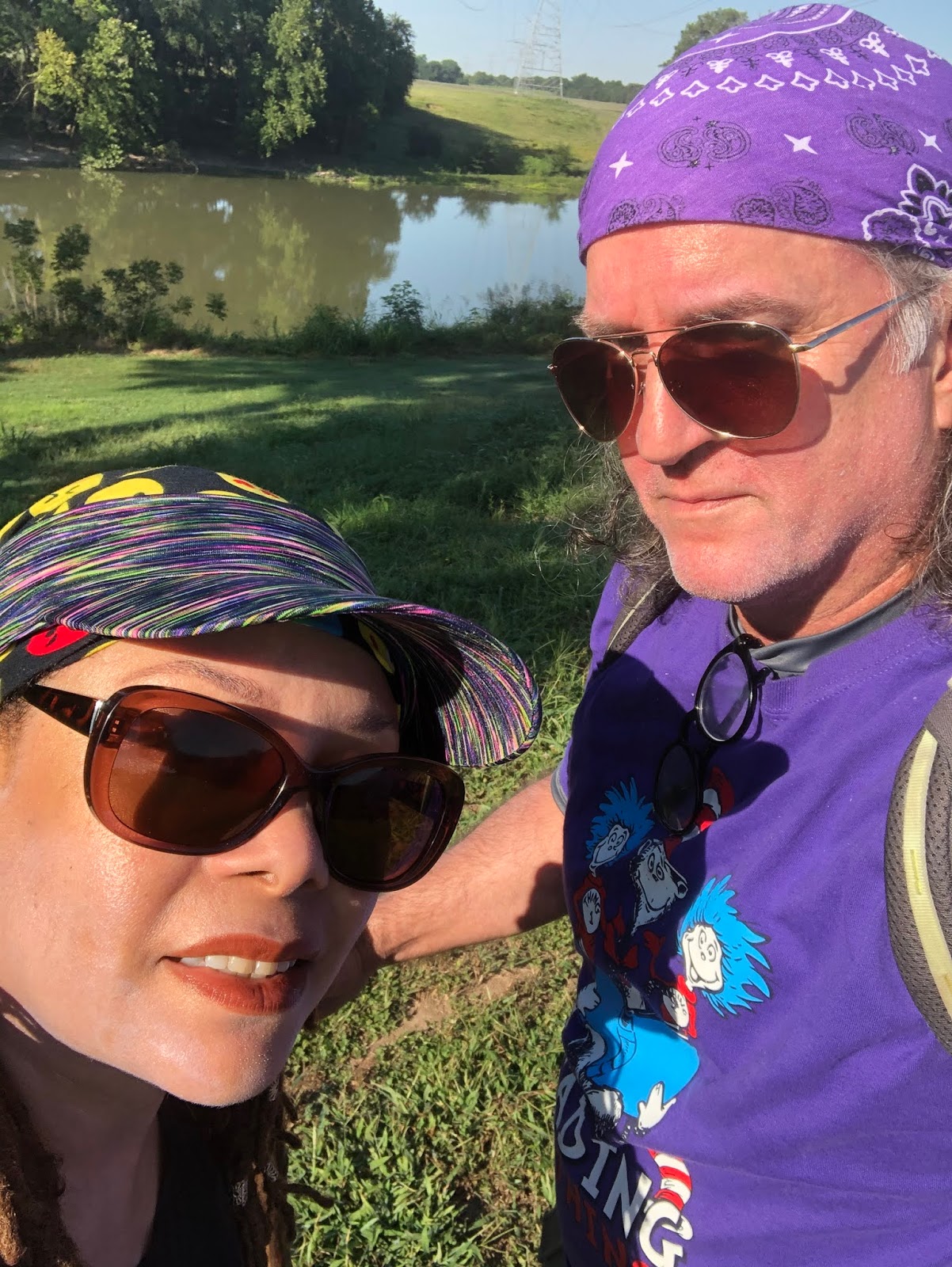
30 Hikes in 30 Days: Day One: Webberville Park, Webberville, Texas

Here Kitty KittyHere Kitty Kitty by Jardine Libaire
My rating: 5 of 5 stars

What a heartbreakingly lovely writer Libaire is. She captures both the joyful magic and excruciating pain of youth, through the eyes of Lee, as human a narrator as I’ve ever read.

Toward the end of the book, Lee watches a group of boys cross a lot outside her building in Brooklyn. In this gorgeous collection of sentences, Libaire speaks directly to the heart (or mine, at least) about what it is to have once been young:

“And I want to go, to be part of it. Absurd as this is, I yearn after the place where they vanished. But in this life we take turns at being enchanting, then enchanted. First we play in the streets, unaware of the freedom burning in the sun on our hair and the cigarette in our mouth, unconscious of the daydreams we inspire. Then it’s our time to sit at a window and watch, and we are moved.”

I nodded as I read these words, a hand on my heart. “Yes,” I said aloud. “Yes.”

View all my reviews

The Young Lords: A Radical HistoryThe Young Lords: A Radical History by Johanna Fernandez
My rating: 5 of 5 stars

It’s a rare occurrence to read a book at exactly the right moment — not just “personally;” I’m talking about the right historical moment, as well. Fernandez’s book, which chronicles the rise, growth, and ultimate dissolution of the Young Lords — from alienated street gang, surviving in 1960s urban poverty, seeing the inequities and injustices firsthand while serving as interpreters of language and culture for their migrant parents, to internationally-known agents of change — is a handbook for today’s youth who are trying to make an impact on today’s troubled society.

As I write this review, there are an unprecedented number of protest actions happening in all fifty states of this country, as well as internationally, in response to the murder of George Floyd, a Minneapolis man whose death at the hands of police officers was caught on video, and is only the most recent in a long line of such killings of unarmed black men. People have broken their Covid 19 quarantines by the thousands to come out and be counted, and there seems to be an overwhelming sentiment of “Enough is enough.”

We’re now at that crucial moment, where the talking heads have made their arguments on CNN, MSNBC, Fox News, and the rest. We’ve gone out to be counted at our local protest, unapologetically calling out for justice in the streets. Some have expressed their anger and heartbreak in more violent forms, others have seized an opportunity to create mayhem and to steal.

And now comes the aforementioned crucial moment– the “lull,” as it were, that all too often ends in the placative “normalcy” that some folks yearn for — that “Great” America that was never great for some. Complacency replaces upheaval, the status quo fills the vacuum left once the protestors put away their picket signs.

This is where Fernandez’s book comes in. Instead of falling prey to the overwhelming tendency toward political inertia, instead of giving in to the “pendulum theory” of American politics (that which swings too far to the right will swing back to the left again), look at the example of the Young Lords and other revolutionaries like them that Fernandez writes about. Be inspired by their victories. (I did not know, for example, that those vivid PSAs I grew up watching as a New York-area kid in the 70’s warning us about lead poisoning — a baby, about to ingest a paint chip, next to a rusted radiator — were a direct result of the door-to-door, grassroots efforts of the Young Lords.) Similarly, their actions at the Bronx’s Lincoln Hospital led to the creation of a Patient Bill of Rights.

We need to be reminded in this important historical moment that political action can and will lead to change. Fernandez gives us this reminder, in an extremely well-written, readable narrative, that is exhaustively researched. She gives us not only the “victories” I’ve mentioned, but also provides a cautionary tale of what happens when movements lose their way, sometimes by falling prey to the very ills they’re speaking up against, creating hierarchies based on ethnicity, gender, or sexual orientation.

When, like so many other well-meaning white liberals, I posted, on Facebook, pictures of myself at our local Black Lives Matter protest, a distant cousin who lives in the UK commented “Dan, is there any hope for your country?”

I responded by saying “There’s something about this current movement that feels different and gives me hope.”

And I do believe that. I’m also concerned about the “lull” and the very real possibility of falling back into the status quo that leaves so many of my black and brown brothers and sisters on the outside, looking in, and wondering how much their lives really do “matter.” As Fernandez says in her Afterword, titled “Coda: Beware of Movements:”

“Social movements and their organizations are not measured temporally but in terms of impact and the extent to which they shift consciousness, public debate, what’s accepted, and how we live.”

Not only do I encourage all the young leaders emerging in this current struggle to read “The Young Lords: A Radical History,” but I do so for any member of the human race who believes we can reach a better, more just and more loving version of our ourselves.

View all my reviews
Mad, Bad & Dangerous to KnowMad, Bad & Dangerous to Know by Samira Ahmed
My rating: 5 of 5 stars

In this, Ahmed’s third novel, she introduces us to a young woman, Khayyam, who, much like the protagonists of the first two novels, “Love, Hate, and Other Filters” and “Internment” is a proud, unapologetic, if soul-searching Indian-American Muslim. She differs from Maya and Layla, respectively, in that she has another couple of layers of duality to her sense of self – she is bi-racial and bi-national, her mother being Indian, and her father being from France.

And, of course, probably the most central to this story, Khayyam is a brilliant young woman, striving to make a mark on a male-dominated world. Her vehicle to do so is an essay competition, and she has decided to focus on the mysterious figure of Leila, who comes up in the work of three male artists of the 19th century canon: French novelist Alexandre Dumas, French painter Eugene Delacroix, and English poet Lord Byron.

Even more masterful than Ahmed’s use of the mystery genre to address the very important theme of male hegemony, is her use of the Young Adult (YA) genre itself. Ahmed has discovered a unique formula for herself as an author: she delivers highly political content — concerning such prevailing themes as Islamophobia, racism, human rights violations, and sexism — in a seemingly apolitical package; namely the Young Adult novel. My belief is that she does so knowingly. She is aware that she is reaching the very audience she needs to reach — young people.

It is this writer’s hope that she will not only succeed in empowering the next generation, in all its diverse manifestations (which, by the way, I know, in my role as educator working with a very diverse student body, she has done), but that she will also politicize them, so that the young people reading her work will take on her themes and apply them to the world they live in, and the world they want their own children to inhabit.

View all my reviews

Love in the Time of Corona: Update Six

A Word from the Elders

Our dog is getting more walks during this outbreak than she’s ever had in any comparable span of time.  In the course of one of these outings, I stopped by our mailbox to see what bills, statements, and/or junk mail had come this time.  The box contained the usual dreck, but also an envelope with my name and address handprinted across its face.  The return address was a sticker like the ones Easter Seals sends you when they want a donation.  My aunt Gabby’s name was the one printed, with “& Gerda” handwritten next to it.  These are my twin aunties, Gabrielle Fuchs and Gerda Rypins.  At nearly 89 years old, they are the lone survivors of their siblings, eldest brother Jeff having passed just over a month ago, and middle brother, my father Hanno, twenty years ago next month.

The letter is in cursive, a sheet of 8.5 x 11 printer paper folded in the middle like stationery, with Gabby taking up two and a half pages and Gerda the remaining side and a half.  Both were sweet, newsy, and funny, Gabby opening with “Hi dearest nephew Dan!”  She complained about the president’s lazy vocabulary (“such as ‘incredible’ and ‘unbelievable.'”)  “He’s so destructive,” she went on.  “I wish they’d tape his ugly mouth forever!”

She went on to discuss their lives living together in the midst of the pandemic, how their local Safeway grocery store is reserving the hours from 7-9 a.m. for “senior shopping.”  (Her emphasis.)

Her twin sister Gerda was characteristically more economical in her words; the aptly named Gabby has always been the more gregarious of the two in my experience.  Gerda’s sense of humor is dryer than her sister’s.  For instance, in her portion of the letter she quips, “By the way, I washed my hands thoroughly before writing to you!”

(Note:  I was going to call this the “Fuchs Sense of Humor,” but it actually reminds me more of my mom, the late, great Carol R. Fuchs, a woman both sisters adored.)

It was wonderful to hear from these two, with whom I’ve reconnected, having spent time with them during our family reunion in Berkeley in the summer of 2018, and exchanging the occasional letter like this one.  It pains me that they’re so far away, but I’m grateful they have each other, just as they have for the past 89 years.  They’ve seen each other through escaping the Nazis in Germany, and the deaths of many more loved ones that the two I’ve mentioned here, so I have no doubt they’ll see each other through this unprecedented moment in our planet’s modern history.

Gabby and Gerda Fuchs with my father Hanno, left, father, Bill, and brother Geoffrey, circa 1934 (?)

Love in the Time of Corona: Update Five

An Anonymous Message

My lovely bride of nearly 18 years and I took a walk this late morning with our sweet and aging dog, Ally, a friendly Shepherd mix.  Apart from a trio of 10 year old boys on bicycles and a lone jogger, we saw no one in our quiet, suburban neighborhood.

I pictured my neighbors, knowing most of them were home, peering at us through the slats of their Venetian blinds and plantation shutters, just as I’ve become accustomed to doing from inside my modest ranch house a few blocks away.

It was unusually hot — reaching nearly 90 degrees by noon.  It was around that time that we started to make our way back home, having worked up a sweat, which felt good after so many days of being sequestered.  Ally, poor thing, was panting, trying her best to find the scant shade offered under the midday sun.

Jeanette was on her phone with our New York family, about whom we’re especially concerned, as that city where both of us were born, and where so many of our loved ones still live, is now the “epicenter” of this virus’s path.

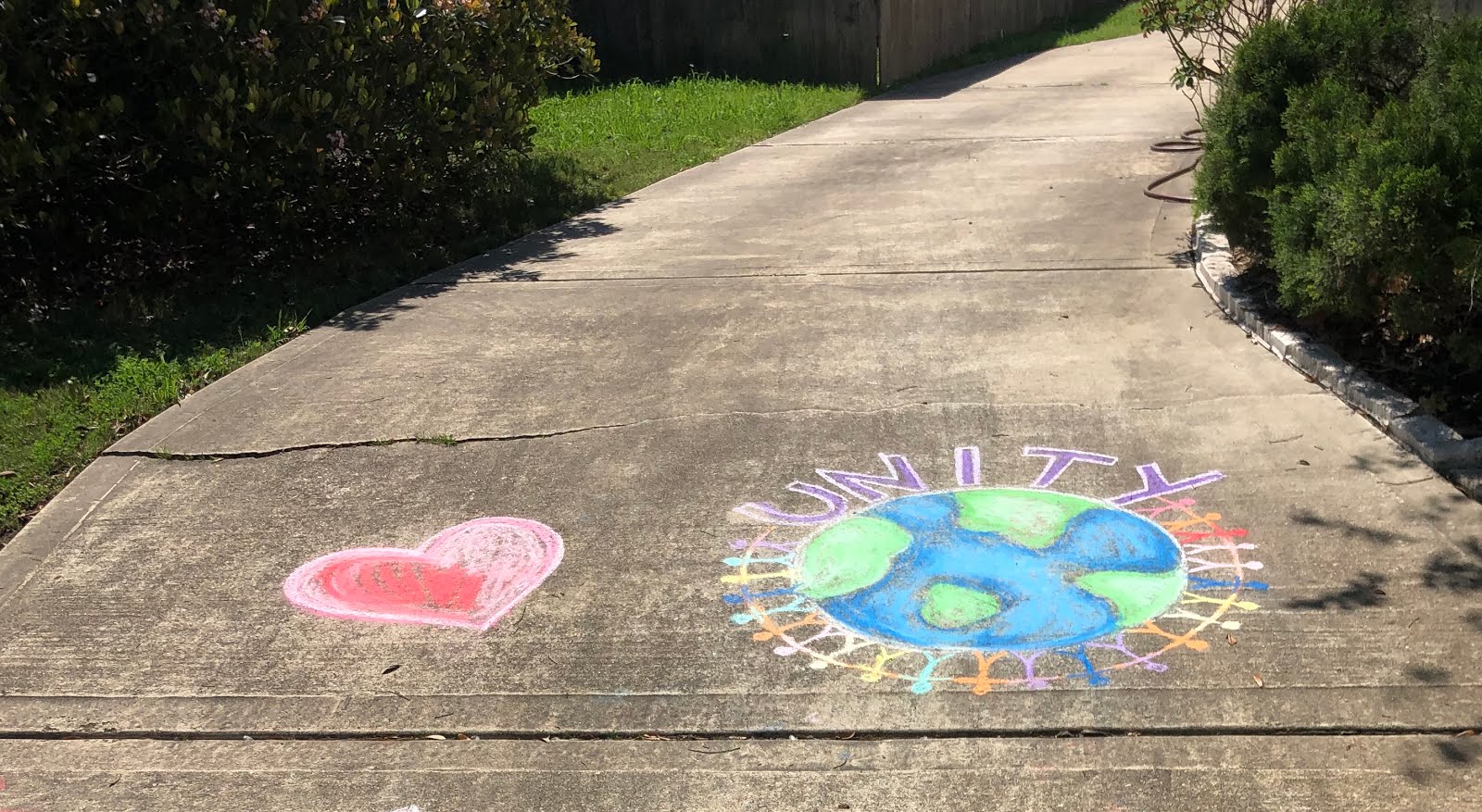
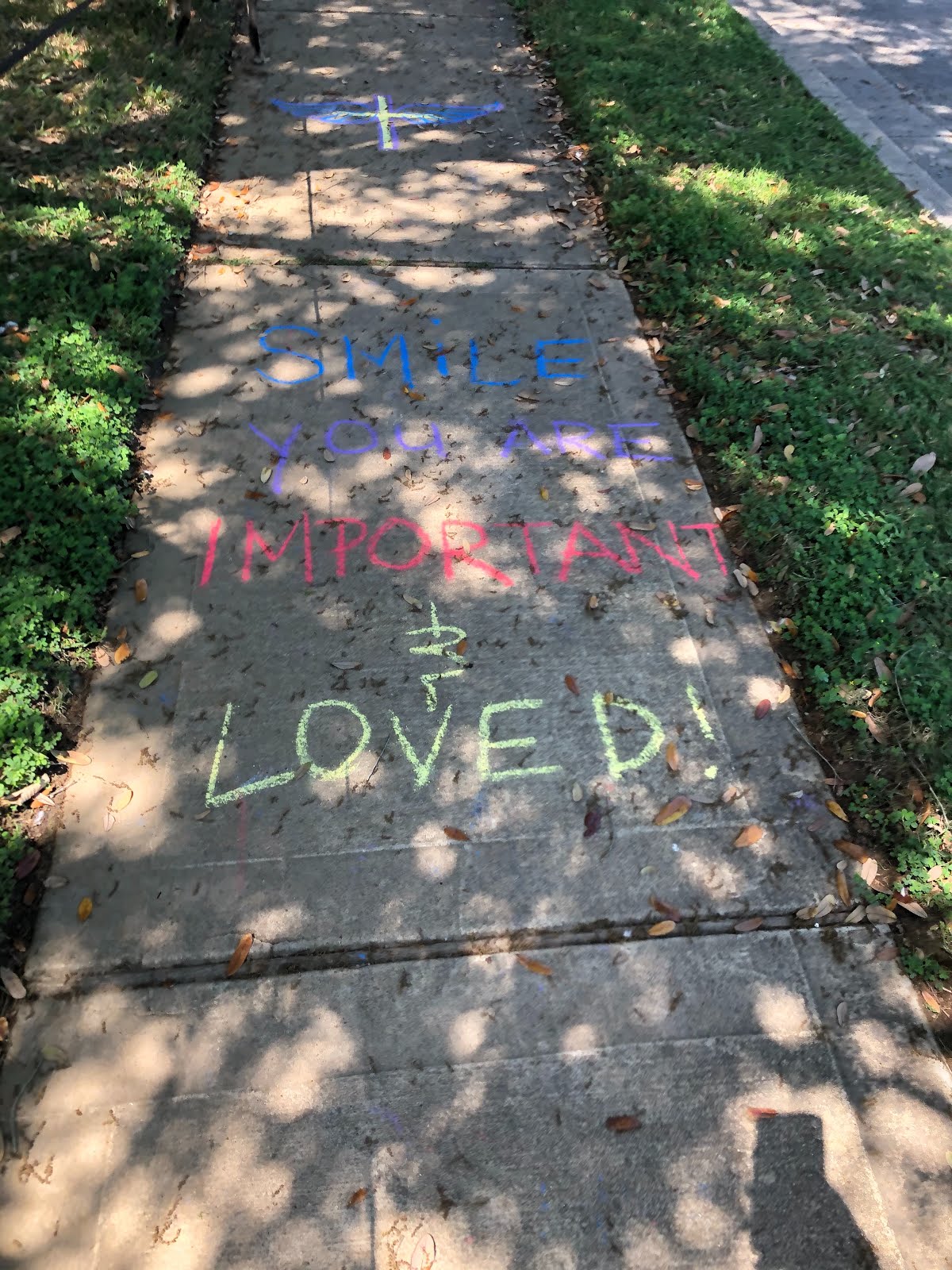
It was during our home stretch that we came upon some “street art” that a neighbor’s child (I assumed) had taken the time to create.  On the driveway was a rendering in colored chalk, of a pink and red heart, next to the planet Earth, its oceans bright blue, interrupted by green continents.  Encircling the globe, hands entwined, were multicolored human figures, and the world was crowned with one word, in large block letters:  “UNITY.”  The artist had written another chalk message, this one on the sidewalk in front of the house.  It read, “SMILE.  YOU ARE IMPORTANT & LOVED!”

I’d like to take this opportunity to thank the person who stopped to send this message out to the world.  We need these brightly colored messages of love.

Now more than ever.

Street Art by Anonymous, Manor, Texas
“SMILE.  YOU ARE IMPORTANT & LOVED!”

Love in the Time of Corona: Update Four

Back to School….Sort Of  

“Distance” Learning? Hmmm….


Today (Monday, 3/23/20) feels different, because it’s the day we were supposed to go back to school, after a week off for Spring Break.  Something about this outbreak, and all the restrictions that come with it, seemed less real, maybe because it was all happening during a time my family and I were “off.”

As far as my district is concerned, I am officially “on-call”; as such, I’m taking a wait-and-see attitude.  Like other parents, I will position my children, kicking and screaming, I’m sure, in front of some of the non-required enrichment assignments they’ve put together on their website, in an effort to prevent student brains from turning to complete mush from lack of use.

Parenting in the Pandemic

Let me start out by saying, I believe myself to be relatively fortunate, as the father of two young men of 14 and 16 respectively who are, by and large, fairly “together” people.  I can only imagine what it must be like for the parents of younger children, or kids with cognitive disabilities and delays.  I wonder about my students and their families, some of whom were already dealing with numerous stressors before the pandemic even happened.

In my role as Father to these two boys — and I know I put this on myself — I must keep up a strong front.  My kids will receive no benefit from my fear of the unknown.  So, in the face of the latest developments — a “Stay-home, stay-safe” (aka shelter-in-place) order for the residents of our county — I can only stay positive and present for my family, because it’s what I know they need.

Inside, however, it’s another story altogether….

My model for post-apocalyptic parenting, Rick Grimes of The Walking Dead

Love in the Time of Corona: Update Three

The author, getting dressed for the quarantine
Starting to lose track of the days now, as this “vacation” goes on and on….
Today I woke up with the desire to look “cute” in the face of this scary, oppressive presence called Covid 19.  (Author’s Note:  At age 56.3, I’m not naive:  My notion of the word “cute” is super-specific at this point in my life.)  I’m tired of lazing around in pajamas or sweats — my sons are unabashedly running around in just their underwear all day, like some high-tech, indoor version of “Lord of the Flies.”
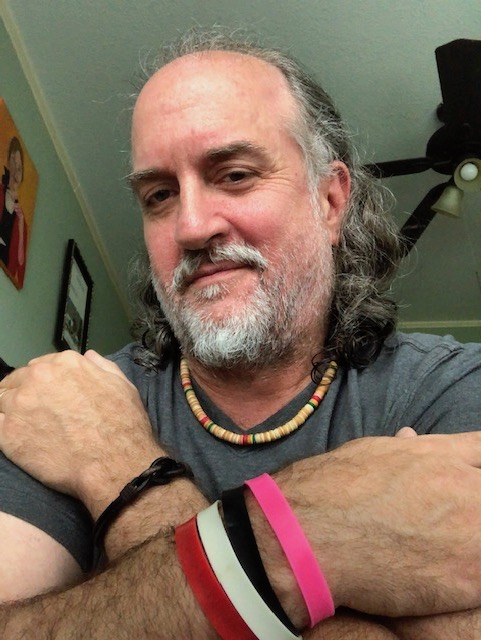
I had that Johnny Deppian urge to accessorize — to break out the Rasta pooka shell necklace and multi-colored rubber bracelets, and to actually wear pants that require a BELT.  (Gasp!)  I’m tempted to re-perforate my earlobe and put in an earring, even though I know my lovely bride will object as she does every time I get this impulse.
Is this what Cabin Fever looks like?  A game of dress-up?  How many more days till I’m trying to jam my feet into my wife’s size-7 pumps?
God help us all if this gets to that point.
God help us all….

Love in the Time of Corona: Update Two

Our government is currently arguing over three proposals that will put checks in the mail to help Americans through this health crisis, which has quickly become a major economic crisis, as well.  While every little bit will be appreciated, I can’t help but picture Mitch McConnell or Chuck Schumer or whoever, trying to decide between a thimble or a shot glass full of water to throw at this raging house fire called Covid 19.  (If I were a political cartoonist, this is what I’d draw.)

Probably the most shocking new “development” I learned about yesterday (and I’m hesitant to use that word, because things are changing so quickly) came when I learned of thousands of Spring Breakers who are crowding some of the beaches in Florida.

There are a variety of ways to feel about this.  My initial, gut-level reaction was something along the lines of “What the fuck is wrong with you people?”  (A reaction I’m sure is NOT in short supply.)  Later, a friend on Facebook railed at the parents for allowing their children to go, despite the warnings we’re hearing all day, every day, from world health officials.  I have yet to hear an interview with one of these parents, defending that decision, though I’m certain these are the same “very stable geniuses” decrying the call for social distancing as an attack on their civil liberties, using in the “disguise of caring about our safety.”  (I read those words on Facebook.)  I was never a Spring Breaker myself, so I’m not quite sure how it works.  I’d assume that in most cases the weeklong debauchery is at least partially bankrolled by Mommy and Daddy.  And when it’s not — when Junior has saved enough for the most elfin’ awesome of awesomest weeks ever — isn’t it the parents’ job to help that young person to understand their duty during this, the strangest of times?

(I certainly would…)

If anyone reading this made the decision to allow your offspring to partake this year, I’d be interested to hear your thinking.

A Load of HooeyA Load of Hooey by Bob Odenkirk
My rating: 3 of 5 stars

In choosing this (audio)book, I purposely looked for something light, as my last two books were “The Underground Railroad” by Colson Whitehead and “Night” by Elie Wiesel, a novel about American Slavery and a memoir about the Holocaust, respectively.

So I needed something light and airy, and this was perfect. Makes a really good audiobook, too, with the voices of Odenkirk, David Cross, Paul F. Tompkins, and others. It reminded me of an early book by Woody Allen that was on my parents’ shelves in my childhood home, “Without Feathers.” Lots of funny ideas, played out to absurdist dimensions. My favorite was one called “Obit for the Creator of Mad Libs.”

Enjoy!

“OBIT FOR THE CREATOR OF MAD LIBS On Tuesday, in Canton, Connecticut, a town famous for the stickiness of its boogers, a stinky old man died of a good disease at his home at 345 Rotten Lane. Mr. Preston Wirtz, whose parents, Ida and Goober, ran a small jelly farm, died in his yellowish toilet. Mr. Wirtz was hated in Uzbekistan for the series of wordplay books he created for slippery children, books known far and wide as “Mad Libs,” beloved by hairy grumps and farty grampas alike. These books were never appreciated by tall elves, selling over two per year for one decade. When asked to describe Mr. Wirtz, his jealous wife, wearing nothing but an egg carton and flip-flops, called him “in a nutshell, the most sour-smelling, bacon-licking, pimple-footed crab-apple I have ever known. I will never always miss him and his broken underwear.” Then she cried herself to sleep in her fart-house.”

― Bob Odenkirk, A Load of Hooey

View all my reviews