The Whole Facial Hair Thing

Things change when you grow your beard. People treat you differently. They look at you as if they owe you money, as if they need to keep their backs to the wall and their eyes on the door. Maybe it’s just me, I don’t know.
The first time I was aware that facial hair mattered was one night back in the mid-1970’s, when I was sitting at my tray table having dinner, watching “Star Trek” reruns on the big Magnavox color TV that my dad had bought because it came with an autographed replica of Hank Aaron’s baseball bat. The one he broke Babe Ruth’s record with. My dad mounted the bat above his office doorway downstairs.
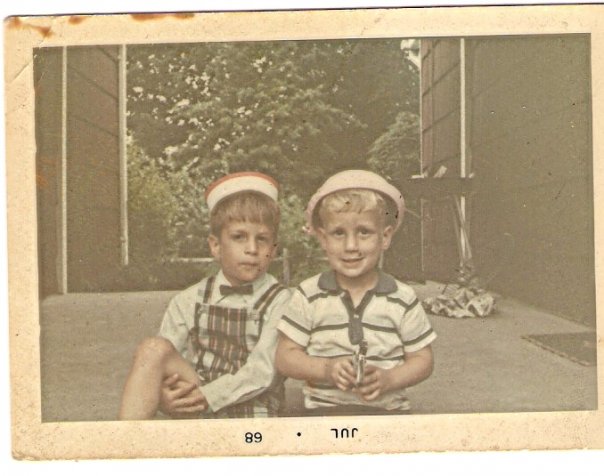
Somehow, in a parallel universe, Mr. Spock was still Mr. Spock, but, well, Evil. He was Evil Spock. Aside from his powder-blue tunic being a little more “butch” than the little pajama shirt he normally wore around the Enterprise, the most obvious characteristic that distinguished Evil Spock from Regular Spock was a Fu Manchu goatee (pictured above). Mr. Spock was always bad-ass — don’t get me wrong. Even with the baby blue jammies. But man, with that beard, he was BAAAAD-ASS! My brother and I loved that episode, and always made sure to call each other in when it came on.
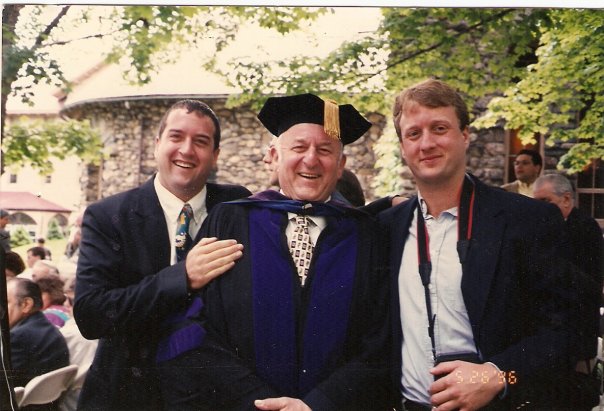
Probably the most distinctive mustachioed gentleman I know would be Brooklyn musician Gerald Menke. Menke (above, center) takes pride in the care and grooming of his ‘stache, even entering (and winning) a local moustache-growing contest at a Red Hook tavern. One evening, he and his wife, my friend and former colleague, arts-educator/actress/vocalist Genevieve de Gaillande, were visiting with us in our apartment on Vanderbilt Street in Brooklyn. Actually, it wasn’t just any night, it was Oscar night. We made a big deal of it, putting out a red carpet (literally), so that people could make an entrance arriving at our Oscar party.
The group was small but enthusiastic and in good spirits. At one point, Jeanette’s best friend, and the godmother of our son, Diego, Johanna Fernandez, looked Menke right in the eye and said, in her best American History Professor voice, “Now, Gerald, will you please explain the moustache for me? Because I’m not getting it.”
There was an awkward silence, during which I started crafting my apology for our friend’s bluntness, but it ended quickly, as Menke cracked a big smile and explained his adventure in the moustache contest. His manner was so pleasant, and so self-effacing that it defused any tension that had been there before. Genevieve, however, had a protective expression on her face, and I made a mental note to keep her and Johanna far apart for the rest of the evening. Which I did.
And to be fair, some people just have strong reactions to facial hair. I actually had a friend and former colleague lean over to me before starting a meeting, and quietly whisper to me that his wife didn’t like for him to grow facial hair, because beards make her think of child molesters. I stroked the goatee I’d grown over the winter break. “Hmmm,” I answered, “how interesting.”
The most important thing is that my wife Jeanette likes it. She’s the one who will need to live with it, kiss it, and smell it. Ultimately, the decision is mine to make, but her decision is right there with mine, neck and neck. And she LIKES it. My five year old son also likes my beard, because, as he explains it, I will soon look like Santa. (Thanks, kid. Thanks a bunch.)
And I like it, too. The people who are intimidated or otherwise freaked out by it will just have to live with it.
Until my next “look” comes calling.

Is Our Fear of Chaos Boring Our Students to Death?

Sometimes, when I visit the many schools I am asked to visit in my line of work, I ask myself the question, “Are we going about this whole education thing all wrong?” Classrooms start to look the same to me after a while. There are kids sitting there, listening to a teacher who has got good intentions for them. Occasionally, that teacher is using some interesting technology, and once in a while they even let the students get their hands on it.

Now before those of you who are teachers start getting your backs up, let me say this post is not yet another attack, blaming the teachers for what’s wrong in the world today. There’s plenty of blame to go around for that. I’m just wondering when we’re going to stop doing the same thing, over and over again.

I’d like to think I did things a little differently when I was a teacher. Because we were a “School of Last Resort” at Satellite Academy High School, we had a great deal of autonomy. The prevailing feeling we got from the Powers-That-Be in our district was “Do what you have to do with these kids, because we’ve tried everything.

So, our alternative school was truly alternative at one time. We did portfolio assessment and projects. Cooperative Learning was present in nearly every class. It wasn’t unusual to see team-taught, interdisciplinary classes like the one Susan (a Social Studies teacher) and I (an English teacher) taught called “Power” about the permutations of power in politics and literature. I taught a college-style Creative Writing Workshop class. Because I could.

It seems that in traditional schools we set up our classrooms to prevent young people from interacting with one another. At Satellite, I thrived on the interactions of my students, not only in that writing class, but in advisory and all my other classes, as well. And it wasn’t just us humanities teachers, either. Our math and science teachers were constantly putting our students into groups and pushing them to ask questions and to THINK together.

Sure, it was loud, and sometimes feathers got ruffled. But you could feel the learning happening. And you could see the excitement in the faces of the students. This is the kind of school I want to run someday.

It’s not okay for us to bore our children into submission anymore. We’ve been doing it for too long, and it’s time for it to stop.

Thank you, Erik Estrada

When people ask me the question, “So, how did you guys end up in Austin?” there are two answers I can give. I usually size up both the audience and the venue, before deciding which answer is most appropriate.
Basically, there is a short version, and then there’s the long version, and the latter involves the hunky man on the left, Mr. Frank “Ponch” Ponciarello himself, Erik Estrada.
First, let me give you the short version: If the audience appears to be someone looking for a “serious” conversation, or if the venue is a place that is staid and/or formal, I’ll go with this one. “Well, you know, we had a small apartment in Brooklyn and two boys that were getting bigger every day. We were basically priced out of homes the size we needed, so we just moved farther and farther out, and we ended up in Texas.” I usually accompany the comment with a wry smile (not unlike the one Erik is flashing in the photo), and that’s the end of that.
If I feel we have a little more time, however, and if the mood is right, I’ll say, “You mean I haven’t told you the story?” And then I’ll launch into it.
One day, just before Labor Day in 2007, Jeanette decided to stay home from work due to a nasty hangover. Our kids were in the care of their grandparents in Santo Domingo at the time, so we were feeling carefree and in full “summer mode,” which probably explains Jeanette’s state that day.
In order to amuse herself, my bride surfed through the cable channels, when suddenly, there he was, the man of her pre-adolescent dreams. Ponch.
“We’re so certain you’ll love our properties in Horseshoe Bay, Texas, we will pay for you and a loved one to fly to Austin and stay in a three-star hotel.”
She began writing down phone numbers and before long she was on the line with a very nice man. “What’s the fine print?” she asked. “What’s the obligation?” “No obligation, ma’am. I’ll just take down your information, and you’ll receive your tickets via email. Our properties sell themselves.”
Once she was convinced that we wouldn’t be taken for a ride, she called me and instructed me to let my boss know that we’d be taking an extra long weekend. I did as I was told.
They picked us up at Bergstrom airport and transported us in a van, with a few other couples who had apparently been reeled in by Estrada, to the Double Tree Hotel on 15th and Guadalupe. We had a great room with a nice view of the UT campus, and just to give you a sense of how little I knew about Austin at that time, I actually looked out the window and said to Jeanette, “Hey look, honey, everyone’s wearing the same color shirt as me!” Burnt orange. Everywhere. I had no idea.
I also had no idea just how close my high school friends Alice and Mignon lived. When I contacted them, they let me know that they were less than a half hour away and that they would be there soon to meet up with us.
We were able to have a good time with my old friends, which went a long way to allowing me to entertain the idea of moving nearly 2000 miles from Brooklyn, the city I’d called my home longer than any other place in the world. Yes, we had to sit through an annoying sales pitch with a cowboy who smelled of cigarettes, in a community we were about 30 years too young for, but we braved the storm and I connected the dots of the professional network I’d created during my 16 years in public education and met a few influential people in the Austin community who were able to open some doors for me on the work front. Less than a year after Jeanette’s fateful sick day, we found ourselves living in Austin, Texas.
And here we are, almost 3 years later. Life is good, despite how much we miss certain people (and the ability to buy fresh sushi at all hours of the day or night), and we have one person to thank for it.
Thank you, Ponch. I knew there was a reason I had that poster of you in my bedroom in 9th grade. (And no, it wasn’t for the reason everyone thought it was at the time…)

Cybercrack: Is Our Techno-addiction Alleviating or Exacerbating Our Collective Alienation?

I recently attended the seventh birthday party of a friend’s daughter at a place called The Main Event in Austin. I’d been there before; it’s one of those over-stimulating kiddie havens, throbbing with the electronic complaints of hundreds of video games. Strobe-lit in day-glo colors, it’s an epileptic seizure waiting to happen. As a parent of children in the 3 to 10 age range, it’s inevitable that we will spend some time in one of these hells, at the behest of a friend, at least two or three times a year, in a good year.

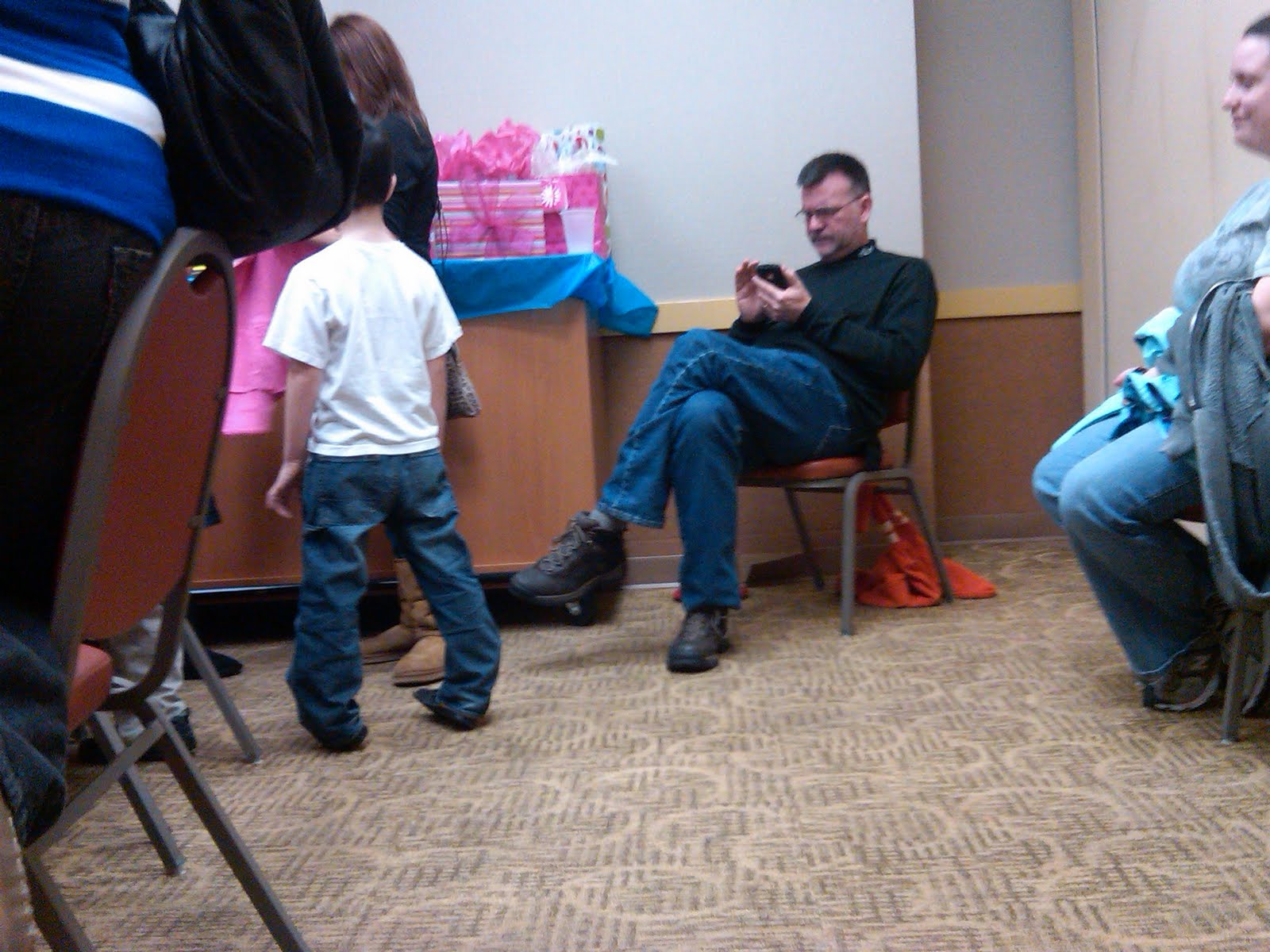
At one point — it was one of those kid-centered, cake-eating moments — I happened to look up from checking email on my Blackberry when I was struck by something: Nearly every other adult in the room was doing what looked suspiciously like what I was doing at that moment. We lined the walls of the little party room, each of us in our own, separate cyber-world.

I found the moment disturbing. I’m often one who sings the praises of technology these days, so pleased am I to have reconnected with so many long-lost friends via Facebook, for example.

And I really do mean that, with not a speck of irony or sarcasm intended. How else would I be in regular contact with Gayle Saks, Miki Kasai, and Ruben Howard? Ruben Howard, for God’s sake! I hadn’t heard from that dude in years and years. Now I get to hear him rant about the economy on a regular basis! And I get to hear about my former students and how their lives are shaping up as adults. In a word, it’s the coolest.

But there is a flipside to this. I am constantly, and I mean constantly, wondering if anyone has anything new to say. On Facebook, Twitter, wherever. If I’ve floated an idea, like this blogpost, in a cyberbasket down the River Cyber, like a little CyberMoses, I’m in an ongoing, sustained state of anticipation. And when I check my pages for like the umpteenth time, and I see that there have been exactly 0 responses, I am decidedly dejected, bordering on the Big D-word, dare I say it, DEPRESSED.

All of which leads me to the question: Does being able to see what some 600 “friends” are thinking and feeling at any given moment necessarily mean I am any less alone than I’ve ever been in the world? If you feel sad for me, feel free to “poke” me. But the question remains — will all that poking make me feel more loved, or more alone?

In the words of Michael Scott, “That’s what she said.”

Sorry, I couldn’t resist.

In Other Words…

My father knew a lot of things. He spoke a number of languages and was well-read. As a younger man, he wrote a novel that he never published. He spent the Sundays of his adult life tearing through the Times Magazine crossword puzzles in dizzying time. In pen! There was no “Google” or “Wikipedia” back in his time, so when he pulled quotations out from memory, it was true erudition. Me, I just go to one of those websites, cut and paste, slap a couple of quotation marks on either end, and I sound smart. He really was smart.

My brother Mike and I have discussed, at length, how much we both admired our dad’s mind. I’d like to think I inherited at least some of his intelligence; and I know Mike has. There’s something else I’ve inherited from Hanno, though, and I’ve never stopped to asked my brother if he has found this trait to have been handed down to him, as well. At a certain age, Mike and I caught on to the fact that it was very hard for our father ever to admit to not knowing something. I don’t know if it was because he thought saying he didn’t know something would somehow lower our esteem for him; this wasn’t possible, of course. As a boy, I viewed my father as a larger-than-life figure. A hero, in the epic sense of the word. I thought his mind was his super-power.

He probably sensed that I felt this way about him. I’ve developed this theory because I see the dynamic playing itself out with my own sons. I am their dictionary, their encyclopedia and their calculator. They come to me with question after question, and, like my father before me, I do my best to answer them. Although I’d like to think I’m better at admitting my ignorance than he was, I do fear letting the boys down and somehow losing the Olympian status I have at the moment, so I, too, am reluctant to say those three dreaded words.

When my brother and I reached a certain age, we could see the signs of when Hanno didn’t know the answer to one of our questions. He would repeat it, stalling for time, searching the memory banks. Then he would begin to hypothesize on the problem. At this point, Mike or I would usually say to him, or to each other, “In other words…,” which was shorthand for “In other words, you don’t know.”

Usually if it got to this point he was caught and would cop to maybe not knowing all there was to know on the topic. Sometimes, though, he would defend his ideas, to varying degrees of success. Because he was a thinker, his squirming could, at times, become a fascinating philosophical discussion. He was that smart.

When we were older, he would give in to self-effacing giggles, followed by a quick, joking, “Fuck you guys.”

It’s just a matter of time, in my case, before Diego and Jackson start asking Jeeves instead of asking Dad. And that’s okay. I want them to know where to go for good information. For now, though, I’ll admit to enjoying being their Phineas J. Whoopie. (For those of you who don’t know, he was a cartoon character in the old “Underdog” series. “The Man with All the Answers.”)

And you thought I wasn’t well-read!

The Boy Who Lived Everywhere

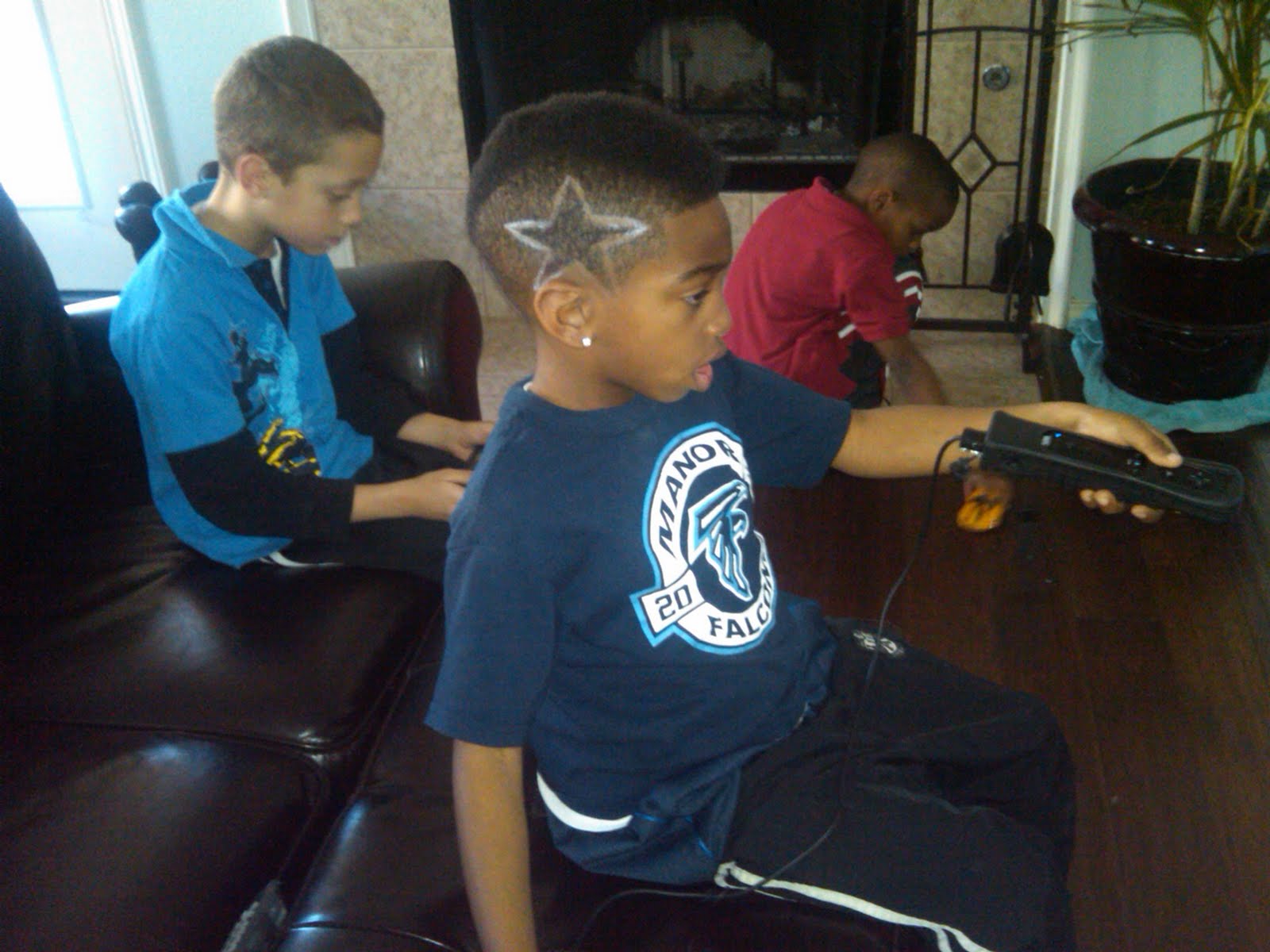
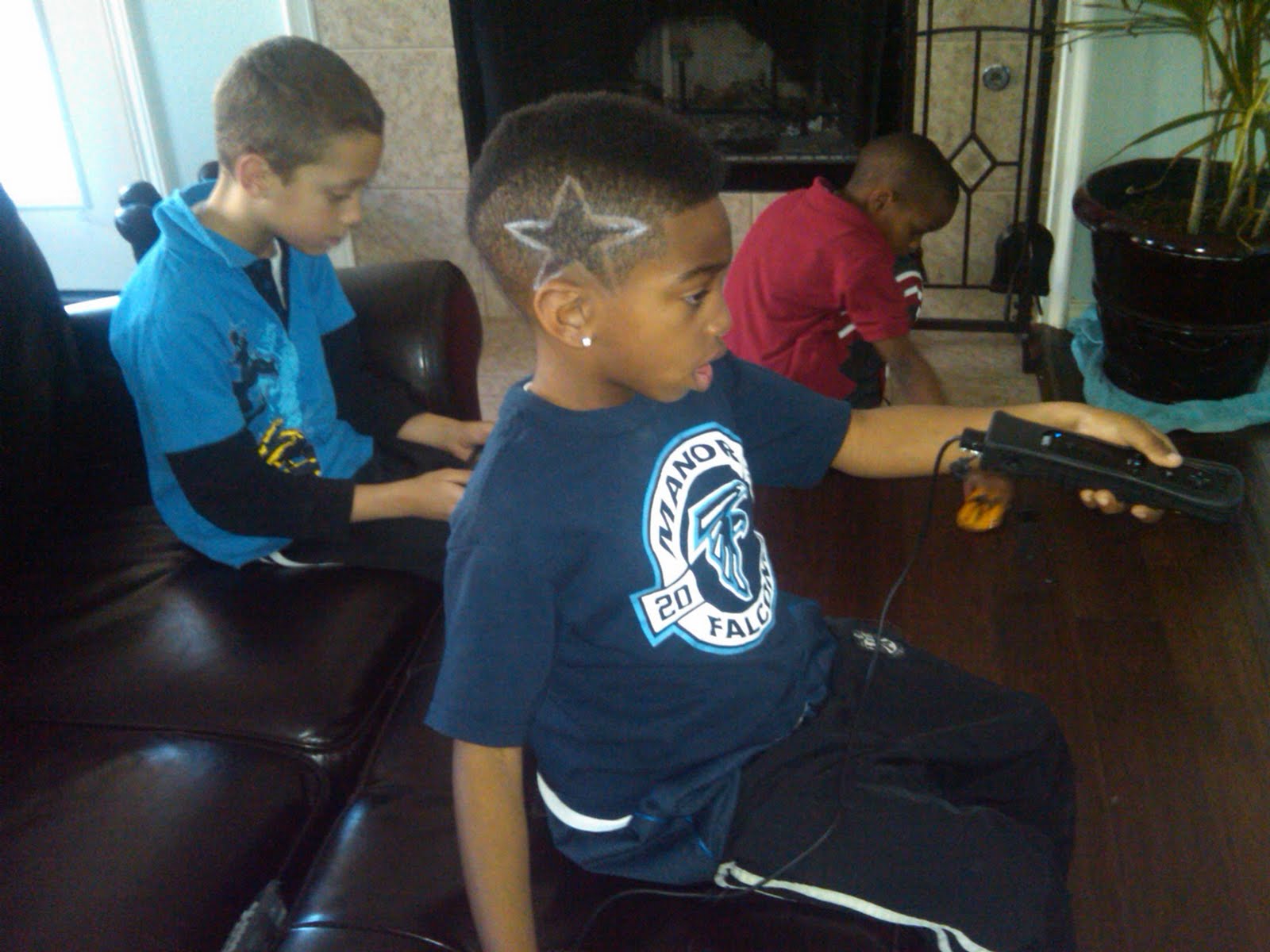
I have begun referring to Malik (not his real name, pictured at left) as “The Boy Who Lives Everywhere,” because he is what his own mother refers to as a “House Hopper.” Malik lives in the house next door and is a very sweet, very polite first-grader, who is just as likely to be in my house on a Saturday afternoon as he is to be in his own, or in the house across the street, or the one next to that. Jeanette and I don’t mind having him around, and are prone to ask him to stay for dinner more often than not.

Basically, what he does (and who can blame him for this, really?) is travel house to house, looking for the next best video game to play. He’s got plenty of his own, but anyone with kids knows that as far as they’re concerned, other people’s toys are much more fun to play with than their own. In his way, Malik is a genius.

Malik crossed the line recently, however, when, as he was eating dinner with us, he said, “I sure would like to stay here and have a sleepover with Jackson and Diego. I’m going to go ask my mom.”

“Slow down, cowboy,” I said. “You forgot something important there, pal.”

“What?” he asked.

“Well, we didn’t invite you to stay over.”

Malik and I shared a moment of silence, just kind of staring at each other. I think he was trying to determine whether or not I was serious. To lighten things a bit, I repeated, smiling this time, “Being invited is important, buddy. Your mom would agree.” He smiled his gap-toothed smile, and said, “Yes, sir,” a little dejected. I gave him a high five, and we enjoyed the rest of his visit that evening.

This led me back to my own childhood, living in a community that was then about the same age as our present community is now. There was a group of us kids, probably about eight to ten, in all, who routinely roamed the streets and back woods of our area. My mother was a stay-at-home mom, so our house was filled, on a regular basis, with any number of our little crew. We rode bikes and skateboards, and were an every-day presence on Hartford Lane and environs.

The experience with Malik brought back to mind the time my brother Mike was hanging around at his friend Jonathan’s house one Saturday. I was in our kitchen at home, keeping my mother company as she prepared dinner, when the phone rang. I wasn’t paying attention to the call, but suddenly my mother was beside herself with laughter. She couldn’t speak, she was laughing so much. When she finally got it out, my father and I were laughing, too.

Apparently, it was Jonathan on the other end of the line. Six-year-old Jonathan Heller had taken it upon himself to pick up the phone and dial our number. When my mother answered, he very politely said, “Hello, Mrs. Fuchs. This is Jonathan. Don’t you think it’s about time Michael headed home for dinner?” She’d then done everything she could to contain herself as she sternly directed Michael to come right home, before breaking up completely.

My brother had clearly overstayed his welcome, and poor Jonathan felt his only recourse was to go to the ultimate authority — my mother. We were — all of us — the Kids Who Lived Everywhere back then. As I think on it now, forty years after the fact, it feels like nostalgia to me. But then I look at Malik and am pleased that he is carrying on in our tradition. Sure, we overstayed our welcome from time to time, or invited ourselves over inappropriately. But we did it because we were reaching out to those who lived near us, and isn’t that what being a “community” is all about?

Falling Shoes

I don’t often think about 9/11. It’s not that I’ve blocked it out, or anything as dramatic as that. It’s been nearly ten years, and in the spirit of survival and not giving in, I have moved on. It’s my strong belief that the collective souls of those thousands of innocents whose lives were so recklessly taken on that day would not wish us to dwell on the devastation, but, rather they’d want us to forge ahead and continue on, and in the process, we avenge their deaths by living our lives.
Occasionally, however, I do remember. I remember the way my student, Sean Lawrence, came into my classroom on the third floor of Satellite Academy on West 30th Street and said in a curious monotone, “I’m not sure, but I think I just saw a plane crash into the World Trade Center.” He had caught a glimpse of that first impact, just as he was crossing Sixth Avenue, heading to school.
I recall the silence of a New York City with no cars driving past, and no planes flying overhead. It was eerie, and we, the inhabitants making our way to our homes that day, walked past each other like shadows, strangely making eye contact (not our usual way), as if to wordlessly reassure one another.
I remember the way we all shifted to the north-facing windows of the F-train, as we emerged in Brooklyn, and seeing, for the first time, the giant plume of smoke that would linger and stink for days. A teenage boy saying, “Oh my God, it’s true. It’s really true.”
Weeks later, as we healed, I was in a bar with some friends, who introduced me to a woman I’d never met. “I was there,” she said. I didn’t have to ask her where. Or when. I just knew by the look in her eyes.
“There’s one thing I’ll never forget,” she said. “The shoes.”
“Shoes?”
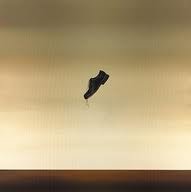
“They just kept falling. Shoes. Women’s shoes, men’s boots, children’s sneakers. They were raining down from the burning building.”
She told me she’d heard from a scientist friend that the physics behind the falling shoes was similar to when a pedestrian is hit by a speeding car and one sees a pair of shoes standing in the exact spot where the victim once stood. Imagine that impact, times a hundred. Times a thousand.
The woman passed this image on to me, and although I’m thankful for not having been there that day, it’s this second-hand image that occasionally wakes me up at night, as I consider what it must have been like to have been in those shoes on that sunny fall morning nearly ten years ago. There are other, more violent images I’ve seen associated with 9/11; the footage of people choosing to jump from 100 stories, rather than be burned to death, a photograph taken by my brother-in-law, one of the first responders, of something that had once been a human being — but it’s these falling shoes that I’ll never forget and that will forever remind me of horrific tragedy and a loss that changed our world forever.

In The Principal's Office


At this stage of my career, I don’t think I could count the number of principal’s offices I’ve been in. I’ve strategized with them, looked over grants, discussed action plans, listened to them complain and celebrate and vent and dream. I’ve served them as a teacher, grant manager, assistant principal, program officer, director and school improvement facilitator. I’ve worked with confident leaders who have years of experience, and first-year administrators who look like deer caught in headlights.

I’ve probably logged as many hours sitting across tables and desks from principals, since I left the classroom in 2004, as I have in any given cubicle I’ve occupied during that time.

Yet, it’s funny: Each and every time I sit and wait for a principal (and I ALWAYS sit and wait, because the nature of a principal’s life is that meetings run long), there comes a moment when I get this feeling that can be described in only one way — I feel like I’m in trouble.

You’d think that having occupied The Big Chair myself, I’d be able to shrug off this sensation after a while, but no. It’s there with me every time. The other day, at Fred Florence Middle School, I nearly turned to the boy sitting next to me, who was holding an ice pack to a swollen cheek, to ask, “What’re you in for?” Instead, I summoned up my best grown-up voice and said, “Are you all right, young man?” “Yes, sir,” he replied politely, lying, I’m sure. One doesn’t sit in the principal’s waiting area with an ice pack on ones face if one is “all right.”

He’s in trouble. A woman in a nurse’s uniform appears from a door I hadn’t noticed and the boy disappears behind it with her. Eventually, the principal is done with her previous meeting and summons me to “come on in.” As it turns out, I’m not in trouble. In fact, she’s glad I’m there, as they usually are, because I am someone who is there to partner with them, clear up questions they may have, and generally make their lives easier. My reticence gives way to an enjoyment of what I’m doing. I derive professional satisfaction knowing that I’ve been of assistance to the head of the school, the person ultimately responsible for improving the lives of every child in that building.

I wish I could say I was in trouble a lot as a kid myself, that these fears represented some kind of “flashback” to my days of youthful rebellion. It would make a better story if I could. The closest I ever came to anything like that was when Coach Kearney, our Dean of Discipline at Harrison High, pulled me over in the hall one day and asked, “Danny, how’s Mr. Greco’s class?” I cringed and didn’t answer. “You’ve missed a few of his classes lately.” “Yeah, a couple,” I agreed. “A couple? Danny, you haven’t been to Mr. Greco’s class in three weeks.”

I explained to Mr. Kearney that my truancy was due to a technicality (“I lived in Michigan in tenth grade and missed Global Studies, and now they’re making me take it, and I’m in a class full of my little brother’s friends, and c’mon, Coach.”).

“I really should send you down to Mr. Hunter’s office,” he paused for effect, looking up and down the hallway, at what, I wasn’t sure. “But you’re a good kid, Danny. If I talk to Joe Greco and tell him you’ll make it to his class and make up the work you’ve missed, are you gonna make me a liar?” “No, sir,” I said in the meek voice I thought he wanted to hear. “Cause I’ll come after you if you do,” he smiled. “Yes, sir.”

And I got away with 15 cuts. Just by being a Good Kid. Maybe I’ve stumbled upon the reason for my anxiety whenever I sit in the main office waiting room. Would I feel less culpable if Coach Kearney had sent me to the assistant principal’s office? It could very well be.

We’ll never know….

"For Your Edification"

(A poem inspired by Kami Lewis Levin)

I prefer to be called
“knickers;”
though you
insist on
using that more
American
term — “panties.”

Your moist
farts
do nothing
to
quench
the thirst of my
parched
soul.

Oh, and by the way,
contrary to
what
you think —
your aureolas,
they’re not
“all that.”
In fact, they
suck.

Before anyone goes getting any crazy ideas, this poem was written in response to a tweet of Kami’s in which she listed seven of her least favorite words of all time. I told her I wanted to write a poem incorporating all the words called “For Kami,” and she said “PLEASE write that poem.”

So I did.

Little did I know it would be from the point of view of a pair of women’s underwear…

Remembering "Opa"

My memories of Dr. Bill Fuchs are vague and fading fast. My father’s father was a dapper man in the old style. When I remember him, he’s nearly always wearing a suit. Sometimes, he’s relaxing at home in a cardigan sweater over a button down shirt, slacks and loafers.

I do recall that he smoked cigars and to this day, as objectionable as I find them, there’s a comforting aspect to their odor, as well, thanks to Opa. That’s what my siblings, cousins and I called him. German for “Grandpa.” Our grandmother, his wife Maryanne, was Oma.

Opa played tennis, and there are good stories from his playing days, like the one my father wrote up and had published in “Tennis” Magazine, called “Portugal Against the World.” The story is both comical and sad, and tells of my grandfather’s entry into a European tennis tournament during World War II. He was a resident of Lisbon at the time, and wished to play representing Portugal, instead of Germany, where he was born, raised, and from which he ultimately fled. As the tale goes, the only flag they could find at the request of the aging tennis player was enormous, two times the size of any of the other flags of the other countries being represented during the tournament. Thus the title.

I found the above photo of Opa quite by accident. I actually did a Google Images search of my father’s name, and this popped up. It’s from a genealogy site. (“The Family History of the Calzaretta, Krieger, Michaels and Rafael Families”) I love it, and am considering using it as my profile picture for a while, just to get him back into the world, even briefly.

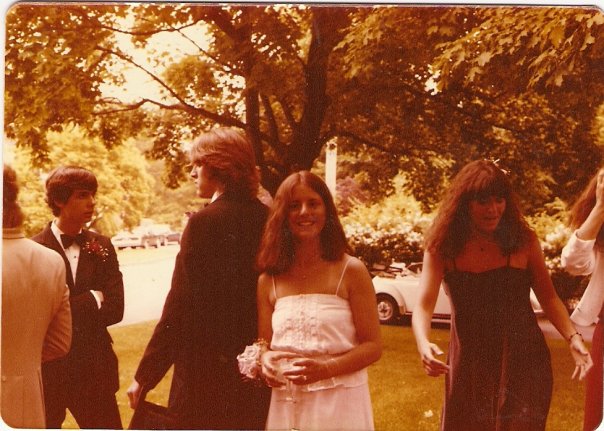
There may be a few of you out there who will remember this: (I sort of downplayed it at the time) but I did get to honor Dr. Fuchs in a rather striking way, when I wore his formal tuxedo to my senior prom, in May of 1981. (You get a glimpse of it above — note the felt top hat I’m holding against my left leg. It had his name, “Dr. B. Fuchs,” embroidered inside.) Unfortunately, I was hot and uncomfortable in the wool tails, and a little stressed about having to drive my girlfriend’s father’s Buick Electra, 225 — a BOAT of an automobile that I almost wrecked on our first turn out of her neighborhood — but I did look good. And it was an honor to have my grandfather “with me.” (He had died less than two years before this picture was taken, so that loss was still fresh for me.)

Our culture doesn’t honor our ancestors the way others do. I’ve always been the keeper of memories in my family, like my uncle Geoffrey Fuchs before me, and I’ll admit to slipping a bit as of late. My hope is that these blogs will re-kindle that flame for me.

I’d say they already have.