Songs whose imagery has been usurped by movies

Here are some songs — in no particular order — featured in unforgettable movie scenes that will now be forever associated with these tunes…

“Singing in the Rain” (Fred Astaire) A Clockwork Orange – (1971, dir. Stanley Kubrick) Malcolm McDowell’s Alex and his cohorts beat a man senseless as they dance along to this tune.

“In Your Eyes” (Peter Gabriel) Say Anything– (1989, dir. Cameron Crowe) Lloyd Dobbler, played by John Cusack, stands atop the hood of his car at dawn, and blares this song out of his very 80’s-looking boom box, in hopes that Diane (Ione Skye) will take him back.

“Stuck In The Middle With You” (Steel Wheel) Reservoir Dogs – (1992, dir. Quentin Tarantino) Mr. Blonde (Michael Madsen) tortures Officer Marvin Nash, as he moves around him, to the beat of this classic oldie, ultimately slicing off Nash’s ear before being shot by Tim Roth’s Mr. Orange.

“Tiny Dancer” (Elton John) Almost Famous – (2000, dir. Cameron Crowe) The members of Stillwater, along with their entire crew of roadies and groupies, enjoy a moment of unmitigated joy in their tour bus, in an impromptu sing-along of the Elton John hit, unofficially inviting 15 year-old journalist William Miller into their family of gypsies.

“Sister Christian” (Night Ranger) Boogie Nights – (1997, dir. Paul Thomas Anderson) John C. Reilly, Thomas Jane, and Mark Wahlberg sit in a growing rage of paranoia, before getting up the nerve to rob coke dealer Albert Molina, who dances in his underwear to the song, as his Asian lover periodically lights firecrackers in the background.

“Raindrops Keep Falling on My Head” (B.J. Thomas) Butch Cassidy and the Sundance Kid – (1969, dir. George Roy Hill) For those of us who saw this movie as young children, this scene, in which Butch takes his friend’s girl for a romantic bike ride (with no rain in sight, strangely) was our first glimpse at seeing the opposite sex as something other than “yucky.” Katherine Ross was stunning.

“Goodbye Horses” (Q Lazzarus) Silence of the Lambs – (1991, dir. Jonathan Demme) I’m not sure how many of us had heard this haunting song before seeing the famous “Buffalo Bill Dance,” (picture “tucking it in”) but if we ever heard it again, we’d certainly think of one of the most disturbing sequences (not to mention brilliant acting by Ted Levine) in modern film…

“Mr. Postman” (The Marvellettes) Mean Streets – (1973, dir. Martin Scorsese) Scorsese uses popular music like crazy in his movies (culminating with a near-nonstop musical soundtrack for Goodfellas in 1990), and this is one of his earliest. He likes to “choreograph” his fight scenes, and this one — after DeNiro and company object to being called a “mook” — is one of the first examples of this well-known Scorsese device.

“Surfin Bird” (The Trashmen) Pink Flamingos – (1972, dir. John Waters) If you haven’t seen it, I’m not going to describe it. Best not to think about this scene for too long.

“Layla (Piano Exit)” Derek and the Dominoes – Goodfellas – (1990, dir. Martin Scorsese) This four-minute “outro” of the song “Layla” becomes the signature song of a LOADED soundtrack, when Ray Liotta explains the meaniing of the term “Goodfellas” while we see the aftermath of Jimmy’s (DeNiro’s) “housecleaning.” The camera pans into the murder scenes of six former associates. The sequence culminates when the song goes silent, along with Liotta’s voiceover, and we hear Joe Pesci’s Tommy whimper, “Oh, no,” when he realizes he’s not going to be made, he’s going to be whacked…

Silly Love Songs: The Soundtrack of a Sappy Boy

Stay with me while we grow old/
And we will live each day in springtime/
Cause lovin’ you has made my life so beautiful/
And every day my life is filled with lovin’ you.

— Lovin You, Minnie Riperton and Richard Rudolph

The Grammy Awards have come and gone, and it kept the attention of my two boys (ages 5 and 7) surprisingly well. I guess it makes sense — people making music and wearing outlandish costumes is kind of like every Disney musical they’ve ever seen. Some were more cartoonish than others, obviously.

I was most struck by the enthusiasm with which Jackson, the five year old, responded when The Bieber (as we call him around Chez Fuchs) appeared on screen. Again, not much mystery there; he’s a child who wows adults with his rhythmic and dancing skills. And you can’t turn on any of the channels my kids enjoy watching without seeing The Bieber promoting his new film, “Never Say Never.” I’ve got highly educated friends of mine professing their love for the kid on their Facebook pages. It’s kind of scary.

So as I’m witnessing my kids’ idolization of Grammy hopefuls like The Bieber, I am prompted to take a look back in time to when I was at my sappiest. The year was 1976, and I was 12 going on 13, squarely in the most uncomfortable time in a boy’s life — the “pre-teen” years. The pop songs that dominated the spring of that year went right to my heart, pulling at its mythical strings. “I Like Dreaming,” “My Eyes Adored You,” and “Silly Love Songs” are three hits that sent me into flights of romantic imaginings. When I heard these songs I needed to find a quiet, private space where I could just sit and listen and place myself in the story I thought the song was trying to tell. One of those places was in the stand of pine trees that marked the property line between the Karneses and the Hills. I liked to climb to the top of these pines, some thirty to forty feet up. From that high I had a great view of the Francises’ back yard, and I would often see Debbie, a dimple-cheeked girl with a dazzling, snaggle-toothed smile and sandy brown hair, running and playing with her three collies who barked non-stop, all day and night. The song was perfect in my mind: Carried your books from school, playing make believe you’re married to me. /You were fifth grade; I was sixth, when we came to meet.”

Of course as anyone and everyone knows, 1976 also marked the pinnacle of the ascendancy of disco music, and although I certainly recall trying to make sense of “Disco Duck” and “(Shake, Shake, Shake) Shake Your Booty,” Rick Dees and K.C. did not feature prominently in the soundtrack of my childhood. Disco was the music that made its way through the rafters of the ice skating rink at Rye Playland, where my friends tried to rip the labels off the back of the girls’ Levi’s as they giggled past, fully aware of their part in the game. When you actually got the tag, which was rare indeed, the idea was to walk the girl in question outside to the boardwalk. Then you’d push your way through a cut-out bit of chain link fence and make your way down to the beach. Once there, you were expected to chat a bit. And then you made out.

I’d like to tell you I know this from my own experience at the time, but then I’d be getting into the realm of fiction. In reality, I may have gone skating once or twice at Playland, but I was self-conscious, awkward, and decidedly unsuccessful in the seeking and acquisition of Levi’s tags. In a word, I was a sap. I made up elaborate stories in my head of defending Debbie’s honor and rescuing her from those who would do her harm. These were usually personified by boys in our class who I identified as bullies. In my fantasies I beat them senseless, utilizing Kung Fu skills that made Bruce Lee’s look amateurish. In tears, she would thank me, and we would kiss.

It wasn’t until a couple of years later, not long after my braces were removed, that I finally had my first kiss. It was an abject failure. The girl was someone I didn’t even know all that well; we were at a drive-in movie together with a group of friends, and I guess she just felt it was the thing to do. Her breath smelled like cigarette smoke and buttery popcorn, and she watched the movie with one eye as we kissed. That would have been in the summer of 1979, when I was sixteen years old. Late, I know, for a first kiss. 1979 was, appropriately, the year of Meatloaf’s “You Took The Words Right Out of My Mouth.” The lyric continues, “It must have been while you were kissing me.”

Thankfully, my first “real girlfriend” saved me later that summer, when she kissed me the way every 16 year old boy wants to be kissed. When I’m asked about my First Kiss, I usually delete the drive-in one, and move right to this one. It happened on a perfect, temperate night, and we were playing ping pong in an odd little outbuilding that her family had constructed for the kids years ago. It had electricity, and I remember this, because at an opportune moment, I turned off the light, pulled her to me in the darkness and had the kiss that made me understand what the big deal was. Thinking of it now, my breathing changes, and my vision clouds a little. (Or maybe I’m just getting to the age where I need my asthma pump and reading glasses.)

Keeping to the theme, our make-out album was Carole King’s Tapestry, which came out in 1971. I liked that it was retro and not tied to the inane stuff that we were hearing on the radio that year. (Ah, who am I kidding? I loved “What A Fool Believes” by the Doobie Brothers and “Crazy Love” by Poco.)

There’s one song that I listen to today that still brings me back to that perfect moment. (And it is a perfect moment. It’s one of those moments I’ll be muttering about as an old man, when my grandchildren come to visit me at the Home.) It’s a stanza from Greg Brown’s 1990 song, “If I Had Known.”

A hayride on an Autumn night
Well we was 15 if I remember right
We were far apart at the start of the ride
but somehow we ended up side by side
We hit a bump and she grabbed my arm
The night was as cold as her lips were warm
I shivered as her hand held mine
And then I kissed her one more time

And Jane if I had known–
I might have stopped kissing right then
It’s just as well we don’t know
when things will never be that good again

Now, there are people out there — some of whom are likely to be reading this — who need to be assured that they’re not to take Greg’s words literally. Of course, there have been experiences that have eclipsed the one I described above since that time.

But the memory of that moment is pristine. It was as if my sappy boyhood fantasies all suddenly came to life. Not surprisingly, those fantasies tailed off after that, as I found that living in the real world wasn’t so bad after all.

Oh and by the way, if I managed to get any of the songs I’ve referenced stuck in your head, I apologize.

Giving in to Valentine's Day

This is one of those holidays about which I’ve got a tremendous amount of ambivalence, which can border on outright hostility at times, depending on my mood. Let me start by acknowledging my single friends, as well as those who are mired in unhappy marriages and relationships. I remember what Valentine’s Day feels like to you, and the whiny complaining you’re about to hear pales in comparison to what your feeling today. I recognize that. So consider yourselves “acknowledged.”

Unlike some couples I know, Jeanette and I did not decide to get married, or begin going out, or have our first kiss, on Saint Valentine’s Day. I can understand why people choose to celebrate each other on the dates that commemorate these events, but being forced to spend money on flowers, chocolates, or whatever it is, seems so random to me. Every year I try to collude with my wife on this point. “Let’s not fall into this corporate bullshit trap, honey. What do you say? No Valentine’s Day for us this year?”

This conversation usually happens right when they first start with the diamond and lingerie ads — just after the New Year. At that point — so far removed from the upcoming holiday, she’s likely to say, “Yeah, sure. Why not? Let’s skip it.” And I am pleased that she is my partner — not only in life, but in standing up to this annual corporate mugging of the American people. We won’t be pulled into it. Hell NO!

You’d think I would have figured it out by now. As we draw closer to February 14, and the ads intensify, and more and more people around us volunteer their plans for the day, and solicit ours, she invariably comes to me. It happens every year, in different places, at different times. This year it was on a Sunday evening, January 30, as we straightened up the kitchen after a good weekend of its use.

“And yes, honey,” she said resolutely (out of nowhere, I might add — the “yes” suggested we’d just been discussing the matter, even though we hadn’t said a word about it since New Years), “I DO want you to make a big deal over me for Valentine’s Day.”

I learned a long time ago that Jeanette is not interested in my political opinion on this particular holiday. It is of no concern to her whether it is man-made or somehow intrinsic to our union. She is a woman and, as such, wishes to be wooed and courted and cared for and doted upon. In a word, she wishes to be loved. And in her defense, who among us doesn’t share this wish?

As artificial as the day may be, Valentine’s is more of a symbol than anything else. So yes, I got her the kind of flowers she likes, and yes, she got me some pajamas with hearts on them. And you know what? I absolutely loved receiving them from her.

Happy Saint Valentine’s Day, y’all!

A Sparkling Holiday in Nantes

There are some experiences that come and go so fast, and are so pristine in their loveliness, they almost defy reality. You look back on them and wonder how much is real, and how much is manufactured by the dream-making faculties inside your mind.

After graduating from Syracuse in the summer of 1986, my girlfriend and I moved to Cambridge, Massachusetts, where we lived with her father in his three bedroom home. Just next door lived a very pleasant French couple, Michel and Jacqueline. Michel worked at one of the local universities, and Jacqueline stayed home with the boys, Damien and Antoine, who were about 6 and 4, if I’m remembering right.

Susan and I worked for a little over a year in Boston, so that we could save up enough money to get us to Europe. We were accepted into a teacher training program in London, where we would stay for the first month, before going to Madrid to live and work. It had been decided that we would spend the Christmas holidays with Michel, Jacqueline and the boys at their home in Nantes. (They had returned to France at the end of that previous summer.)

Our experience in London was amazing, to put it simply; I’m sure it will come up in another blog at another time. We arranged to take the ferry over the channel to Le Havre, then a commuter train to Nantes. I did my best to get us around, as neither of us spoke French, but my facility with phrasebooks is considerable. (I chalk this up to being my father’s son. He spoke a number of languages.) Michel was there to greet us when our train arrived, much to my relief, at their stop in Nantes.

Nantes was a quaint town, all decked out for the holidays in lights and garland. Michel and his family were warm hosts who made us feel at home and showed us around the town. For Christmas day, they drove us out to Jacqueline’s parents’ house by the sea. We were fed an outrageous feast that included quail and suckling pig. My best memory from that visit was sitting in the dank basement of their old house, shucking oysters with Jacqueline’s father. Neither one of us could speak the other’s language, but we laughed and enjoyed ourselves together, in the simple act of shucking oysters. The wine might have had something to do with it.

Man, the wine. It just flowed and flowed and flowed. And it was ALL excellent. Not one bad sip the whole time. This may — I’m realizing now — be the reason this blogpost is so devoid of the usual detail. It is a little foggy, as I think back.

Anyway, yes, the wine flowed throughout Christmas, and it flowed on New Year’s Eve, when we sat down, back in Nantes, with Michel, Jacqueline and several of their friends. They were an interesting bunch, many of whom were working on the unification of the European currencies into something that would be called the “Euro.” I remember thinking it was a crazy idea; no way they would get that done by the year 2000, even though that seemed a long way away.

Michel sat at the head of the table, next to a case of champagne. Every few minutes he would pop a new bottle and pass it around. The flavor of that wine was like none I’d had before or since. So perfect. And the bubbles had the effect of lifting my spirits, filling me with love.

At one point, in this state of euphoria, I looked to my left, where Jacqueline was speaking, in French, of course, about something I couldn’t understand. I had always found her attractive; she was petite, with sharp features and fair, freckled skin. Her hair was in fine, sandy-blond curls that framed the edges of her face. But the detail that caught me on this particular night (we were probably into the early morning by this point) was that she was wearing some kind of makeup that had just the subtlest presence of glitter in it. Her face was sparkling. Just like the wine.

I’d never seen anything so beautiful. I considered taking Michel aside and sharing a moment like the one that two of the main characters share in my favorite movie of all time, Bill Forsyth’s Local Hero, when the American, played by Peter Riegert, professes his love for his friend Gordon’s wife.

Thankfully, I thought better of it and said good-night instead. We enjoyed the rest of our visit and made our way to our new life in Madrid. As I said, I’m not sure how much of what I’m remembering about that trip, and about that moment, is accurate truth, and how much is the fabrication of a romantic mind, but I often think of that family, who I haven’t seen since those holidays. Damien and Antoine would be in their twenties now, and who knows, maybe there still might be a hint of glitter on Jacqueline’s cheek….

A Thousand Cuts

Imagine it — your body, covered with a thousand cuts. Even if they were small ones, paper cuts, one thousand would certainly mean pain. Pain that would linger for a long, long time.

Yesterday the Austin Independent School District’s Board of Trustees and Superintendent put forth a list of just over one thousand recommended staffing cuts. In my twenty years in public education, I have to say I’ve never seen anything quite so brutal. It’s one thing to hear about the possibility — the probability, even — of a “reduction in force.” I’ve been hearing those rumblings for as long as I’ve been an educator. But to see it in black and white, naming specific schools and actual teaching positions is a new one for me.

Maybe this is one of those Texas moments. This is a “Right to Work” state, after all, with no real teachers’ union to speak of. (There are “unions” who are happy to allow you to pay dues to them, but they are legislatively and judicially prevented from having any real collective bargaining power.) Someone with more local knowledge than what I have may be able to elucidate on how we got to this sorry state. It’s unclear to me how it happened, but apparently someone was writing checks with their mouth that their ass couldn’t cash. And here we are, our body about to be covered in a thousand cuts.

There is, as you might imagine, an undercurrent of fear as districts begin putting out these recommendations regarding staffing cuts in the schools. And if it’s palpable in the cushy atmosphere of the Education Service Center where I work, it’s far worse in the school buildings. Many of the principals I work with have told me of the revolving door of teachers that have been coming to their offices, asking them if their jobs are “safe.”

I think if I were a principal right now, in this climate, my message to my staff would be that we’re going to continue to take care of each other as best we can as adults, so that we can do what we’ve always done for our students. They should never have the sense that there is anything different going on.

This brings up an interesting question: How are our schools going to talk to their students and families about the cuts that are coming — the thousand cuts that are not just names on paper, but relationships that matter to the children, relationships that are, in the best cases, crucial?

The price of the proposed cuts will be much higher than any dollar amount being discussed right now. Imagine our collective body, as a city, as a society trying to provide for our children, covered by a thousand cuts.

It’s going to be a very costly bottom line.

Honoring My Mother and Overcoming My Fears

My mother always maintained that I should be an actor. She and I bonded as movie lovers, when I would stay up late watching Creature Features and Chiller Theatre with her, and she would often encourage me to imitate the characters we’d just seen — Dracula, the Wolfman — my impersonations gave her a chuckle. She urged me to overcome my shyness and get on stage, which I never did. Not in her lifetime, anyway.

Well, that’s not entirely true. I had a brief cameo in a sketch we performed in the Harrison High School Gong Show my senior year. Harlan Zimmerman was playing the principal of the school, Dr. Goodhart, and I was his loyal henchman, the assistant principal, Mr. Hunter. I portrayed him as a Secret Service agent, complete with dark glasses and a lapel pin. I didn’t say a word, but I managed to bring the house down, when I pointed to a particularly rowdy segment of the audience, in exactly the way I’d seen Hunter point at a group of my more detention-prone friends. I don’t think my mother was in the audience that day, but my sister Jessica was, and she, like my mother, pushed me to try my hand at acting.

As an underclassman at Syracuse, I appeared in a handful of student films, giving performances of which I was generally less than proud. I remember Gordon Antell, one of the student filmmakers, saying, “I like working with Dan because if you put a fireman’s helmet on him, he looks like a fireman, if you put a cowboy hat on him, he looks like a cowboy.” I think he meant this as a compliment, but it made me wonder whether I was more of a prop than an actor in those short films.

I did take a significant step when I decided to enroll in a class during my junior year called “Acting for Non-Majors.” It was basically a Scene Study class. I can’t remember whether we discussed doing it together or not, but one of my best friends, Ruben Howard, also signed up for the course. Coincidentally, a good friend from my childhood, Barry Brown, was also in the class, as was Darryl Bell, who went on to be a successful actor, appearing in Spike Lee’s “School Daze” and as one of the stars of the Cosby spinoff, “A Different World”. Our teacher, Larry Tackett, was a lovably prickly man who I always thought of as a mix of Burl Ives and Garfield the Cat. After one of us would give a long-winded, convoluted bit of feedback to a fellow student, Larry was fond of taking a breath and saying, “Be that as it may, Sally Brown,” before giving his own, more concise response. I also recall that he’d get us to be quiet by saying, “Okay, people, cool your jets. Let’s bring it down to a dull roar.” And he used to require us to keep a journal for the class, in which he would interact with each of us privately, writing his appreciations of our comments, and asking us thought-provoking questions.

A turning point came when I decided to perform a monologue that I found in a compilation of high school playwrights. The one I chose was from the point of view of a teenage boy who had just attended his mother’s funeral. This would have been about 1984; I had no way of knowing, of course, that I would have this very experience about four years later. I allowed myself to get caught up in the honesty of the words and did my best to deliver them as frankly as I could. When I looked up, signifying that I had come to the endpoint of my scene, I sensed that the room was somehow different. My classmates appeared reluctant to look directly at me. There was some sniffling and wiping of eyes. One girl excused herself, made her way down from her place on the risers that served as our seats, and left the theatre. Larry mentioned a detail, the way I hugged myself at one point, holding onto my sweater as though it were my mother; “What a wonderfully vivid choice,” he said, amid much nodding. I didn’t have the nerve to say that I didn’t think it was a “choice” at all, as I hadn’t planned for it to happen.

There was talk after that performance of my possibly changing majors. Larry introduced me to the head of the drama program, Arthur Storch, best known for his portrayal of the psychiatrist in The Exorcist. The one who gets his balls crushed by Linda Blair. “I heard about your monologue,” he told me. “Sorry I missed it. Sounds electrifying.” I didn’t know how to respond to that, so I muttered a thank you. The three of us discussed the notion of switching into the drama program as a junior. By the end of the discussion, we all agreed that there was too much ground to be made up and that it would mean a year and a half’s worth of coursework. And tuition. “I hope you’ll continue to study acting, just the same, even as an English major,” Mr. Storch said. I told him I hoped so too.

My mother was, of course, excited by my interest in theatre and one Christmas she gave me Uta Hagen’s book, “Respect For Acting.” She didn’t say anything, just that she hoped I’d enjoy it. In it, she had also inserted a newspaper clipping, a story profiling HB Studio, the acting school that Ms. Hagen and her husband, the late Herbert Berghof founded in the aftermath of the McCarthy years.

I enjoyed the book, and it did make me want to continue acting. I was caught up in the idea of going off to Europe with my girlfriend at the time, so much of my energy went into making that happen. Then my mother got ill. And by the time she died, on November 18, 1988, I still hadn’t appeared in a play. I was 25 years old.

When I got up the emotional strength to return to Madrid, I vowed to honor my mother’s wish. I sought out and found English-language theatre groups, auditioned for them and got in. The first one I worked with was called Teatro Tespis and was an educational theatre company that did simplified versions of Shakespeare plays for Spanish middle school students learning English. My first live performance in a play was in “The Merchant of Venice” as Bassanio, the ingenue. (I was often cast as the ingenue in those days, when I was young and pretty.) Still, I had a good time with it and, with my mother very much present in my heart, I had a successful debut, in a middle school auditorium in Madrid, packed with 2,000 students. Heidi, our director, told me afterwards, “It’s official. You’re an actor, and if you can make it with this audience, you can make it anywhere.”

I also worked with a group called the Madrid Players — a band consisting mostly of expatriate Brits and Americans who put together pretty respectable productions. I played Lysander, another ingenue, in “A Midsummer Night’s Dream,” and was proud of both my performance and the production, directed by a talented Englishwoman named Janet Gordon.

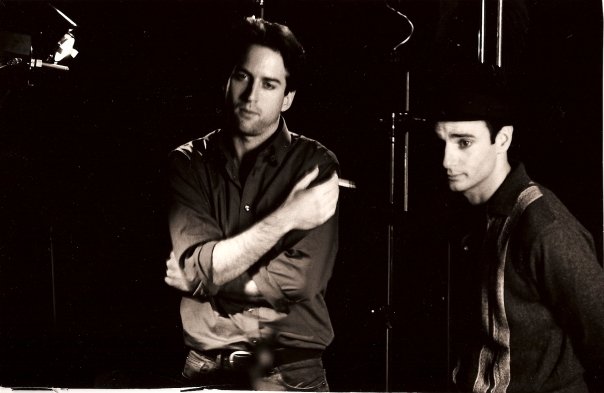
Eventually, I became too homesick for New York, and for my family there, and I said goodbye to Madrid and to my theatre friends. One of my first acts when I returned was to go to HB Studio and sign up for classes, and I had the great fortune to study with William Hickey, perhaps best known for his portrayal of the aging Don in “Prizzi’s Honor.” But I didn’t just want to study; I wanted to act, as well. Luckily, my friend from Syracuse, James Savoca, was doing interesting things off-off Broadway and was open to me coming along for the ride. We wrote and performed sketch comedy in a really fun group called “City Soup” and did a night of one-act plays that we wrote and acted in with a separate group called “Crowded Theatre.” (See photo, above.) I’ve since had the pleasure of helping James with early drafts of the films he has gone on to make, and I got to do table readings with Drea de Matteo and Chris Messina among other very talented actors, in participating in the casting process.

Of course, my life has little to do with acting and the theatre these days. I’m so grateful to people like Larry and Heidi and Janet and James and even Gordon, way back when, for giving me the opportunity to honor my mother’s wish, and to tap into an aspect of myself that I needed to explore. I’ve moved on to other things (education reform, fatherhood, etc.), but I do sometimes wonder to myself whether there might still be a few roles out there still waiting for me to play them…

Cafe Society 2.0 (A registered trademark of Starbucks)

Don’t judge me, because I know what I’m about to say is totally uncool, but I really, really like hanging out in Starbucks, especially when I am fortunate enough to score an overstuffed chair. This one, in South Fort Worth, is small and gives into the Barnes & Noble next door. There is an exhibit of attractive black and white photographs, some of tourist sights in Fort Worth, others of people’s hands. If I was someone with money, I’d consider purchasing one.

People sit, thumbing their mobile phones and tapping on their laptop keyboards, like me. There’s a funky DVD playing, something along the lines of Sade. Smooth jazz, only cooler. TCU students sit and eat and chat, using the word “like” so much that I imagine a device that will administer electric shocks each time they say it. Finally, mercifully, they shut up and get to work on whatever it is they’ve come together to work on today — a group project of some sort, I’m thinking. Currently they’re doing their best at some silent reading, but are easily distracted. One of them gets a call on her cell and disappears, chattering loudly. Another is listening to her iPod and can’t seem to focus.

It’s similar but different from the cafes I used to hang around in when I lived in Madrid. A decidedly Americanized version. But I do appreciate that I can do some pretty darn good people watching, while I sit and nurse my one coffee and no one bugs me about it.

If I had a life that allowed for this use of my time, I’d be in a Starbucks on the regular. Maybe I will schedule things so that I can make this a part of my monthly visits to Fort Worth.

Oh, she’s back. Talking about her friend with the mysterious growth who just called. She has like a whole like list of like possible like diagnoses.

ZAP! ZAP! ZAP! ZAP!

Okay, I love the cafe society. 2.0 works just fine for me.

The International Bowling Hall of Fame Rocks (No Really, It Does)

Yesterday afternoon, speculating on whether or not the local schools I work with here in the Dallas/Ft. Worth area would be closed due to the weather, I tweeted, “Snow day in Dallas schools tomorrow? Will I finally be able to visit the International Bowling Museum in Arlington? Fingers crossed!”

Well, lo and behold, I woke up to the sound of ice pelting my hotel room window, and when I looked out, there was a sheet of snow and ice on the roads — not much by northeast standards, but here, enough to close the schools.

After doing some reports on my computer, and answering a few work emails, I looked at the tweet again and thought, ah, what the hell? So I bundled up as best I could with what I brought with me and walked about a block and a half to the museum. As you might have guessed, I was virtually the only patron in the place, which makes sense. I don’t think a whole lot of people get up the morning of an ice storm and say, “I know, I’ll go to the bowling museum.”

I have to say… I loved it. I loved the International Bowling Museum. The woman at the gift shop was extremely friendly, and she was happy to give me a discount (we called it an “educator’s discount,” but we both knew it was a get-somebody-in-the-door discount). I learned a few things I didn’t know, like that it’s possible bowling originated in Egypt 6,000 years ago, and how bowling balls are manufactured.

But when I thought about it over lunch afterwards, I understood that it wasn’t the cool stuff I learned, or the highly interactive exhibits, including two miniature bowling alleys you could actually bowl on. It was the memories that place brought back. As I watched a clip on the birth of televised bowling on shows like Celebrity Bowling and Bowling for Dollars, I was transported back to the Saturday afternoons of my childhood, watching those very shows in our downstairs playroom. On the following Sunday mornings, we often got up early with my dad and headed down to our local bowling alley to bowl a few games. We got into it, and even had our own bowling balls, with our names etched into them. Mine was purple, and Mike’s was green.

It gave me a smile thinking back on that time. It also gave me a desire to take my boys bowling with me — just the three of us. I think it could become a tradition, just as it did for me, my brother and my dad. We bowl on the Wii all the time, but there’s something about the sound and feel of a bowling alley that’s special. I experienced it as a boy, and I want my sons to experience it, as well. Just as the memory of it warms me now, on this cold night alone in a hotel room in North Texas, I want the memories my boys and I make together to protect and comfort them throughout life’s journey.
It occurs to me now that the Bowling Museum did exactly what it was designed to do. It made me nostalgic, it made me yearn to bowl, and, most importantly to them, I’m sure, it made me want to introduce a whole new generation to the sport. If you’re ever in Arlington, I’d recommend you take the time to visit the International Bowling Museum and Hall of Fame.

My Brief Songwriting Career, Such As It Was

This morning, as I got comfortable with my rental car — some kind of midsized Dodge (“Avenger,” I think it’s called. Weird name for a car.) — I did what I always do in that situation: hit the “Scan” button on the radio, listening for halfway decent stations. Upon hearing a familiar riff, I left it on 100.3, KJKK, “Jack FM.” I began to sing along with Chrissie Hynde, approximating the lyrics, “Middle of the road/It’s the common thing/I’m standing in a middle life cry with my pants behind me…”

Wait a minute, I thought, I know that riff. And then I remembered: Jem Aswad and I sat in the basement hallway of our freshman year dormitory, the Robert Shaw Living/Learning Center, well after hours, Jem on the guitar, me straining to make my voice sound anywhere near acceptable. I don’t remember what drugs we were on, but I have to believe they were good; either that, or Jem was a serious masochist.

We “wrote” a number of songs, the worst of which may have been “I’m Rotting,” a touching tune about life equalling continual decay. (We were so deep.) In our defense, the A-G-E riff heard on “Middle of the Road” was ours first. Sadly, we did not record “I’m Rotting” to provide proof of this.

(Whoa, man, I just thought of something: We wrote a song about the decay of growing old, and the chords were A, G, E, man! Too bad those were the only chords. In the whole song.)

Okay, so we never became the rock stars we aimed to be. To his credit, Jem has come much closer, writing for Rolling Stone, MTV and Billboard. And he still plays guitar quite well, often appearing at PS 321 in Park Slope, Brooklyn, playing for his daughter’s rapt class.

Me, I’ve made something of a name for myself as a vocalist in certain exclusive Karaoke circles. Due to blogging guidelines, I am not at liberty to repeat that name here, unfortunately.
Hey listen, the way I like to think of it is this: We may not have written any good songs down there is the bowels of Shaw Hall in the small wee hours of the morning.

But we did create one hell of a friendship.

Thank God it’s lasted longer than “I’m Rotting.”

Say What You Need to Say

As an undergraduate in the English Department of Syracuse University’s College of Arts & Sciences, it was inevitable, in the early 1980’s, that I be introduced to the work of Raymond Carver. He was teaching Creative Writing in what was becoming the most renowned graduate program in the country, and his work was gaining a confident muscularity as he emerged from his drinking life and started anew with poet Tess Gallagher, who also taught in the program.

Like many college students at that time, I was bowled over by Carver’s stories. They were terse, economical, and had an emotional directness I’d never experienced in my reading up to that point.

I used to see him at readings every once in a while. I even sat next to him when Edward Albee came to read at the Hall of Languages, because I was friendly with his niece, Amy, who introduced me to him. “Uncle Ray, this is Dan Fuchs. He’s a writer, too.” He shook my hand shyly, and his shyness was so powerful I could only reflect it back at him. If I said anything to him, I don’t know what it was.

One typically cold winter day, not long after meeting him, I saw Ray standing outside the University Bookstore following a book-signing he had just done. He was alone, smoking a cigarette and looked so at peace that I chose not to say hello. I told myself I’d have plenty of other opportunities to speak with him.

Of course, I never did. I was vacationing in Greece in 1988 when I read the news of his death, which floored me. The combination of knowing I’d never get the rush of reading a new Carver story in the New Yorker or Esquire again, paired with the regret I felt as I understood our conversation would never happen, was like having the wind knocked out of me momentarily.

I vowed that from then on I would seize the opportunity, whenever it presented itself, to reach out to the people I admire. In the Spring of 1990, I went to see Richard Ford do a reading at ACHNA (Asociacion Cultural Hispano Norteamericano) in Madrid. With the same nervousness I felt meeting his departed friend, I shook Ford’s hand, and managed to say, “You and I have a mutual friend in Toby Wolff.” “Really?” he said, his eyes lighting up. “Well, isn’t that something? Were you a student of his?” When I said that I was, he called his wife over, “Kristina, come over here. This is Dan Fuchs. He was a student of Toby’s at SU.” (At this point I was starting to notice the annoyance creeping onto the expressions of the others who were waiting for Ford to inscribe their books. I didn’t care.) “Oh wow,” Kristina said. “Did you know they just had a new baby?” “You’re kidding!” I answered, genuinely surprised. The two of them were so engaging; I wanted to offer to show them around the city, but I could already see a publicist type, redirecting Richard to the line of book buyers who were waiting. “I’ll get out of your way,” I said. “It was nice meeting you.” “Hey, you too, Dan,” Richard said. “Did you want me to inscribe that for you?” I’d almost forgotten and handed him the book, a Spanish edition of Rock Springs. In it he wrote, “For Dan, With the pleasure of meeting you, and with good hopes for your work. Richard Ford, April 24, 1990, Madrid.”

I now hold the book as one of my prized possessions. It was a moment I knew my mother, only a year and a half gone from the world, would have been proud of, when I realized that even my idols are a part of the family to which we all belong. I’d like to think Ray was pleased, too.