Facebook and Mother’s Day

I’m pretty sure it was a new thing this year; I don’t recall seeing mom pictures last Mother’s Day on Facebook. At first, when I saw Lisa Rivera’s post imploring me to help “get as many beautiful moms on there as we can,” I found the idea kind of corny. But then I thought about the possibilities of it. I wanted to know the answer to the question. I wanted to see how many profile pictures would have moms in it.

So I did something I almost never do. I cut and pasted Lisa’s post and waited to see what would come of it. Sure enough, many of my other friends responded with kind words – about my mother and their own – and their profile pictures changed, too.

Tonight, as Mother’s Day 2011 comes to a close, it warms my heart to see so much love going out to the mothers, whose job is, after all, so relentlessly hard.

It will be interesting to see if the same thing happens on Father’s Day next month. It’s on Sunday, June 19th, by the way. In case anyone is wondering. And I need guitar strings.

Happy Mother’s Day to all the mothers, and to all the motherless children who miss their moms so much today, and every other. Remember to take all that love they gave you and give it to someone else. It’s the passing along of love, after all, that’s going to save us in the end.

Jackson Hanno Fuchs, Six Years Old Today

On her son’s third birthday, my friend Kami Lewis Levin wrote a touching letter to him, one that I would never think of trying to duplicate. Instead, let me do my best to describe for you the birth of the younger of my two sons, Jackson Hanno Fuchs, born on this date, May 7, six years ago, in 2005.

It was a Sunday morning, the day Jackson decided to make his first entrance. I say “decided,” because when he was ready, he was ready. Unlike his older brother, who made us wait all day, before deciding to come swimming out into this world, Jackson was very nearly born in the front seat of my car, which I ditched facing the wrong way on a one-way street, in a no parking zone, in front of Long Island College Hospital in Brooklyn.

The unsympathetic, condescending nurses who greet us insist that Jeanette is incorrect when she tells them, “I’m going to have this baby right now.”

“No you’re not, sweetheart. You’re fine. Come on in here to triage, so we can see what’s going on.”

They lay her down on the table in the triage room and upon a quick examination concur that she is, in fact, going to have this baby now.

“Right this way,” they say in urgent tones.

“No wait, this room’s taken.” (I catch a glimpse of an Asian woman, sweating, panting and screaming and once again am amazed at the biological imperative that has women put themselves through this more than once.)

The next room down is free, and the midwife we’ve met with during our pre-natal visits is there, waiting for us. Before we can greet each other, they are lifting J up onto the bed, and that’s when I hear the crying. Our second son, Jackson Hanno Fuchs, has landed safely in the midwife’s hands, at the exact moment his mother touches down on the delivery bed.

And thus, a baby boy — and his personality — was born.

I am thankful for his impatient, action-seeking nature. He brings excitement and humor into my life each and every day. He is a true original, and his is the kind of a smile that charms an entire room, like my father’s did. Many will clamor to become the beneficiary of that smile. The fact that I am able to see it on a daily basis leaves me feeling blessed, if sometimes “challenged,” to put it lightly by the sheer force of his one-of-a-kind personality.

A Day In The Life of My Boys

We wake up and find Daddy in Abuela’s sala, watching TV and scribbling something in that notebook he’s always writing in. He explains that Mommy is visiting with her goddaughter, Arlene, one of the many cousins who hugged and kissed us at the wedding reception last Saturday.

He lets us play games on his computer while he showers and gets dressed. He then says, “Raise your hand if you want to go to the Bronx Zoo.”

“Yay! Meeee!” we both say, raising our hands high.

Getting dressed is quick this time; we know the faster we do it the faster we go to the zoo!

We walk past the little playground, through the echoing tunnel with the animal paintings on the walls, to the zoo. We see monkeys, snakes, bison, baboons, peacocks, bears, giraffes and gorillas.

We never get to see the lions or tigers, because Daddy begins rushing us at a certain point. We have to get picked up by Mommy, who will drive us all to see someone named Judy.

All we know is that the promise of seeing our cousin Hannah is wrapped up somewhere in all of this.

When Mommy comes to pick us up we’re tired from all the walking we did at the zoo and fall fast asleep in the back of the rental car.

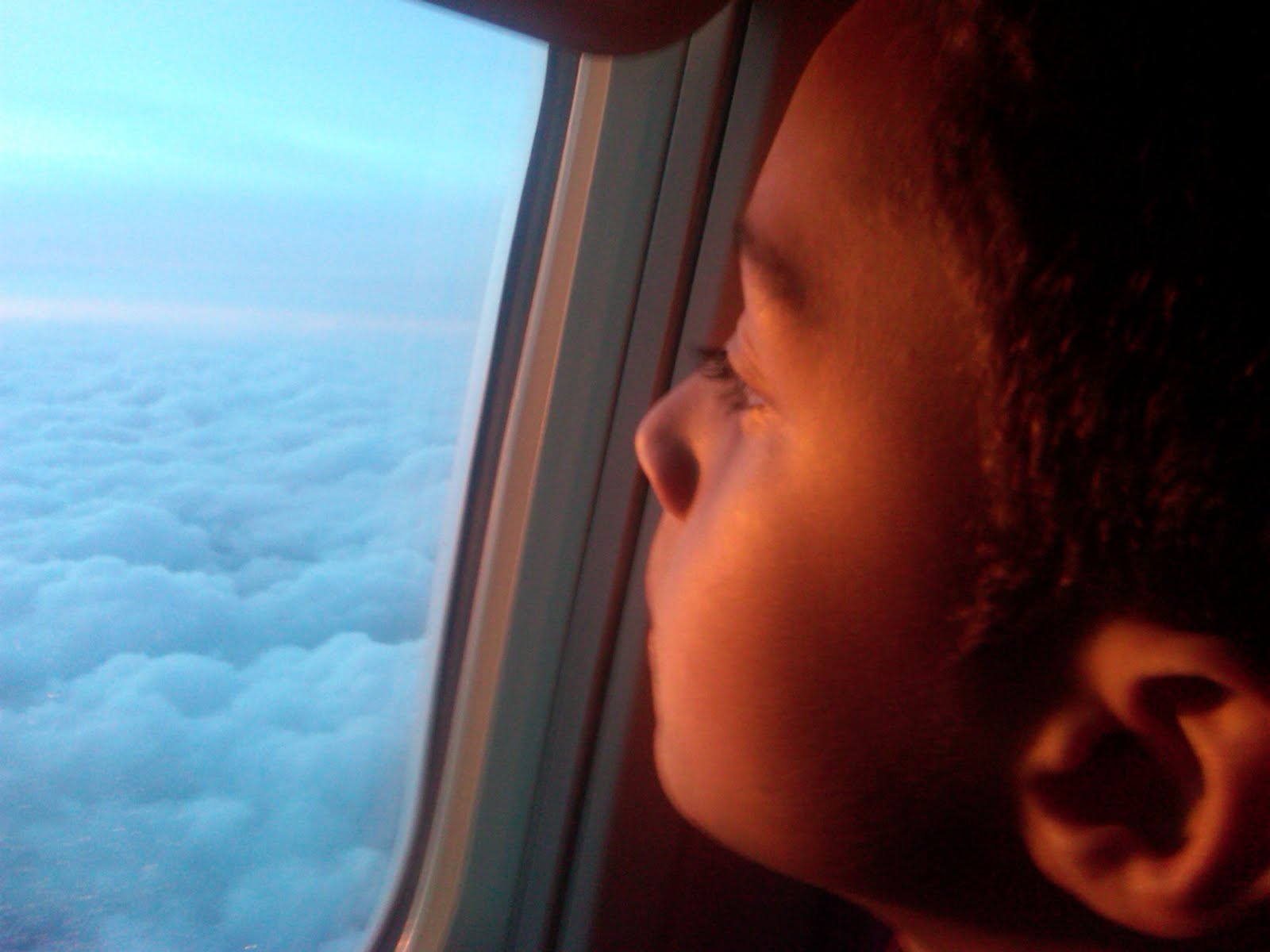
Daddy and Mommy wake us up and we’re at a house we’ve never seen before. Cool, because it’s high up and you can see boats out the big front windows. Uncle Mike shows us the marks where the seagulls drop the clams from high up to break and eat them. Daddy sits on one side of Judy and Mommy sits on the other, talking with her. She looks at us and smiles once in a while.

At the end, Mommy calls us to give Judy a hug good-bye, and we do.

Then it’s back in the car and dinner with Cousin Hannah at her house – pizza and spaghetti, and throwing balls and a Frisbee in the front yard, then back. We try to play with as many of Hannah’s toys as we can until it’s time to leave again.

One more set of cousins to see – Andrew and Matthew. “Is it far to Andrew’s house?” we ask.

“No,” says Daddy, “in fact it’s right on our way back to Abuela’s house.”

Pretty soon we’re going up the elevator and then we’re gunning through Andrew’s toys with him, while baby Matthew runs around, crazy.

And that’s how we spent our last day in New York.

Grateful

This afternoon I was able to have a quick visit with my stepmother, Judy Karnes-Fuchs, who is, essentially, in hospice at her son Matthew’s condo in Norwalk. I had no idea what to expect and was given the impression beforehand that she was in pretty bad shape. At first, I had ambivalent feelings about bringing the boys with us, because even though I knew seeing them might be a nice thing for her, I felt they didn’t know her well enough to be subjected to what I was sure would be a pretty unpleasant sight.

Thankfully, traffic, and other factors, made us run late, so the only option was to go directly up to see Judy in Norwalk. J. felt strongly that the boys should, in fact see Judy, and give her a hug, and ultimately I gave in and we brought them upstairs to see her.

I’m grateful for the traffic, and grateful for J.’s insistence.

Judy stood just behind Matt, pushing a portable oxygen tank along with her, the breathing apparatus in her nose. Although it was hard to see her in this condition, I realized that my mind had drawn much worse pictures for me than this. I gave her a warm but gentle hug, as did J., and the boys shyly came in and said hello. They then went out on the terrace with me, and we looked out over Norwalk Harbor, the sun glaring off the water in the late afternoon, before coming in and sitting politely on the sofa watching Scooby Doo as the grown-ups chatted.

I was grateful for the expanse of the harbor, and grateful for the quiet majesty of the clamming boat that made its way to the dock.

I sat next to Judy and we chatted. We talked about her health, sure, and the kind of care she was receiving from the nurse and social worker who come spend each day with her. But we also talked of other matters, as well.

Judy is an important figure in my life. She made me grow in the process of accepting her as my father’s wife. Everyone knew my mother and I had a special relationship, and I think because of that Judy and I were under the microscope when she and Dad got together.

She was nothing like my mother, and I was different from her three kids, but that was eventually fine for both of us. I stood with my father at his wedding in 1990, as his best man.

I am grateful to have stood at the altar with Hanno and Judy on their wedding day.

I grew to appreciate many things about Judy Karnes – her humor, her kindness, her warmth. She’s a singular individual; I haven’t met anyone else quite like her, and I don’t think I ever will.

By the end of our brief visit this afternoon, she was on a familiar topic – talking about how kind my father was, and how he rescued her.

I told her something then that I have been needing to say for all these years – for her sake and for mine. “Remember, Judy,” I said, “love is a two way street. Just the way you feel he rescued you, you rescued him as well.”

And it’s true. Judy Karnes and Hanno Fuchs rescued each other from loneliness, and became excellent partners to one another.

For that, I told her, I shall always be grateful.

Nostalgia Tripping With Dear Old Friends


As usual, I’m my nostalgic self, only more so, of course, on this trip to my home state and home city. J and I have seen family and friends. There’s no way for us to see everyone in the course of a week, and my sinus issues knocked out a couple of prime opportunities with some very special people in my life.

Today I got to have lunch with my old pal Jem. I met him at his office building, just north of Astor Place. It was a fitting spot; many of our youthful indiscretions occurred within a ten block radius of that location.

After the handshake/hug, Jem started listing lunch possibilities, but I had one place on the top of my list.

“Is the Yaffa Café still in business?” I asked.

His eyes curled up and he smiled that big smile of his. “I knew you were going to say that,” he said.

We made our way east on 8th Street, all the while looking around to see what was still open from the days when we were kids. The Continental Club on 3rd Avenue was still there, and Jem noted that it was surrounded by six ATM machines, something you couldn’t find except at one bank on the corner of First Avenue and Avenue A, back in the day.

As we reminisced, I was pleased to see the Holiday Bar was also still operating. It was – and still looks to be – a no-nonsense dive bar. My favorite kind.

Crossing First Avenue, we were both pleased to see that the Yaffa Café, a regular haunt of ours in the late 80’s and early 90’s, was, in fact, still there, still open 24 hours, and, as we entered, we saw that it was virtually unchanged. Jem had the same thing he used to have when we were young(er) – the Yaffa salad. I ordered us some hummus and pita to start with and then went for the turkey burger. This was the place where I first experienced a turkey burger, and it tasted exactly the same as I remember it tasting then.

We filled each other in on our lives – our children, our siblings, our jobs, and what we’ve been reading. The familiarity of this friend, with whom I connected so immediately on an autumn evening playing guitars in our Syracuse dormitory, came right back, with no awkwardness, no stumbling.

I grew not only nostalgic, but also a little self-pitying. In Austin, I have some budding friendships, but nothing so familiar as this. They say that you leave your family at a certain age, and that your friends become your family at that point. This is certainly true of my bond with Jem. He is like a brother to me. It’s not a fair comparison, I know. We’ve only been in Austin for three years, and that first musical (that’s being kind) meeting between me and Jem happened thirty years ago this coming September.

J and I met with more recent, but equally dear friends, for dinner tonight, when we visited the new home of our former next-door neighbors, the Savinskys. We created a strong connection during our time as new parents in the Park Vanderbilt apartments from 2002 to 2008. Our friendship was, and is, based on laughter, conversation, our children, and good meals.

Both Yan and Olga emigrated from the former Soviet Union, from Ukraine and Russia, respectively, and they always make a point to feed us a generous spread of delicacies from their homeland. Tonight, in their lovely seaside condominium, with the view of Manhattan and Brighton Beaches, was no exception. As with Jem, the chemistry of our friendship slipped right back into place. We ate, drank, and laughed, as our boys played loudly with their old friend, Misha upstairs. We were all sorry to say goodbye.

J and I believe in our Austin experiment, and we’re both willing to see it through. I think this visit is making both of us a little melancholy, though, as we are reminded of all these wonderful, beloved people we have left behind.

Life Underground: The NYC Subway Revisited


Over the past couple of days, J and I have made a couple of trips on the subway – one to meet up with my sister Jessica and my nephew Levi, who’s finishing up his first year at Julliard, and the other to have dinner with friends in Chelsea.

I’d forgotten a few little details that immediately came back into evidence. One is “track work.” Particularly up in the elevated sections of the number 2 train line in the Bronx, where we are staying, there seems perpetually to be track work going on. Track work as in, “Ladies and gentlemen, please plan ahead. Midday, late nights and weekends, please expect delays, due to regularly scheduled track work. We thank you for your patience.”

These words are spoken (and have been being spoken for the past ten years or so) by a recorded voice, in perfect diction. I guess the incomprehensible sound of actual human voices became too unbearable, so they replaced it with the nice man’s voice. He also says things like, “Ladies and gentlemen, please be careful of the gap between the train and the platform” and “Stand clear of the closing doors, please.”

The Giant Track Rats are something else I hadn’t thought of in quite some time. As we waited to transfer to the 2 train at 96th Street, I proposed a game to J. “Let’s play, ‘Spot the Giant Track Rat.’ Whoever sees one first wins a prize.” Sure enough, once the tracks were clear, J. won the game, spotting a GTR making off with what looked like a giant bag of popcorn someone had dropped on to the tracks. Despite being the “winner,” J’s face paled a bit. “That’s disgusting,” she said.

I couldn’t disagree.

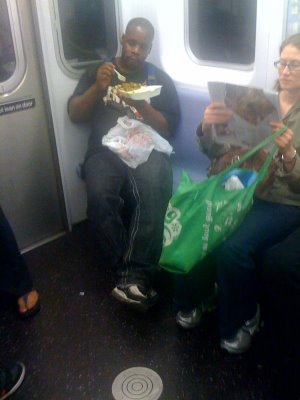
And that’s the other big thing I had forgotten: the gastronomy of the New York City Subway system. Almost every train car, at any time of the day or night has someone eating something. And I’m not just talking about someone sneaking a Snickers bar here and there. I am talking about full-on meals, washed down by giant cans of green tea or Budweiser tall boys poorly disguised in brown paper bags. Someone should do a cookbook based on a survey of favorite subway meals. I think it would be a pretty interesting international menu.

At first, I was a little mortified being back on the “iron horse,” as a friend used to call it. Once I was in my 30’s and moved out of Manhattan to Brooklyn, the subway lost its glamor. And once J. hooked her wagon to my star, and we started making offspring, we bought a car and said “Deuces” to the NYC Public Transit System.

But tonight I did sort of sit back at one point and look around at the dirty floors, and up at the ads for “Torn Earlobe” and Erectile Dysfunction treatments with a measure of nostalgia, and when I caught my reflection in the darkened glass of the window inside the tunnel, I saw that even though the man looking back at me was balder, fatter, and grayer than the one who used to look back, when this was my daily mode of getting from here to there, he was smiling, much as he did way back then.

I Missed One

It has finally happened. I missed a day’s blogpost. It occurred on Sunday, May 1, 2011. I also missed my morning pages, which threw me off for the rest of the day. After a long day of flying, we had a long day of driving, from New York to Lawrence, Massachusetts for the wedding of one of Jeanette’s cousins. It was a great party, and worth the trip, but made for a lot of rushing around and resulted in my feeling like shit. My sinusitis has provided me with pretty much non-stop headaches from day one of the trip. On Sunday morning, nausea became a part of the show. So the last thing I wanted to do was to write anything. Even now, sitting on my sister-in-law’s comfortable couch in the Monday morning quiet, before the rest of the family is up, I feel the pain as it begins creeping into my temples and molars. I’m going to continue to fight this, and eventually I’ll win. But right now I can tell you one thing:

Being sick while on vacation really bites.

Doctor My Sinuses

I decided I couldn’t travel without first seeing my corn-pone, down-home, good-ole-boy doctor, John Boyd, M.D. He’s a strange guy – a mix of all business General Practitioner, with some rather bizarre remarks sprinkled around for flavor.

This time, when I told him I was going on the plane that evening, he did a very dramatic “Oh, Jesus,” complete with eye roll and everything. “So I’ve got four hours to cure you?”

He’s a big, beefy man who you could easily imagine on the back of a fishing boat or shooting a deer, dressed all in camouflage. He has a good head of graying brown hair, but other than that is far from the picture of help himself. (“Picture of help” is an interesting slip, so I won’t delete it. Obviously, I meant “health.”)

His general demeanor and gait suggest joint pain and flatulence, and his sight is assisted by glasses. In a word, although he conducts business with a definite sense of confidence in his knowledge of the profession, Dr. John is, well, a bit of a mess.

His coup-de-gras came when he told me, “Well, Daniel, this second round of antibiotics is going to cost you . . . so BEND OVER.”

Now don’t get me wrong – I’m a big fan of “colloquialisms,” and “bend over” is a good one. Very descriptive. But there’s just something about the fact that when I normally hear Dr. Boyd say these words, he means them in a very literal sense and they’re followed by a few seconds of something you kind of have to have experienced to really understand.

Let’s call it a “three-second violation” and be done with the topic.

A Moment of Criticism in This Young Writer’s Life

I’m a little surprised that I remembered this, but the first short story I ever work shopped with Toby Wolff as an undergrad at Syracuse University was a piece called “The Gray Rose.” It was a classic moment; I came in there fancying myself the Young Author, much celebrated as a high school student and now finding out the difference between the kind of critique I received there and how things worked in college.

Toby had taken my story and made enough copies for the group of about ten other young writers. He had already read and critiqued it, but the process was that you first read your story aloud as your colleagues read along, making notations. Then there was a feedback session, after which you received copies of your marked up manuscript, including the one marked up by the instructor.

I was excited that my turn had finally come up; there had been some good discussion concerning what good short stories were comprised of, and I was certain this one had it all.

I don’t remember the particulars – you’ll understand in a moment why I might have put “The Gray Rose” out of my mind since that back in the early 1980’s. It was a love story, and it ended with the woman setting out on her own, despite the riches that her man offered her.

When I finished reading it aloud, I looked up and saw that my classmates had been moved by the plight of my heroine.

“Okay,” said Toby, “What do people think of ‘The Gray Rose.’”

One by one, my classmates raved about the story. They found it powerful and moving. The could really feel her feeling her feelings. A lot of talk about feelings; that much I remember.

Then cam the moment that changed me forever as a writer. Toby Wolff, who I now knew after having taken a literature class with him, and whose book I owned and admired, said, “Well, I frankly didn’t find the main character believable or very interesting.”

My heart sank. It felt like someone had stabbed me in the heart. He must have seen my expression or picked up on my shock, because he added, “But clearly this story was a success with your audience, so that says something.”

No, this was not comfort. In fact, it made it worse. I didn’t want to be a popular writer – I wanted to be good.

Toby went on to point to some turns of phrase he found interesting and/or original. These were always underlined with a straight, thick line, followed by the word “good” or “nice.” He then picked out a few clunkers – sentences and that strained under the weight of cliché. These were underscored with a squiggly line.

I didn’t really hear anything else he said. I looked up occasionally as he went on, ultimately stating, “This really just feels like a very formulaic “bird-in-a-gilded-cage” story.”

Home at my apartment that night, I licked my wounds, and was faced with a decision. I could either give up on improving and continue to put out this level of material, I could stop writing altogether, or I could look over Toby’s comments and think about what it would mean for me to step up to the plate in the way he was talking about.

By the next week, I was back, listening carefully to his critiques and also reading very closely the published short fiction he assigned us as part of the class: Raymond Carver, Barry Hannah, Tim O’Brien, Bobbie Anne Mason, Richard Ford, and Grace Paley come to mind. All are heavy on character; their stories are peopled by memorable characters who stay with you after you’ve finished reading. They go through something and come out the other end of it changed somehow.

The next story I shared in workshop was called “Looking in Windows” about a voyeuristic little boy who lives his life by looking into the windows, and into the lives, of the people in the building across the street. Still a bit of a too-tight, clichéd ending, but I was on the right track. Toby complimented me on the narrator’s voice, and I knew I was on the right track.

I have since written fiction that has been pretty good, including a novel I’m hoping to find while in New York, and some pretty bad stuff, as well. Toby taught to keep trying. Above all, his message has always been to make the characters matter, and to work, work , work, and read.

I’ve mentioned before that I’m grateful for his guidance and kindness. I was also appreciative of his criticism; it made me a better writer.