Summer, Then and Now

Diego and Jackson have three more days of school until summer break. Both are reasonably excited to know the daily grind of book learnin’ will shut down for a couple of months and their regimented days of walking in lines and staying quiet are coming to an end.

But they don’t seem as excited as I remember feeling, and I think it’s because they won’t have the kind of amazing summer I used to have as a boy living at 18 Hartford Lane in White Plains, New York. As I remember it, we were given free rein of the surrounding woods and college campus. By “we” I mean our cast of characters: my brother, Mike, Miki Kasai, the Mahoney kids — Guy and Richie, Jay Siegel, Brian and Henry Jackson, Brian Walker, Eddie Barham, and others from Whitewood Road, like John and Steven Ricci and Matt Karnes. There was Johnny Arndt, from the little colony at the end of our street. Their family had been there before anyone else, and were very different. There were three grown brothers — Frank, John and Landi. They were like hillbillies compared to the rest of us, and I can recall Landi, the youngest brother, who had long, unkempt hair, patrolling the woods with his “squirrel rifle.” Presumably he shot squirrels out of trees, then skinned, gutted and cooked them up.

Their parents — Johnny’s grandparents — Frank Sr. and Katie, better known as “Oopa” and “Ooma,” were Germans from the old country. They had thick accents and just one or two teeth between the two of them. The one time I was in their house — I don’t recall why I was there — I was fascinated by how OLD everything felt, from the sepia-toned family portraits to the sagging, water-damaged ceilings. I’m sure, in retrospect, that the old house was on a list at the County Clerk’s office of condemned buildings from the era before the developers bought up the strip of land now known as Hartford Lane.

Our little crew spent countless hours exploring the woods, which had become the property of Westchester Community College. Some of our favorite spots included a science building with a two headed fetal pig in a jar and two man-made ponds that were stocked with yellow perch and bass. Some of the large-mouth bass got pretty big, so that a mythology emerged . We told each other stories of a fish called “Bathtub.” Bathtub was our Moby Dick — the One That Got Away. Every time we snagged our line on a branch or rock, losing our tackle and bait in the process, it was blamed on the lethal jaws of Bathtub.

One of the ponds, behind the football field and down a nature trail, was our favorite. On it was the Fishing Lodge — since burned down by some bored vandal or careless idiot — built for Huntington Hartford, whose land this had once been. We used to climb up into the creaky structure and cast our line off the second floor porch. It was interesting to try and look past all the graffiti and used condoms and try to imagine what this building was like back in its heyday. We’d also discovered a hunting lodge, from the same era, nestled deeper in the woods.

Miki and I eventually even conquered the Hartford Mansion, now used by the college for storage. We jimmied our way in through a lower window into complete darkness, fumbling breathlessly around before finding a doorway into the house. There was graffiti on most of the walls, which told us we weren’t the first to break in. Upstairs there was a room with dentist chairs in it. In the attic we found aging black and white photographs and papers we tried to decipher.

It was a fascinating expereince, and I loved the sense of adventure of my youth. I thank my parents for trusting me enough to have these adventures, and I’m saddened by the thought that it’s unlikely I’ll ever allow my own children the same amount of rope. I’m just not sure it’s possible in the world as it is now.


Mary Carolyn Runyan Fuchs, (Would Have Been) 80 Years Old Today

Today is the date on which my mother was born, back in 1931. On the other two significant May birthdays in my immediate family – Jackson’s on the 7th, and Diego’s on the 16th – I discussed their birth stories. Both were first-hand accounts, with varying degrees of accuracy, but, generally speaking, both were the truth. I was not around for my late mother’s birth, obviously, but I thought it would make for an interesting exercise to write the story anyway…

Just two days after Memorial Day, and it is already feeling like August in Little Rock. I am grateful to have been transferred, a few months ago, to an office job that requires no travel and comes with an electric fan that cuts the heat some.

I believe the transfer may have been Mr. _______’s doing; he is one of the railroad’s Vice Presidents, and runs the Little Rock regional office. Mr. ________ is a kind, church-going man, and when I mentioned to him in passing that Hazel was in a family way a few months back, he became very interested, making a point to tell me the story of his first-born, a son named James, whose acquaintance I have made. He will be attending West Point in the fall and Mr. _________ is very proud, and rightly so.

Less than a month later, I received the letter offering me my current position of Assistant to the Director of Human Resources at the Rock Island Railroad’s Little Rock office. The day I was unpacking my things at my new desk, Mr. __________ happened to be meeting with the Director. He greeted me warmly, congratulating me on my new post, before I thought I detected a little wink, as if to say, “Glad I could do this for you, Herman.”

This morning I receive a telephone call before I can even take my hat off. It is from the maternity ward at St. Vincent’s Hospital. Hazel is doing well, and the baby should be arriving soon.

I head on down there as fast as my old Model T will take me, which is not very fast. I find my way to the maternity ward and am met by a colored nurse who pats my shoulder in a reassuring manner and lets me know everything is going “just as it ought to be.”

The seats nearest the electric fan have all been taken; they’re filled by nervous-looking men of around my age and general appearance. They nod at me, as I hang my hat and jacket. I have managed to sweat through my shirt. To cool off, I fan myself with an abandoned copy of the Gazette. I try reading a story about the new invention of something called a wind tunnel, which will allow scientists to test aircraft on the ground. I am interested – having been a navy man during the Great War – but I find it difficult to concentrate under the present set of circumstances.

I am napping when the same nurse calls my name. She leads me through a door I hadn’t noticed before, and down a bright corridor. We stand before a window and look at a room full of newborns in bassinets.

“Can you guess which one is yours?” she smiles.

“I don’t believe I can,” I answer in a way that makes her laugh so loud the babies seem to hear it through the glass of the window.

She points to one of the cribs, and I see my little girl, Mary Carolyn, for the first time. She is a thing of beauty – pink and sparkling clean. I close my eyes and thank the Lord for His blessing. Then I tap the glass, attempting to get Mary’s attention, all the while trying to imagine how much my world has been changed.

My Brush With the Law, continued

My day started yesterday at a most unusual location – the courthouse in downtown Fort Worth. I decided that if I didn’t take care of my speeding ticket right away, it was the kind of thing that could turn around and bite me hard in the ass later on down the road.

So there I was, going through the metal detectors, wearing my snappy black button down shirt with the Region 13 logo on it, as if to say, “Hello, fellow state workers. I am your brother. Please take pity on me.”

Then I just started letting the current of their system carry me along, and I have to say it was quite efficient. Impressive, really. Despite my offense being a mere traffic stop, there’s something about being in a courthouse that just makes me feel guilty of something.

After scanning my ticket and insurance information into the system on a nifty desktop scanner, the woman behind the glass – “Cashier Six” – sent me to the last in a row of little courtrooms. A dour Hindi woman took my paperwork and I sat on a bench in the gallery, watching other people go up to the judge as their names were called.

Then I heard a small, female voice call my name meekly, and I approached the bench in what I thought was a respectful way, even smiling at the bailiff and saying “Good morning” to him.

“Did you call his name?” I heard him mutter to the judge.

“No, I think the prosecutor did,” she answered.

When I realized what I’d done, disrupting the flow of this well-oiled glockenspiel of a courthouse, I was mortified. “I’m SO sorry,” I said, backing away from the judge.

I then went out and found “the prosecutor,” a woman who had walked right past me out the door and into the hallway, expecting me to follow her, just as I had made my way comically to the bench.

She looked about fourteen years old, despite her attempt at lady-lawyer attire, in a crisp white button down shirt and 1930’s-style knee-length skirt. I’d noticed her and a young man (equally youthful –looking, so that I’d assumed they were interns from a local high school or something) working busily at a computer screen and shuffling papers.

Anyway, we eventually figured things out, and I’m happy to say there will not only be no traffic school, but the infraction won’t appear on my record . . . if I can keep from getting a speeding ticket in Fort Worth in the next 90 days. So my day in (traffic) court was a success…

Busted in Fort Worth

There I was cruising back to my hotel after lunch at Whataburger in Fort Worth. (What a pathetic set of words!) Suddenly, I see him, parked on the left shoulder. I hit the brakes to try and slow down a bit, but he’s got me. I see the flashing red and blue lights come on in my rear-view mirror and say it out loud.

“Shit. You got me.”

I pull over, and he takes a couple of minutes to run my plates, or so I assume. I’m aware of not knowing what to do with my hands. When he finally comes to my window, he looks very much the part — flat-top crew cut, mirrored sunglasses and the whole nine.

But when he speaks, I’m thrown off by the unmistakable Irish brogue. Like most people in his position, he’s all business. I appreciate, however, that he’s not superior about it, as some cops can be. I have the sense he’s even a little sympathetic, as if he himself has been in the position of getting caught speeding at some point in his life.

I’m polite, and patiently wait for him to finish writing out my ticket. Then I’m off the shoulder, back on to I-30 East, my eyes going from the road to my speedometer and back again.

Take Me Out to The Ballgame (Just Don't Take Me OUT)

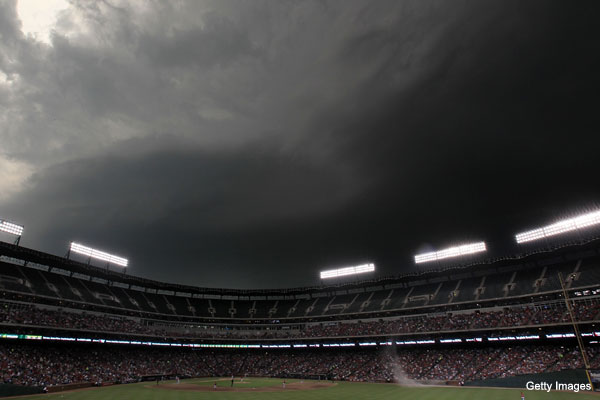
Weeks ago, I bought a ticket to tonight’s Texas Rangers game against the Chicago White Sox. I’d been to a game last year, during their run to the World Series and enjoyed it, so I was looking forward to being back in that lovely stadium.
After eating a nasty but cost-effective dinner at my hotel (Salisbury Steak, mashed potatoes, gravy, and corn on the cob — all of it too salty), I figured it would be a good idea to make my way, on foot, up to the ballpark, about a mile away. That way I would not only work off some of the heavy food I’d just had, I’d also get there early. The weather forecast was not good and did not bode well for the prospects of a full game. I figured I’d take in a couple of hours and then see what was happening at around 9, when the storm was supposed to move in.
Once inside the stadium, I had that same rush of excitement I’ve always gotten at pro ballgames, from my earliest memories of Shea Stadium in Flushing — the way the expanse of green opens out in front of you, then unnatural brightness of the light stanchions, that fill the bowl with artificial sunlight.

According to the reports I’d glanced, the game promised to be a low-scoring pitcher’s duel. That was dispelled when the Sox hit a solo shot to open up the scoring in the first half-inning of the game. Josh Hamilton, back from injury, was in good form, going two for two, with two stolen bases. So much for the pitcher’s duel.
It was 4-2 Chicago when the weather started coming in. First the dust began swirling. You could see the clothing on the players and umpires billowing like sails on their bodies. Occasionally a player had to call time due to dust clouds. Then there was an announcement asking people from the upper decks to move down into the lower sections. This was due to high winds.
When the grounds crew brought out the tarp and covered the infield, nearly losing the tarp to the high winds as they did so, I made the decision, prompted also by a text message from my wife, to get out of Dodge, as they say. I swiftly made my way to the third base exit, and ran across the street in heavy rain, waving down a trolley bus. The driver told me to hop in and drove me down to my hotel.
Once inside, I felt safer, but not completely safe, as I began to see reports of tornado warnings. The hail then began rapping at my window, and I thought about all the tornadoes that have been happening this spring, most notably this past weekend, when the town of Joplin, Missouri was wiped off the map.
I said a special thank-you to no one in particular, grateful that I was okay, that I would be home in two days, where I would hug and kiss my wife and children.

The Importance of Play (A Work in Progress)

It was time to stop what I was doing and be a dad by going outside and playing with my kids.

And I’m glad I did. It is essential to take the time to turn off the TV, the DS, the PSP, the computer, or whatever electronic device it may be, and get outside to play a bit.

This evening, after dinner, in the half hour they had before bedtime, my sons Diego and Jackson accompanied me out to our small backyard, where we played catch and “Monkey in the Middle,” made doubly fun by the fact that we were throwing an actual toy monkey, instead of a ball. We ran, we threw, we caught. We dove onto the grass.

More than anything, we laughed. The laughter is so important. Without it, life becomes one mandate after the other. Threats followed by consequences.

So many of my childhood memories involve playing, with my friends, my brother, and my parents. Play was an integral part of my development, just as I know it will be for my own children, as well.

"Tainted Gloves" or "Kiss My Asterisk": How the Cheaters Killed My Love of Baseball

The other night, while watching playoff basketball with a friend, we got onto the topic of baseball players. He, like many people, is a great admirer of Manny Ramirez, one of the most talented right-handed hitters ever to play the game.

When I mentioned as much, my friend’s voice dropped. “Yeah, too bad he’s tainted.”

In case you’ve been living under a rock for the past 15 years, he was referring to “juicing,” or the use of performance enhancing drugs, such as anabolic steroids. Since the mid-to-late 1980’s such use has been scrutinized closely in baseball. There are all kinds of theories as to why men have taken to “cheating” – from economics to peer pressure to “keeping up with the Joneses.”

My first awareness of steroids in baseball came in 1989, when I first saw Lenny Dykstra, one of my favorite Mets from the scrappy, dominant 1986 World Champion squad, in a Philadelphia Phillies uniform. He didn’t look like the same guy. Okay, so he’d been working out, but something just wasn’t right.

Then came the “Bash Brothers” in Oakland — Canseco and McGwire. Both were big men, but their muscles ballooned almost comically in the time they were teammates. By this time, if you didn’t smell a rat, there was something wrong with you.

But there were two events in contemporary major league baseball – both of which involved the long ball, the homerun, once the most basic display of unbridled power in the sport. First there was the cartoonish back and forth of McGwire and Sammy Sosa, as they surpassed Roger Maris’s single-season homerun record in a tit-for-tat battle that boosted baseball’s ratings and made fawning sycophants of once-respected sports commentators.

And of course the coup de gras was when Barry Bonds broke Hank Aaron’s total homerun record with number 756 in August of 2007. He has since been indicted for perjury and has had an asterisk branded onto his record-setting baseball that sits in the Baseball Hall of Fame in Cooperstown, New York.

As a father of two boys, all of this makes me think back to my own childhood. I remember watching the news as a ten year old that Hank Aaron, one of my favorite players, had beaten Babe Ruth’s lifetime record for home runs, by hitting his 715th. My brother and I had a fairly extensive baseball card collection . Our team was the Mets, of course, but we loved looking at all the men on those cards, reading their statistics on the back, while chewing on gum so stale it tasted like cardboard. There was no greater joy than sprawling on the floor and looking at our cards, trading for doubles and triples. Our father endorsed our enthusiasm with his own, telling us tales of his own favorites from the Brooklyn Dodgers, Pee Wee Reese, Don Newcombe, Roy Campanella and Jackie Robinson.

Today, thanks to all the doping and asterisks, I will find it hard to encourage the kind of love of the game my brother and I, and our father before us, had. Thanks to the poor judgment of a number of men, the game itself has been tainted. Don’t get me wrong; I know the men I looked up to were by no means perfect. But they reached their milestones, set their records and did their jobs on the strength they had, not the strength they acquired by shooting foreign substances into their veins.

The Rapture: What Will It REALLY Look Like?

All this talk about the Rapture and Judgment Day has led me down the path of wondering what the “end of days” will really look like when it does finally come.

My feeling is that we’re far more likely to go out with a whimper than a bang, and that we will continue to slowly bring about a man-made cause of our own extinction.

I don’t see widespread looting – the running joke on Facebook and elsewhere during this latest hoax – or a heartfelt announcement from Anderson Cooper confirming the veracity of the latest forecast of Armageddon.

Instead, I’m imagining populations of people being allowed, by the rest of us, to die off due to malnutrition and starvation. The so-called “fittest” will continue to survive, thanks to how superior we are to everyone else, all the while using our superiority to continue our contamination of the planet. Eventually our abuse of science will decimate a significant portion of the “haves,” either through some military mishap that involves weapons gone wrong, or by way of the toxification of our ecosystem to the point where it can no longer sustain us.

I could see this process taking hundreds of excrutiating years to play itself out. Life for the poorest among us will get more and more difficult, and those of us with resources will dig in our heels, fortify the ramparts and build our luxury bunkers (as featured on ABC’S Good Morning America).

I’m not all that familiar with the Bible. Or the Koran. I’m not sure whether or not either of them contain any verses that could be interpreted as the scenario I’ve just described. My point is that using scripture to envision a “televised” Rapture underscores our unique chauvinism as a species. The End of Days won’t be a dramatic TV event.

It will be the snuffing out of a candle that has been burning, less and less brilliantly, for centuries.

Journaling and Blogging

It’s an interesting, two-sided exercise in which I find myself engaged these days — writing in my journal, longhand, each morning for about an hour, and ending my day by blogging on my computer for at least that long. Sometimes the journal entry gets transcribed and revised as the blog, but not always.

It’s a bit like standing with one foot in one century, the other in another. One medium — the journal — feels archaic, anachronistic, even. The other is “cutting edge,” or so I’m led to believe (although there is some debate as to the future of “long-form” blogging).

Blogging is innately public; the writing has “followers,” as well as people who happen upon it during Google searches. My journals end up on bookshelves, or in mildewing cardboard boxes in the basement of my sister’s hundred year old brownstone in Brooklyn, New York.

My hope, ultimately, is that all this daily reflecting (navel-gazing, if you will) will eventually lead me to write that dazzling piece of long fiction that I know is in that navel somewhere. I’ve unleashed the demons before — the proof is somewhere in the aforementioned damp basement. It’s time to release the beast one more time.

If You Knew My Father…

… you’d understand why this song moves me every time I hear it. I wish I’d had the opportunity to play it for him:

“Kind & Generous”
(Natalie Merchant)


You’ve been so kind and generous
I don’t know how you keep on giving
For your kindness I’m in debt to you
For your selflessness, my admiration
And for everything you’ve done

You know I’m bound…
I’m bound to thank you for it

You’ve been so kind and generous
I don’t know how you keep on giving
For your kindness I’m in debt to you
And I never could have come this far without you
So for everything you’ve done

You know I’m bound…
I’m bound to thank you for it

I want to thank you
For so many gifts
You gave with love and tenderness
I want to thank you

I want to thank you
For your generosity
The love and the honesty
That you gave me

I want to thank you
Show my gratitude
My love and my respect for you
I want to thank you

I want to…

Thank you
Thank you
Thank you
Thank you
Thank you
Thank you