Miles Above New York, Heading Home

I opened my window shade, on this morning’s US Airways flight to Charlotte, and was greeted by a spectacular bird’s-eye view of New York City, with all of Brooklyn spread out before me. It was a clear morning, so I could make out the landmarks — the Verrazano Bridge, reaching to Staten Island, the Coney Island’s Cyclone roller coaster was visible on the beach, with Prospect Park in the distance. I approximated where our old building at 651 Vanderbilt Street probably was.

Further away in the early morning sunshine, the spiky buildings of Manhattan Island bristled the horizon; I could see the Woolworth Building to the south, the Chrysler, the Empire State, of course, and the Citicorp Building.

I said a silent goodbye to the familiar geography of my birth city, to the landscape of my youth. And my plane made its way steadily southward, toward Charlotte, where I would switch to another plane bound for Austin, my home.

Live Life Like a Funeral

I forgive myself the trespass of missing yesterday’s Morning Pages. It was a day, after all, for the living to mourn the dead, to be present in a way those being mourned cannot.

So I tried to spend yesterday in the moment, not with my mind or heart elsewhere, or thumbing the keys of my Blackberry. Being in that place, knowing Judy’s body was there in that casket, but not Judy, made me want to make each person I spoke with feel listened to by me. In that moment of condolence, I wanted each to feel appreciated.

Why not live my life in this way? Why not live life like a funeral?

The thing about funerals that’s kind of nice is that you get to see people you haven’t seen in a long time. I saw my relatives, of course — my sister Jess, brother-in-law Tony and nephew Levi. Matt, Michael and Donna Karnes, my “step-siblings,” as my brother Mike called them in his eulogy.

There were Judy’s aging sister Betty and her son Ricky who flew in from Arizona. And there were the old classmates from Valhalla High School, Rob McCrain, Walter McAlpin and his wife Gretchen Ehrhardt, and James Pruner, none of whom I’d seen in at least the past 35 years. Jim made a touching gesture by encouraging me to attend their 30th reunion next month.

Jim and I had — along with many others — just shoveled soil onto Judy’s casket, scooped up with the back side of the spade, to symbolize a reluctance to do this one last act, a particularly emotional moment of the ritual, in my mind.

And there we all stood, listening to more ancient words being recited — the “Kaddish” this time — the syncopated song of the Jewish dead. Judy was laid to rest right where she had talked about wanting to be, beside my father under the headstone reading “FUCHS.”

My way of returning my focus to living and life was to call Jeanette last night and tell her how much I love her and our boys. I then took a bike ride with Hannah, asking her to show me around the neighborhood, but really just wanting some time with my niece, at the end of what must have been a difficult day for her. I told her to try and write three pages a day in her journal. I informed her that it’s good for the mind.

This morning I rode my bike around Mike’s beautiful neighborhood, before sitting down with my own journal and doing just that.

There, in the Midst of Mourning

There, in the midst of mourning, in the very temple
where I laid my father to rest eleven years ago, I sat,
feeling a little outside
my own body.

I was not in the first row this time, but
in the second, one row, one degree, removed from
what was going one in the hearts of those
in the first — the immediate family in whose blood
flowed the blood of the person for whom
they were weeping.

I did shed some tears of my own, hearing
the cantor again, her strains pulling directly at the frayed edges
of my still broken heart. The pain was not only for
the father I miss, but for his widow, just departed.
Listening to the words of remembrance, I became aware of
my own connection with her,
my own reasons for grieving.

In that second row I sat, my heart
open and full of love — love for my own family,
the wife and children miles away. Being in that sacred space
opened my heart up further than just Jeanette, Diego
and Jackson Fuchs. I felt the love for my siblings and
step-siblings, my in-laws, for my parents and step-mother,
and for all the ancestors who came before me.
My heart opened wider and it invited in the
strangers in the room, and their ancestors, as well.

As the cantor sang on in an ancient language
I didn’t understand, and yet somehow comprehended more clearly than
any word I have ever spoken, my heart opened further,
and I was reminded of the truth I am so
grateful already to have understood some time ago:

God is love.

And love will save us all.

Salmon

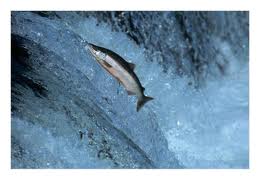
Whenever I visit my brother in White Plains, New York, I think of salmon. Their lives’ journeys culminate in this dramatic moment of peril, in which they essentially return home.

My brother returned home after packing a lot of living into his undergraduate years at Hobart College in upstate New York. He had his travels with friends, across country and to Europe, on Eurail passes.

He had adventures I’ll probably never even hear about. And then, like a salmon, he returned home. To spawn. He got married to his lovely bride and had a beautiful daughter Hannah, whom he named after our father, Hanno.

I wonder during these trips, as I see the beauty of the landscape, and feel the familiarity of the very air I breathe, if I am somehow destined to return to this area, too. Maybe not now, but someday?

As it is, I’ve been pretty well “priced-out” as a salmon in this particular river, and my spawning days are over. But who knows what the future holds?

In Honor of Judy Karnes-Fuchs, Nov. 4, 1933 – June 3, 2011

To remember a remarkable woman, who passed away on early Friday morning, June 3, 2011, I am re-posting a piece I called “Grateful,” about the important role she played in my father’s life, and in mine, as well:

Grateful

(May 4, 2011)

This afternoon I was able to have a quick visit with my stepmother, Judy Karnes-Fuchs, who is, essentially, in hospice at her son Matthew’s condo in Norwalk. I had no idea what to expect and was given the impression beforehand that she was in pretty bad shape. At first, I had ambivalent feelings about bringing the boys with us, because even though I knew seeing them might be a nice thing for her, I felt they didn’t know her well enough to be subjected to what I was sure would be a pretty unpleasant sight.

Thankfully, traffic, and other factors, made us run late, so the only option was to go directly up to see Judy in Norwalk. J. felt strongly that the boys should, in fact see Judy, and give her a hug, and ultimately I gave in and we brought them upstairs to see her.

I’m grateful for the traffic, and grateful for J.’s insistence.

Judy stood just behind Matt, pushing a portable oxygen tank along with her, the breathing apparatus in her nose. Although it was hard to see her in this condition, I realized that my mind had drawn much worse pictures for me than this. I gave her a warm but gentle hug, as did J., and the boys shyly came in and said hello. They then went out on the terrace with me, and we looked out over Norwalk Harbor, the sun glaring off the water in the late afternoon, before coming in and sitting politely on the sofa watching Scooby Doo as the grown-ups chatted.

I was grateful for the expanse of the harbor, and grateful for the quiet majesty of the clamming boat that made its way to the dock.

I sat next to Judy and we chatted. We talked about her health, sure, and the kind of care she was receiving from the nurse and social worker who come spend each day with her. But we also talked of other matters, as well.

Judy is an important figure in my life. She made me grow in the process of accepting her as my father’s wife. Everyone knew my mother and I had a special relationship, and I think because of that Judy and I were under the microscope when she and Dad got together.

She was nothing like my mother, and I was different from her three kids, but that was eventually fine for both of us. I stood with my father at his wedding in 1990, as his best man.

I am grateful to have stood at the altar with Hanno and Judy on their wedding day.

I grew to appreciate many things about Judy Karnes – her humor, her kindness, her warmth. She’s a singular individual; I haven’t met anyone else quite like her, and I don’t think I ever will.

By the end of our brief visit this afternoon, she was on a familiar topic – talking about how kind my father was, and how he rescued her.

I told her something then that I have been needing to say for all these years – for her sake and for mine. “Remember, Judy,” I said, “love is a two way street. Just the way you feel he rescued you, you rescued him as well.”

And it’s true. Judy Karnes and Hanno Fuchs rescued each other from loneliness, and became excellent partners to one another.

For that, I told her, I shall always be grateful.
What If Something Extraordinary Happened Today? Like . . .

. . . riding my bike home from my morning run, I discovered an old woman wandering down the center line of Shadowglen Boulevard.? What if she was in her nightgown and appeared disoriented and unaware of where, or who, she was? What if she did recognize me, however, but not as myself? What if she thought I was _________________?

. . . backing out the driveway as I took the kids to school, I ran over the neighbor’s dog – in front of the neighbor’s kids? (And mine?) And what if I never liked that dog, anyway?

. . . dropping my kids at school, a man mistook me for the guy who had been sleeping with his wife, and decided to confront me in front of the elementary school, at the peak of drop-off time?

. . . heading to work after dropping off the kids, I realized I had forgotten an important document and, stopping at home, found my wife ­­­­_________________?

. . . driving to work, they broke in on my regularly scheduled radio programing to announce that a terrorist had detonated a handheld nuclear explosive in Times Square?

. . . Edmund Oropez and Paul Cruz came to my cubicle and asked if I’d be interested in being the principal of _____________________?

. . . sitting at work, I got a call from Santiago Forrero, saying that the Parental Control ad I appeared in had won an award and that the ad agency would like to fly me to the awards ceremony in _____________?

. . . instead of something happening to me, like in all these scenarios, I decided to get off my ass, take some initiative, and make something happen??

Tweet Me White: Being a Fan in the Age of Twitter

As you may have already noticed, I have officially become a major fan of Kings of Leon, a straight-up American rock and roll band from Oklahoma/Tennessee, who keep things simple and rock out prodigiously. I’ve already seen them twice and plan to see them again. I own some of their songs and would like to own more.

So far, it sounds very much like what it has always been like for me to be a fan of someone. My first concert was Santana. I owned some of their music (on vinyl, of course) and wanted to own more. I’ve been a fan of James Taylor’s and can remember seeing him somewhere in Port Chester, New York when I was in the 11th grade. My tastes opened up and I started going to shows by Elvis Costello, the Clash, the Who, U2 and the Talking Heads in college. Again, I owned their records and saw all of them live.

After college I can remember seeing many other bands, including the Rolling Stones at the Corrida de Toros in Madrid, a real treat. Again, the relationship consisted of Go To Show and Buy Album, not always in that order.

Fast forward to now. I go to see a fantastic KoL show at the Frank Erwin Center. It is clear that this band is performing at a very high level. The excitement at the show is palpable, and their last couple of albums are masterful. Then, a day or two after the show, my friend, Ken Weinstein, emails me the following, from Kings of Leon drummer, Nathan Followill (aka #doctorfollowill):

Thank you Austin. I hate your football team but I love your city. Y’all were fucking amazing and I can’t wait 2 get back 4 some more. Boomer

Oh wow. This was a message to me from the drummer I had just witnessed rocking out in a major way (“melting faces,” as he likes to tweet). I began following him on Twitter shortly thereafter. Then I started following Caleb, (#caleb_followill), Matthew (#matfollowill), and Jared (#youngfollowill).

I wouldn’t go so far as to say I’m a stalker, but it’s been a fun way to keep track of their tour (they’re in the UK right now), video releases (“Going Back Down South” just came out yesterday) and general fun stuff, random thoughts, and even personal photographs.

It’s a level of personal access that we didn’t have to our rock stars when I was a younger man. Sure, there may be people who employ assistants to do their tweeting for them. (I follow Sheryl Crow and have a feeling she may do this.) But I prefer to think that they type their thoughts onto their iPhones and Blackberries, just like the rest of do in this age of tweeting.

Oh and by the way, I was really hoping to get through this blog about Twitter and tweeting without mentioning Anthony Weiner’s name. But I just did.

Oh well.

Welcome to the "Tour de Fun": A Day Out With Daddy

J. had to work Memorial Day, for some inhumane reason (something about making up a Bad Weather Day, I don’t know). It turned out to be a good thing for J, as she was able to get a lot done that needed doing.

Which left me behind with Those People. They actually treated me fairly well, in general. A few bumpy spots where my anger spiked and/or I had to count to three. Mostly they were low-key — a few Boy Fights mixed in for flavor.

Eventually, after much lazing around, they playing video games, me watching French Open tennis, we made our way out of the house. Our first stop on the “Tour de Fun” was Cafe 290, our local greasy spoon. J can’t stand the place, but I’m nostalgic, and it’s the one bit of authentic, down-home cooking we have in our area.

It’s not in as much of a time warp as Tom’s Restaurant in Brooklyn. There is no equivalent to Gus Vlahavas, welcoming you with a kind handshake and showing you their high school yearbook from 1957. At 290, there’s a sense that they stopped decorating at some point, and stopped dusting shortly thereafter. The antique BB guns, hand crank mixers and black-and-white photos on the walls almost make the place feel like a roadside museum in some tiny country town.

Tom’s, on the other hand, is alive with electric light and music. The sense one gets in there is of time travel, as though you’ve stepped through a portal in the space/time continuum, coming out in 1954.

Cafe 290 is as much for those who have made the long drive from Houston as it is for the locals. My children love it because they can order macaroni and cheese or corn dogs, and because — like at Tom’s — the milk shakes are these big, over-the-top monstrosities of whipped cream and cherries.

I like it not only for the nostalgia (Did I mention I’m nostalgic? I am, in case you hadn’t noticed), but also for the grilled cheese sandwich, served on “Texas Toast” — big, unhealthy and delicious slices of white bread with plenty of butter.

After our lunch, I drove us to Lifetime Fitness where Jackson and I had some pool time, and Diego sunbathed, waiting patiently until it was time to go to the Child Center and his greatest love . . . video games. Then Daddy got his two hours of time alone, to try and work off the grilled cheese and to soak in the jacuzzi.

I later “cooked” them a dinner of frozen cod, french fries and “fiesta corn” out of a can. Uncharacteristically, Diego said Grace. “Thank you, Lord, for this food, our family, our friends and giving us shelter. Thank you, Daddy, for making this dinner for us. And please keep Mommy safe as she drives home to us.”

He was sweet and light-hearted for the rest of the evening — unusually affectionate. J. organized a Dance Party, and I got some great video of both boys rockin’ out. All in all, a very good day, as our days go.

Motorcycle Rallies: Annual Reminders of a Road Not Taken

There’s a pen and ink self-portrait I did in one of my earliest journals, the summer after my freshman year, at age 18. In it, I have a long mane of hair, swept back (by the wind, I suppose), a bushy beard, and there’s a cigarette hanging out of my mouth. I’m wearing a leather jacket, and there’s a helmet under my arm. The helmet has lightning bolts on either side.

Now in reality I can count on one hand the times I’ve even been on a motorcycle. There was the time Russ Fiducia, our neighbor, gave me a ride on the back of his enormous Honda – the bike on which he would be killed in a crash on the Hutchinson River Parkway not much later. And I also have a foggy recollection of a mini bike to which my brother and I had some passing access – in Michigan maybe? I can’t recall.

And that’s it.

Yet there is still this call of the road that hits me when the Republic of Texas (RoT) Rally rolls into town in June. (The Central Texas HOG rally is this weekend — a much smaller version, it’s what got me thinking along these lines.) This call is not even real, in that it could ever be answered. My mother, even in death, brings out the newspaper clippings of horrible deaths suffered by motorcyclists, at no fault of their own. And those who know me well know I’m a coward at heart. That many cc’s of horsepower (or whatever – I don’t know much about internal combustion engines, either) would scare the shit out of me, I’m sure.

So where does this “call of the wild” come from? I can certainly point to two early influences right off the bat: Evel Knievel and Arthur Fonzarelli, on the wildly popular sitcom, Happy Days. In my youth, both captured my imagination. Every so often ABC’s Wide World of Sports would feature one of Knievel’s stunts. He became larger than life by virtue of how many cars he could jump over and how many bones he broke. My friends and I routinely set up ramps and jumps for our bikes, emulating him.

And then there was the Fonz. Any boy living in 1970’s America was enamored of the Fonz, unless they were raised in a Skinner box or something. He was the personification of cool – possessing the power to magically turn on both juke boxes and bobby-soxers, with a snap of his fingers or a flick of his wrist. Like 1950’s icons Marlon Brando and James Dean, the Fonz rode a motorcycle. During the opening credits, you could see Henry Winkler, the actor playing Fonzie, pull up unsteadily on a motorcycle.

I’m not sure if it was because of Winkler’s reticence, but they didn’t really play up the biker angle, initially. But then came Season Four and an episode called “Fonzie Loves Pinky,” in which the Fonz meets his match in a tough-talking, pink-wearing, pink-motorcycle-riding mama by the name of Pinky Tuscadero.

I fell immediately, helplessly, head-over-heels in love with her. I wonder now if this hadn’t been a brilliant move on the part of the producers of the show – as their core demographic reached puberty, they provided us with a heterosexual surrogate for the one we’d been in love with since the beginning.

There was a moment, in my late 30’s when I went through a brief crisis. My father had just died, leaving me an orphan. I was single and not sure I’d ever find the Love of My Life, with whom I’d eventually settle down and have kids. Visiting a friend in DC, we walked down Constitution Avenue and suddenly the largest parade of motorcycles I’d ever seen – Rolling Thunder, as it turned out – rolled past, deafening us.

“Sometimes I think I’d like to just buy a motorcycle and leave everything behind,” I said.

“Why don’t you?” she asked.

“I should.” I smiled, and we went back to watching the bikers, their shiny machines glimmering loudly in the late May sunlight. I think we both knew it would never happen, but I enjoyed thinking back on my pen and ink caricature and imagining what that life might have been like.