To My Younger Self, Discovered in An Old Journal: I Forgive You

Up on the high bookshelf in my home office, there sits an ugly, plaid-bound journal of mine. It has been in my possession since 1982, and it provides a unique embarrassing window into who I was, or more accurately, who I was trying to be at the time.

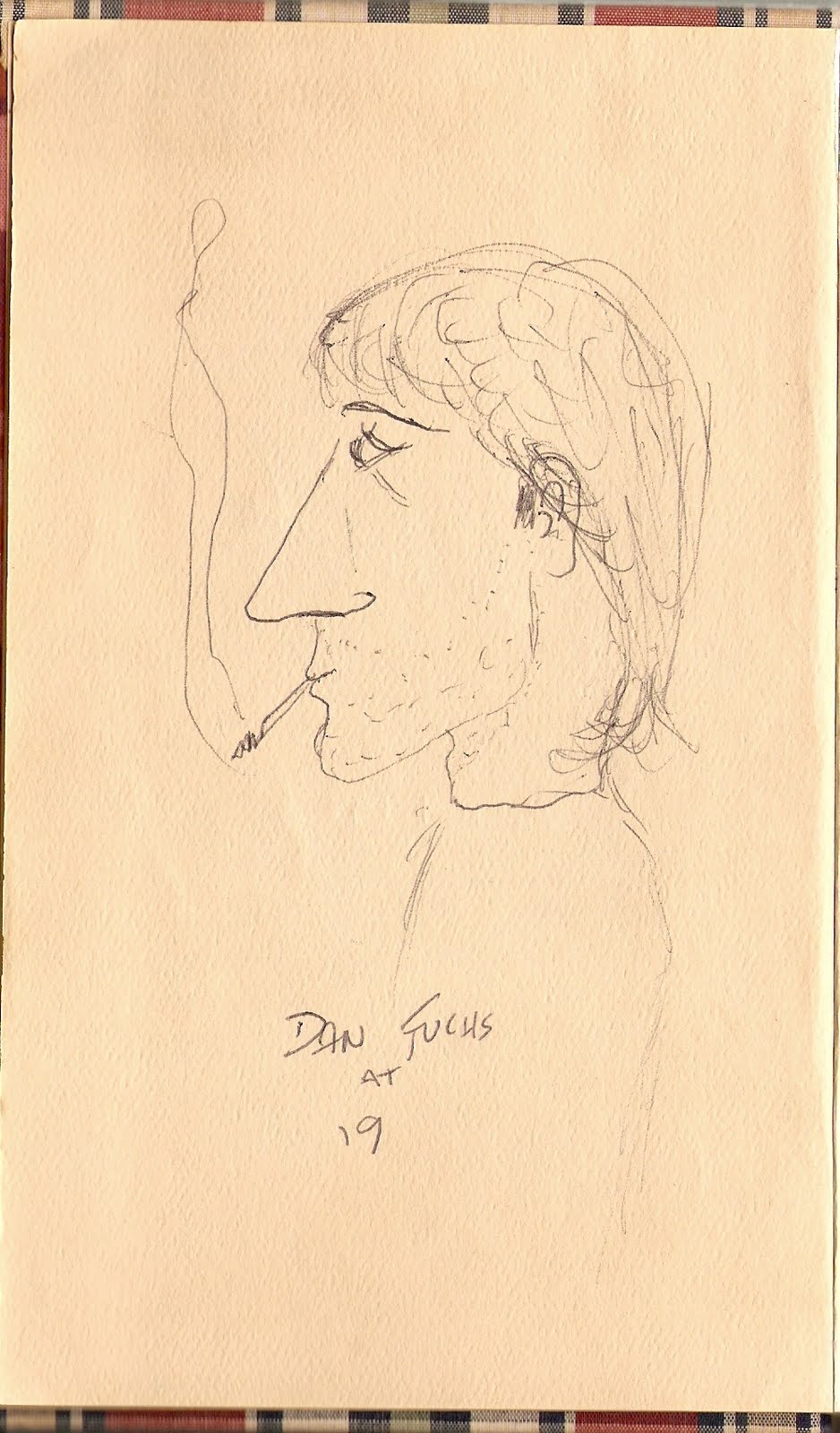
I’ve alluded to it a couple of times in this blog – once to share a sketch I did, a self portrait that shows me as a long-haired and bearded biker, and the other to transcribe set lists from a couple of amazing rock concerts I saw in the period of one week in the fall of my sophomore year in college.

Recently I thumbed through the 30-year-old diary, and could feel myself blushing. I’m periodically tempted to torch the thing, or feed it, page by page, through the paper shredder.

Lately, however, I’ve tried to distance myself a bit, in order to consider my writing as it was in those days in a different light. When I step outside myself I’m able to see a young man of 19 – still a child, essentially – who is using a blank book in order to gain an understanding of, and become comfortable with, a number of aspects of his life. They are facets that all have one thing in common within his existence; namely, they are all new to him.

Since starting college a year earlier, he has experienced a number of “romantic” encounters, after a relatively sheltered life in that arena up to this point. He writes a lot about these couplings – not pornographically, but keeping a tally (I have decided to write down a list of the year’s infatuations, starting on New Year’s Eve till now.) He writes this on December 31, 1982, recapping his year, writing down the initials of a number of young women. He then attempts to put them in the context of his emotions, which he also grapples with, often to melodramatic effect:

I came to a realization last nite. I don’t think I could ever love M again. (Actually I do love her; I don’t think I could be in love with her again.) I get depressed sometimes, though, just because I am new to all the superficialities that bachelors put up with and perpetuate.In addition, his autobiography consists of overwrought poems and a slew of bad rock and roll songs of his devising – formulaic stuff about sex and partying, with titles like “Too Cool for Chaos,” and “Let’s Go It Again” – giving the impression that he is trying to mask his insecurities about both.

Finally there are ideas for short stories , along with a rough draft of the first one he ever workshops – in an evening class with author Rhoda Lerman at the Extension School. There is some spectacularly bad writing:

The skinny brunette who he had been exchanging darts of the eyes with was now apparently alone, as the tall, Italian-looking fellow slung his coat over one arm and offered the other to a chunky blonde. Her eyes were now fixed on his, and he smiled at her pleasing, dark features.

But I forgive my 19-year-old self; he was doing what I’ve encouraged my own writing students to do over the years. He’s flexing his writing muscles, trying on new vocabulary, making errors with grammar and spelling, and tripping over clichés, all in the service of going for the perfect turn of phrase. His characters are, like the author at that time, introspective and emotionally underdeveloped, but he clearly cares about them and their situations, and there are glimpses of good writing here and there.

Mr. Valentine had made a fortune in the ball bearing business and retired at age fifty. I had never seen him do any type of work, household or otherwise. He just read and watched cultural television. He cooked occasionally, but it didn’t seem like work when he did it. “I shall beckon my daughter,” he said in a mock-Shakespearean voice. “Angela! Your friend David is here!”

It was good enough to prompt Rhoda to tell me, along with my best friend, also in the class, “There are a lot of people trying to write in our workshop. You two are the only writers, as far as I can tell.”

This conversation was a turning point, one that propelled me forward in my wish to be what she perceived me to be. That journey continues to this day, and despite cringing when I read my early writing, I could never burn or shred it. He (that awkward, skinny kid, trying to get comfortable in his own skin) was, and continues in some sense to be, me, after all. And if I could go back, I can honestly say I wouldn’t change a thing.

How the Mighty Have Fallen

This evening I met up with a couple of friends at the Flying Saucer, a beer bar in North Austin, at the Triangle. We had a good time — I wasn’t drinking because of the antibiotics I’m taking for the never-ending sinus issues. We laughed it up for the most part, but there was serious talk, too, about the world, education, and our lives.

Back in my 20’s and 30’s, most Saturday nights in the summer meant a long evening, sometimes ending at the break of dawn. Lots of subway rides. Many different establishments.

Tonight, I was home by 10:30, and ready to be there. When I lived in Madrid, 10:30 was when Saturday night started.

I’m not stressing about it. In fact, I’m glad.

I believe it’s what’s known as “age-appropriate behavior.”

More Rock and Roll Memories From Bygone Times

Looking through my journal from the fall of my sophomore year in college, 1982, 29 years ago in Syracuse, I found something interesting. Amongst the embarrassing schlock that forms the majority of my entries – a plethora of pseudo-rock star posing – I found two set lists I wrote down from concerts I saw that year.

On September 26, 1982, I went with three friends to Buffalo’s Rich Stadium. We slept in our car in someone’s front yard, paying a small fee to park there. Once inside, we watched the Clash open, and then the Who, a band I idolized at the time. I wrote down their playlist from that day in my journal. They opened at 5:25 p.m. and closed the show after a three-song encore at 7:40.

For you Who fans out there, here it is:

1) Substitute

2) I Can’t Explain

3) Dangerous

4) Sister Disco

5) The Quiet One

6) It’s Hard

7) Eminence Front

8) Behind Blue Eyes

9) Baba O’Reilly

10) I Am One

11) Funk Meets the Godfather

12) Drowned

13) A Man is a Man

14) Cry If You Want

15) Who Are You?

16) Pinball Wizard

17) See Me, Feel Me

18) 5:15

19) Love, Reign O’er Me

20) Long Live Rock

21) Won’t Get Fooled Again

22) Naked Eye (encore)

23) Summertime Blues (encore)

24) Twist and Shout (encore)

It’s going to sound ridiculous for me to say this now, but they don’t make shows like that anymore. Then, a week later, I saw the Clash headline at SUNY Binghamton. They opened at about 9:30 p.m. and played the last of five encore songs at around 11.

For all you Clash-heads, here’s their set list:

1) London Calling

2) Janie Jones

3) Know Your Rights

4) Spanish Bombs

5) The Guns of Brixton

6) Train in Vain

7) Rock the Casbah

8) The Magnificent Seven

9) The Leader

10) Police on My Back

11) English Civil War

12) This is Radio Clash

13) Bankrobber

14) Career Opportunities

15) Should I Stay Or Should I Go

16) Brand New Cadillac

17) Clampdown

18) Armagideon Time (encore)

19) Somebody Got Murdered (encore)

20) I Fought the Law (encore)

21) White Man in Hammersmith Palais (encore)

22) Garageland (encore)

I wish I could write more about either of these experiences, but the truth is, I don’t remember much, for precisely the reasons one might think a 19 year-old young man might forget a rock concert. I’m glad I wrote the set lists down.

The Need to Read

I’ve been trying to read more lately, for a couple of reasons. For one thing, I savor the experience of immersing myself in a good, well-written story. As a writer, too, it’s as much like exercising as writing in my journal, or blogging. You cannot be a writer without being a reader. I’ve known that for some time now. Finally, and perhaps most powerfully, it occurs to me that my parents were both readers. My mother was partial to literature – writers like Cheever, Updike and her favorite, John Gardner. She consumed biographies and autobiographies voraciously, and I remember how proud I was to have recommended Toby Wolff’s memoir, This Boy’s Life, which she enjoyed and praised. Her magazine of choice was The New Yorker, known for the high quality of its articles, poems and short fiction. (Not to mention the cartoons, which I grew up reading and doing my best to understand. I think this may have helped the development of an early sense of subtle irony in me.)

My father preferred the spy novel genre. He often read Robert Ludlum and John le Carré, among others. Funny, as I write this it occurs to me that I inherited my mother’s taste in books, and my brother Mike got my father’s. That’s interesting.

At any rate, I’ve come to the sad conclusion that I’m more a TV viewer than I am a reader. What I plan to do is start turning off the tube and opening up the Kindle. It will improve my life; I’m absolutely sure of it.

In Defense of Teachers, Yet Again

Yesterday during my lunch hour I took the opportunity, as I often do, to check my personal email and saw that a former colleague from New York had posted a brief clip of actor Matt Damon defending teachers to a reporter and her cameraman. She was posing the argument that there are bad teachers (“10% of teachers are bad,” says the cameraman at one point. “Where’d you get that number?” asks Damon’s mom, a teacher, who is standing with him, looking very proud the whole time.)

The interviewer makes the mistake of suggesting that the reason Damon is an actor is the knowledge that if he doesn’t do it he won’t have any income. This sets him off, and he compares her question to what he calls “paternalistic ed policy” that oversimplifies the complex problems facing students, their families and their schools.

Of course, I posted the clip to my Facebook profile page immediately, which set off a flurry of re-posting, “likes” and comments – particularly among my teacher and educational support friends.

Damon’s main point seems to be about having a passion for one’s craft. “Why would anyone choose to work long hours for shitty pay? Teachers teach because they love teaching.”

I agree that a love of teaching is probably why most people do it. In my case, it wasn’t exactly my “calling,” as they say. The circumstances of my life became a kind of confluence of events that led me into being a public school teacher. Once I was there, I loved it, and that love is what kept me there for fifteen years or so.

In order to make a living when I resided in Madrid, Spain in the late 1980’s I did what nearly every American and British expat of my age did: I taught English. (My major in college now began making some sense for the first time.)

Upon returning to New York in 1990, I took out an ad in El Diario La Prensa, the Spanish-language daily, and got a few English teaching gigs that way, mostly with hard-working people from Latin America and the Caribbean who were looking to better their lives, or their children’s lives, by improving their English.

It was my college friend Sonia Murrow who ultimately encouraged me to consider becoming a public school teacher. She was having a good experience teaching Social Studies at a school I’d never heard of, Satellite Academy High School, across Chambers Street from the Tweed Courthouse and City Hall. As fate would have it, they’d hired a teacher who didn’t work out, and Sonia brought me in to meet the Coordinator at the time, Alan Baratz, who had famously asked in a staff meeting, “Does anyone here know anybody who can come in and NOT be a complete disaster?”

And with those words of inspired confidence, my teacher career was born. It hadn’t been my original plan (I was on an actor’s track back then), but it shaped my destiny and made me the person I am today.

I was extremely nervous when I first started, but as I walked the hallways I had the distinct feeling that this was exactly where I was meant to be, and that I’d be there for a long time. In the face of my nervousness, I fell back on the tools I had. In the “nuts & bolts” realm, I had picked up some teaching strategies in Madrid, which did help.

Mostly, though, I used what my parents handed down to me – my sense of humor, and my respect for, and ability to be kind to other people. It sounds simplistic and Pollyanna, I know, but that’s what made me a successful teacher. Tenure didn’t lessen that, or cause me to “coast.” If it changed me or my teaching in any way, it humbled me. I felt as though all the sacrifice and hard work was finally being rewarded, and I felt inspired to do an even better job and, ultimately, to take what I’d learned from the teachers, families and students I’d worked with at Satellite and try to encourage and inspire others with it.

I’ve probably met and worked with thousands of teachers, as a co-worker, administrator, consultant or staff developer at this point in my career, and yes, there are some who should not be teaching kids. I encourage their supervisors to help them looking into other opportunities when I can.

Mostly, though, I meet people who work hard day after day, with the success and future lives of their students squarely at the center of what they do. They are not victims or leeching siphoning off your tax dollars for a paid summer vacation. They’re the ones with a passion for inspiring young people to think, grow and strive, and if we continue to vilify our public school teachers, we’re going to very sorry in many, many ways.

The Sibling Zero-Sum Cycle of Life

The other day Jackson and Diego were engaged in their usual routine, playing until it turned into arguing. Then the arguing became hitting and kicking, which subsequently transformed into crying and tattling. The Sibling Zero-Sum Cycle of Life. I realized that my two boys are (at least) the third straight generation of Fuchs brothers to engage in this sort of behavior.

My early childhood is punctuated by painful memories of red-faced hair-pulling, balled up little fists hammering on bone and flesh, and my younger brother’s notorious tendency to hit me, usually in the back, his little knuckles shaking my spinal cord, and then lock himself in the bathroom.

I suppose a person more religious than I might take this opportunity to refer back to Cain and Abel; however, I’ll just take it back one more generation to Jackson and Diego’s Opa Hanno and his older brother, Geoffrey. As the story goes, my father was running behind his big brother – chasing him, perhaps? – when Jeff slammed the screen door into Hanno’s little face, breaking his nose.

I intend to share this post with my Uncle Geoffrey, the keeper of the family history, to get his take on this sliver of Fuchs family lore. I’d also like to ask him if my Opa Bill had a history of fighting with any of his brothers.

Something tells me I know what the answer to that one will be.

Poker Night Memories, In Brief

We used to have our next-door neighbors, Yan and Olga, over for dinner and cards. Yan and I would always drink a little too much, as he never failed to produce some obscure, delicious bottle of something – either vodka or some aperitif I’d never heard of – and we’d get pleasantly buzzed, as our wives chatted. We would all commiserate about parenthood and how fucking hard it is, and it was a wonderful comfort to find someone who could share our struggles.

They had such a fun, funny dynamic during these conversations about our families. Olga’s tone would start to shift, and her comments would turn towards the negative, all for comic effect, of course, until she’d say something purposely extreme. Yan, in that quintessentially Jewish way, would raise his eyebrows, shrug and say something like, “Well, I don’t know about that.

“Yes,” Olga would say, as if closing the book on the subject and reminding her husband that the point, like all points, was true because she said it was. And that was final.

This tickled me and J. and when we couldn’t contain our laughter, Olga would join in, and then Yan. None of us were very good poker players; as I remember it the women were generally better than us men, but our heavy drinking was a built-in excuse, I figure. Olga didn’t generally drink, and J. sipped her red wine beatifically.

Dog Daze

The other day, after making sure I was sitting, Jeanette announced that she was ready to start looking for a dog. As fate would have it, I uncharacteristically became the voice of reason, asking her to consider the economic side of the proposition. She said she understood and that she was concerned about Jackson’s anger issues and that she thought a dog might serve to moderate that. I agreed, all the while suppressing the urge to jump for joy. I think rescuing a puppy could be just what this family needs right now.

Dogs were a big part of my life as a boy. When we lived on Whitewood Road, a beautiful stray appeared one day. He was tan and white with a nose the color of liverwurst. My mother, in her literary brilliance, named the dog “Tandog,” as original a dog’s name as I’ve heard to this day.

“Tanny,” as we called him (a little confusing at times, as I was known as Danny then) was a career stray. He allowed us to think of him as our dog for a couple of years, before exiting from our lives just as quickly as he’d entered it. I don’t remember much about him, except that he was quiet and had a calm demeanor. If there’s an existing photo of him anywhere in this world, I don’t know where it is. But I’ve got him in my memory, his image as clear as day.

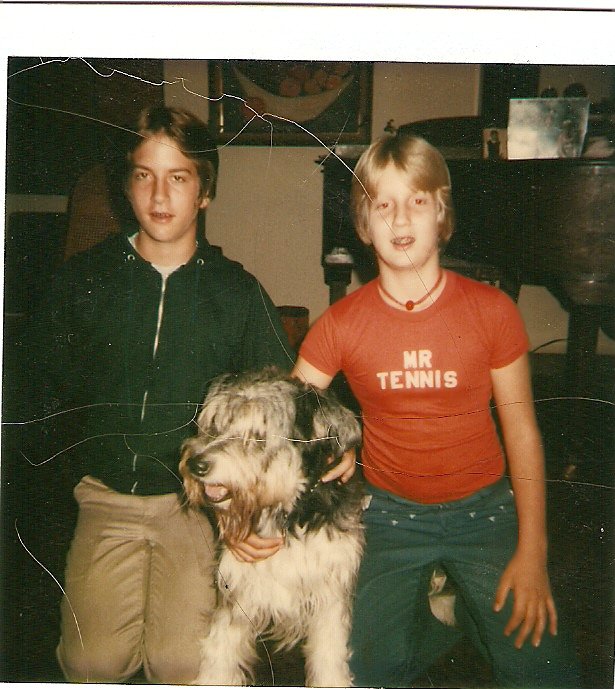
Then there was Bo Bo, pictured here. We answered an ad in the local paper, the Reporter Dispatch, which read “Lovable Puppy.” His owner, a pretty woman, as I recall, was going away to college, or a new job, where they didn’t allow dogs. Mike and I played with him in their yard, and it didn’t take long for us to make our decision.

He wasn’t a “puppy” in the most literal sense. He was probably about a year old – fully grown and housebroken. He was a long-haired mongrel, and when people asked what breed he was, my father called him a “dogfood commercial mutt,” which was pretty accurate. He was, supposedly, a mix of schnauzer and Old English sheepdog.

The day he came home with us, he sniffed around our home nervously, every once in a while looking out the window, as if wondering where he was. It took him a day or two to settle in, and then he became the fifth member of our family.

A few weeks later the young woman who’d owned Bo contacted us to let us know her plans to move had fallen through. I was too young to understand the emotional complexities of the situation, but my parents had her over to “visit” Bo. As the story goes, she watched him running and playing with Mike and me in the back yard and made the decision that Bo would be happier with us. I have a dim recollection of her sitting on our back porch crying and being consoled by my parents. Then she left, and I never saw her again.

Bo was not always perfectly “lovable” as the girl’s ad had claimed. He was overly aggressive at times, antagonizing the other dogs on our street. There was Smokey on one side, a beautiful Norwegian Elkhound who belonged to my best friend Miki. On the other there was Deero, a Dalmatian who simply enraged our dog. He even jumped through a plate-glass window once.

But he was also quite sweet and gentle at times. He was with us from the time I was about six until my freshman year in college in 1981. Thankfully, I was spared his passing, but it was hard on my brother, who was especially attached to our dog.

We’re hoping to choose a dog from our local animal shelter, probably around the third week in August, when we return from our weekend in San Antonio. Then our lives will change forever, and for the better.

Space Exploration, in Miniature

When I was a boy, I was something of a “hobbyist,” you could say. I enjoyed model-making, though I always struggled with the more intricate details, like applying the glue in a way that didn’t drip on the model itself, or applying decals. Painting was a challenge. Sometimes Miki, my nextdoor neighbor and BFF, would get the same models I had, and the comparison was embarrassing. He had a steady hand; no surprise that he ended up a research scientist; as I picture it, he is carefully injecting samples into test tubes, before placing them in a centrifuge. (Okay, I have no idea what I’m talking about, but I watch a lot of CSI, so I figure that counts for something.) If you look at the things I’ve super-glued around my home – a drawer front in the kitchen, or the handle of a plastic cup measure, you’ll see I haven’t changed much – they’re a little off-line, and you can see where the glue dripped and then dried.

But hey, the drawer works, and the cup measure has a handle, so leave me alone about the drips, okay?

One of my favorite hobbies is one I hadn’t thought of in years and years, until the other day, when Diego came home from camp. It has been a wonderful camp – both fun and educational. They have performed dances and skits, and also done a good deal of science, in a fun, hands-on program called “Mad Science.” In his hand, Diego had a cardboard rocket. I immediately flashed back to my days as a collector of Estes rockets. Miki and I were in it together, and we would go with my father or his to the Westchester Community College campus, where we would set up our launch pads. The thrill was short lived, as the little “engines” were ignited, the rockets flew up, the parachutes deployed, and they came floating back down.

The king of all Estes rockets was the Saturn V. (Miki and I weren’t aware of Roman numerals back then, so we called it the Saturn “Vee.”) Miki was the first to have one, and I remember when it went up it was a big moment for us.

I told Diego about Estes, and now, of course, he wants to get one. I think it’s a great idea, and I’m looking forward to getting into hobbies with my boys. It will be interesting to see how Diego and Jackson experience rocketry. For Miki and me it was very real; we can both remember watching rocket and shuttle launches on TV, so we were mimicking what was really happening in the world.

We’re now in a post-exploration phase, with the shuttle program closing down earlier this month. I’m sure there will come a time when we get excited about the exploration of space again, but for now it’s an abstraction. Still, I see the way Diego’s eyes light up with scientific curiosity, and I plan on stoking that fire. Who knows? Maybe he’ll be the first man to set foot on Mars.

Dreaming of Rain

Last night I dreamt of rain. It pounded down and I was walking around the house closing windows and checking doors. The wind blew hard but there was a sense of safety. The house would keep the elements out.

Along with the sense of safety came one of relief. We’re living with an ongoing drought here in Central Texas, and last night, before turning in, as the boys were taking a bath, I took the opportunity to sit in my wicker chaise in the back yard and drink a beer. It was still about ninety degrees and the only breeze came from my outdoor ceiling fans on the back patio. Reclining, I surveyed my tiny realm; the grass looked sad and brown, and the clouds welled up like a bad actor, trying to make himself cry.

When I was a child in elementary school in the northern suburbs of New York City, there were mornings when I woke to flashes of lightning and rolling thunder. On those mornings, my mother – a late sleeper, normally – would pry herself out of bed so that she could drive us to the bus stop on Knollwood Road at the end of our street. We would sit there in the back seat – no seat belts back then, let alone child seats – chattering about whatever the topic would have been back in those days (Bugs Bunny, Underdog, Jaws) and listening to the rain’s uneven percussion on the roof of our Gran Torino wagon. Sometimes my best friend Miki (my “Brother From Another Mother,” in today’s parlance) would join us, and we’d wait for that cheddar-yellow Bluebird bus (number 4, I think it was) to pull up before making the mad, soaking dash to its open door, a quick goodbye to Mom thrown over the shoulder as I started my sprint. Thinking back on it now, missing her as much as I do, I wish I’d lingered longer.

Here in the waking world of the present, there has been, predictably, no rain, despite the imminent arrival of Hurricane Don on the Texas Gulf Coast. Mark Murray, the local weather guy who contributes to KGSR said yesterday we were unlikely to feel Don’s effect here in our scorching, sun-drenched corner of the world.

Thus, my dreams of rain.