Judd Apatow: Chronicler of . . . ME

I know it’s a bit trite for a 40-something, upper middle class white man to say it, but I’m going to say it anyway:  I see myself in Judd Apatow‘s work.  Consistently.

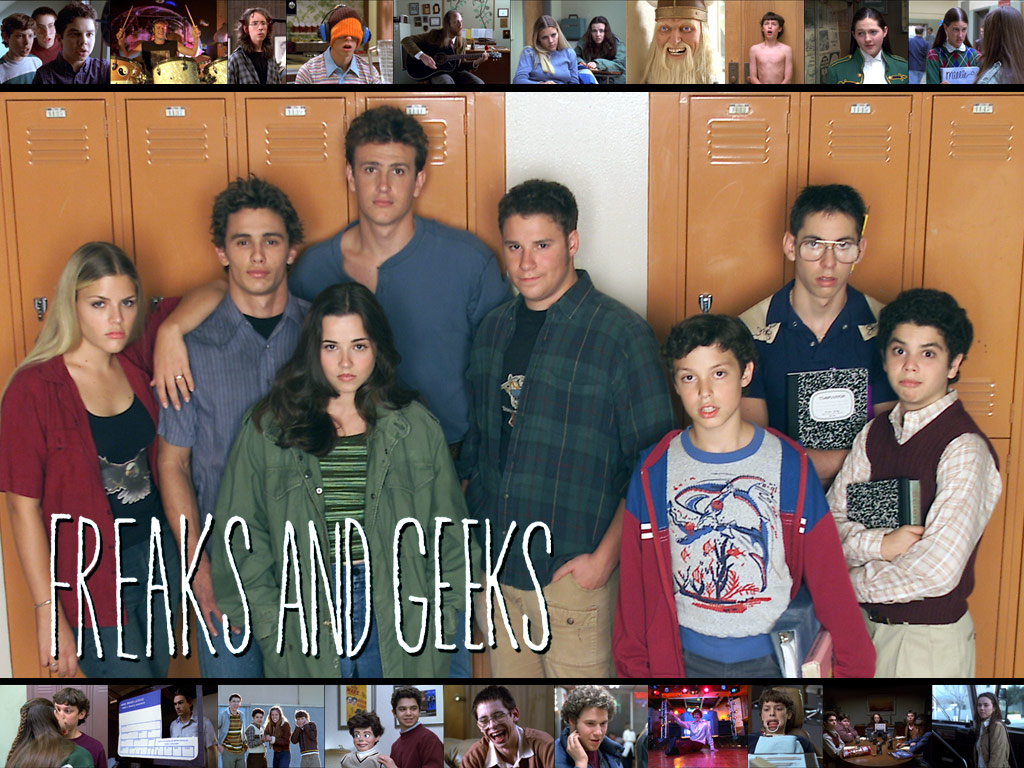
And I just realized, watching a DVR’d episode of Freaks and Geeks, which the Sundance Channel thankfully shows every morning at 5 am, that I’ve been seeing myself in Judd Apatow’s work for as long as he’s been doing that work.

With Freaks and Geeks, Apatow arguably gives the most honest portrayal of high school that has ever aired on network television.  Actually, I need to be more specific.  He provides a perfect picture of high school in the late 1970’s and early 80’s, when I was a suburban lad, growing up on the outskirts of New York City.

The show takes place in Michigan, I believe — a place where I also spent a portion of my adolescence.  As the title suggests, Freaks and Geeks is about cliques and the stringent social structure in high school.  Perhaps because I moved around a bit (I attended three different high schools), I was able to move from clique to clique, as well.  For a time I was a geek, and a freak, and a jock.

I remember hanging out with people who looked like the characters in Freaks and Geeks, having the kinds of conversations they so awkwardly have, about love and fitting in, wishing to be considered an adult, while simultaneously lamenting my childhood, as it faded into the distance behind me.

The series only lasted for 18 episodes, suggesting a short-sightedness that some network executive fell prey to.  I can picture him now, shaking his large head, jowls frothing, as he wonders why he didn’t foresee the stardom that was in store for so many of the people involved in that little show.  He must kick himself every time a new Apatow hit comes out.

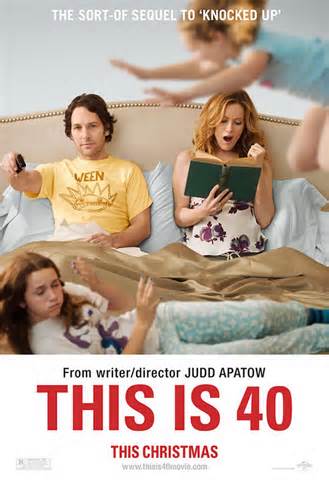
A more recent Apatow-produced hit was a kind of spin-off from his very successful 2007 film, Knocked Up, called This is 40.  My wife and I saw it on a date night, and we laughed.  A lot.  We whispered, “Oh my God, that’s us!” and punched each other in the shoulders.  It was a great time, and Mr. Apatow once again proved himself the chronicler of my bourgeois, suburban life.

It leaves me wondering:  Will there be a This is 80?  I just hope I’m around to see it.  If I am, I have no doubt it will make me laugh and think, and see myself, the way both Freaks and Geeks and This is 40 have done.

Review: Drinking with Men by Rosie Schaap

Drinking with Men: A MemoirDrinking with Men: A Memoir by Rosie Schaap
My rating: 4 of 5 stars

I’ve been a lover of bars for many years, so I went into this book suspecting I’d like it.  I bought it after hearing Rosie Schaap interviewed on NPR’s Morning Edition, where she’d read a segment that hooked me.  Something in her tone sounded familiar, and I knew I had to read her memoir.

If you’ve ever been a regular at a bar — and in my twenties and thirties I was — you will recognize yourself in this book.  As it turned out, Rosie writes about a couple of places I frequented in New York, so that I found myself scanning my memory, wondering if I’d ever met her.  I was a regular at Puffy’s Tavern, a TriBeCa bar that figures prominently in the book, where my fellow teachers and I wound down each Friday during “F Slot,” as we called it.  (The final period of our school day was E Slot back then.)  This was in the mid-to-late 1990’s, precisely when she drank there.  I recognized her descriptions of certain regulars, and half-expected her to describe the rowdy group of high school teachers from the alternative high school a few blocks away on Chambers Street.

She never did make that mention, but I wonder.  Surely we must have crossed paths — if not at Puffy’s, then perhaps at Milano’s?  Or Tom and Jerry’s?  Whether we ever did meet or not, after reading her book, I felt like we had.

View all my reviews

Diggin' It

When I was a child, I wanted to be a grave digger.  There.  You see your face?  You see your reaction?  I got that a lot when I would tell people that.  They would ask me the question:  “Danny?  What do you want to be when you grow up?”  And I would say, quite sincerely, “I want to be a grave digger.”

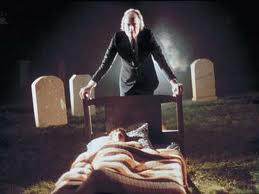
You know, as I write the words down, I can see why people responded the way they did.  It’s a pretty dark thing for a sweet little boy to say.  Kind of “Addams Family”-esque.  When most people think of grave diggers, they probably think of this guy:

“The Tall Man” from Phantasm, a movie that truly terrified my brother and me

So I can see why it may have creeped some of my parents’ friends out when I shared my career aspirations with them.  But, by way of an explanation, I need to share what I was “into” at that time in my life.

I really dug digging.  I used to go out in my back yard and dig holes, just for the sake of digging them.  I wasn’t looking for buried treasure.  (I did, however, find the occasional deer jaw, which was pretty cool.)  And I wasn’t trying to get to China.  Archeology was a notion I enjoyed, but I wasn’t that specific.  I simply liked the experience of making a hole in the ground where there had been no hole before.

I hadn’t thought about my grave digger dreams at all, for maybe the last 40 years or more, until this past weekend, when I got out in the yard with my rake and my shovel in order to dig out an 8 x 8 foot patch of grass in preparation for our 4 x 4 raised bed garden we’re constructing.  My yard, like many in this area, is populated by a strain of super grass called Bermuda grass.  It grows in a heavy, clay-like soil, and is not your run of the mill pretty sod grass.  You won’t find Bermuda grass at any well-manicured baseball stadium or golf course, let me put it that way.  Digging in this stuff should be an Olympic sport.  Or, at the very least, an event in one of those “Tough Man” competitions — the ones you see late at night on ESPN 2, with giant Lithuanian dudes going up against giant Swedish dudes, pulling trees out of the ground, or doing a 40-yard dash with a refrigerator over each shoulder.

This grass is No Joke.

As I dug out the plot for my vegetable bed, smelling the wormy soil, watching the grub worms roll into shrimp-like balls, and seeing spiders skittering for cover, that simple pleasure came rushing back to me, and I was in the back yard at 18 Hartford Lane once more.  I found myself smiling — not so much at the nostalgic flashback, but at the simple joy of digging.  It still does it for me.  (The arthritic wrists and throbbing back are new, but hey, that’s just part of the package.)

There is a derisive cliche in the world of education.  Some asshole, somewhere along the line, was quoted as saying, when faced with a student who just “didn’t get it,” “Hey, the world needs ditch diggers, too.”  It’s a quote I’ve always hated, but if and when they divide us up, one line for the intellectual phonies, and the other for the ditch diggers, you better believe I am going to reach for that shovel.

(Maybe I’d sneak a pencil into my pocket, too.  I might just want to write about those other assholes, after all….)

Driving from the Back Seat

I’m in the back seat of my father’s station wagon, drowsy and comfortable, after some family outing that has made for a full, exhausting day.  Like my brother, I’m lying on the floor back there.  This is in the days before the invention of the child car seat, when seat belts went across your lap only and were considered more or less an optional nuisance.

I drift off, lulled by the repetitive thunking of the uneven asphalt beneath me.  My thoughts melt into each other and make less and less sense, like sentences tumbling off a page, letter by letter, splashing into an unseen pool of water somewhere far below.

Suddenly, I’m sitting upright in the back seat, alone.  I look around for my brother, who is no longer back there with me.  The tires on the asphalt still pound out a steady rhythm, as I look to the front seat and see that my parents, too, are gone.  I reach over the seat, barely able to get the tips of my fingers on the steering wheel.  It’s too dark to see what’s going on with the pedals, and I can’t understand how it is that I’m still moving forward in the night.  But I am.

Thunk, thunk, thunk.

Minimally, I maintain control of the car, and my sense of the road is vague, at best.  Some rumbling suggests I may be veering off to the left.  I know I should pull the steering wheel hard right, but something happens, and I am frozen.  Immediate action is required, but I am paralyzed.

If this dream has any resolution, any finish, I don’t know what it is.  I believe it ends in that moment of fear and realization that I can’t move.  Usually, when people talk about their recurring dreams, like the one about the math assignment that’s due, I forget I have a recurring dream at all.  This one comes up irregularly, from time to time, and feels the same each time.  According to a website called allexperts.com, there is a simple explanation to my dream.

This particular expert tells “Restless Erica,” the reader who shares my dream, the following:

Your dream describes an issue in your life circumstances. It suggests you are not in control of your life, that you have “taken a back seat” and allowed the control to be in someone else’s hand. Your attempts to gain control or direct your life may feel scary and cause you to “stay in the back seat and duck”. Your lack of destination may be causing you to struggle to regain control. 

Well, duh.

I suppose there might be some truth to this, even if it does feel a bit “clap-trap.”  Maybe it is time to come up with a new, original plan of action for my family that is uniquely mine.  Texas was my wife’s idea, but I’ve embraced it.  I went to Spain and loved it…because my girlfriend suggested it.  Syracuse University was a great experience, one my father had before me.  A case could certainly be made that I’m a bit of a Restless Erica myself.

I’ll give that one some thought, as life continues to move forward on the uneven asphalt of time.  Truth be told, I’m not that concerned about it, and am quite content to lie down, my ear to the floorboards.

Thunk, thunk, thunk.

Just ASK Them

51 Chambers Street where Satellite Academy resided, on one dimly lit, dusty floor,  from the late 70s till 2000

“Slipping through the cracks” is a cliché; however I can tell you it is a very real phenomenon.  Kids do it every day, in hundreds, maybe thousands, of American high schools.   When I worked at a small public school in New York City, especially designed for those students, I knew first-hand of the many ways in which they had failed school, and school had failed them. they wove a common thread when they told of “feeling like a number” and not “being known” in their old schools.  Some kids told stories of being “internal cutters” in buildings so large they could be counted present at certain key moments of the day, then wander into less patrolled sections of the school and “chill” until it came time to leave each afternoon, successfully avoiding classes that bored or confounded them.
Of course back in those days, I was filled with self-satisfaction, knowing I was One of the Good Ones, helping youth find their way back to the educational path from which they had strayed.  I had the opportunity – the luxury, I realize now – to be encouraged by my school’s (and, at one time, my district’s) leadership to be a leader myself, in inspiring my students using creative means.  We had approximately 200 students in our building, cared for and educated by around 20 adults.  I’d be lying if I suggested we were successful in guiding all of them, but we were good at helping a majority of them feel they had found a scholastic home – a place where they could be free to be vulnerable in that way that allows you to pick yourself up and try again. 
The school where I work is anything but small, as I have mentioned in a previous post.  In that same post, I meditate on the notion of bringing a “small school mentality” to a large campus.  I don’t know that I had a clear sense of what I meant when I wrote those words the first time, but I think I know now.
And here it is:

Just listen to them. 

It sounds absurdly like an oversimplification, and I know it probably is.  Don’t dismiss the idea, though.  What most of the people who graduated from the school where I taught in New York will tell you (and I hope they’ll read this and chime in) is that the first step comes when a student begins to seriously consider what is not working in their education.  Teachers are asked to reflect on student failure all the time, as they should be.  But rarely do we ask students to think, and talk, about what they believe has gone wrong. 

Here are some questions that a teacher might think about asking their students:

  • ·      Tell me about you and school.
  • ·      Tell me a about the last time you loved a class and why you think you did.
  • ·      Who was the best teacher you ever had and why?
  • ·      Who was the worst teacher you ever had and why?  (No names, please.)
  • ·      What do you think you need in order to be successful?

There are teachers who will read this and have a negative response, dismissing me as one of those liberals who enables children, rather than challenging them.  I’d argue that these questions are challenging ones – especially to ask sincerely and in a safe atmosphere that will ensure honest results.  Some will say, “Well, when I was a student no one asked me questions like these.  They just told you to do the work, and either you did it, or you didn’t.”
What I would encourage that teacher to understand is that the self-actualization they may have had as a teenager is rare.  Yes, many of our students are capable of pushing through whatever the assignment is, with a minimum of help.  However, there are others who bring with them through our school doors myriad shackles, accumulated over years of failure and/or being passed along. 
It’s difficult for you to know every one of your students well in a school where your individual student load approaches 200 – the TOTAL number of students we worked with in our small transfer high school in New York City.  I don’t deny that.   But the teachers I see thriving, coming to work with smiles on their faces, and leaving in the afternoon looking invigorated and not depleted, tend to be the ones that try.  Keep fighting the good fight.  And if you want to take a step in the right direction, stop that one kid who keeps on failing, seemingly without a care in the world, and ask him my first question. 
“Tell me about you and school.” 
You might be amazed at what you hear, and it might just energize you at the same time. 

But one thing is for sure:

You’ll never know if you don’t just ask.

The Soil Connects

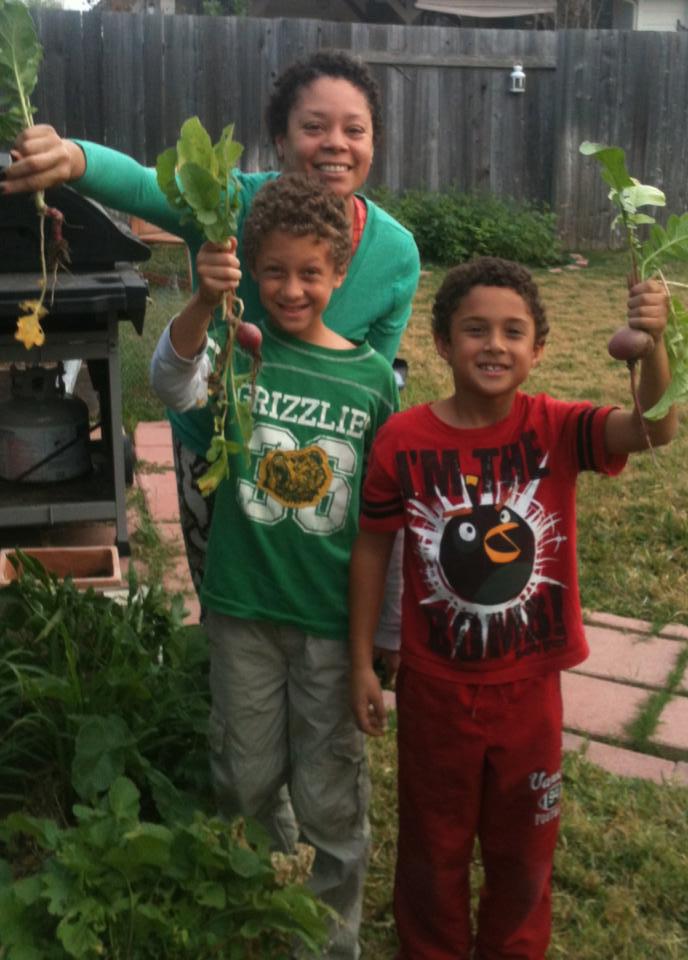
Jeanette, Diego and Jackson, showing off a recent crop of beets in our back yard

Jeanette and I recently began attending something called a “Citizen Gardener” class.  Sponsored by the Sustainable Food Center of Austin, the class is designed not only to help novice gardeners understand what they’re doing — or trying to do — in their back yards, but also to train a corps of volunteers who presumably will go out and share their skills in community gardens around the Austin metro area.  It’s one of those great ideas I wish had been my own, because it manages to incorporate both the fun of gardening with the larger idea of service, and connecting with the community around you.

I’m all for the idea of connecting, though I’ll be honest:  this class is more about connecting with my wife and children than it is about any grander sense of the word.  Yes, I do like the idealistic notion of breaking down the barriers between myself and my Fellow Man, but I’m even more excited about doing something special with Jeanette.  My wife and I don’t see each other enough.  It’s a simple statement, but it’s also one that resonates.  It’s the kind of sentence you read and then nod your head and think, “You know what?  My spouse an d I don’t see each other enough either…”  It’s the nature of the world we live in.

So to have an activity, a hobby, or a passion we can share is something I think we’ve always looked for.  Lately, we’ve tried yoga, which has been great.   In the past, we’ve played a little tennis together, worked out at the gym on occasion, and even went roller blading, albeit briefly, which we joke about, because it was supposed to be what we did on our first date, and it only took me about fifteen years to make good on that promise.

Gardening is something that I think will work better than these other activities, only because it ihas always been a connector for me.  When I think of home gardening, I immediately think of my father, out in our yard at 18 Hartford Lane.  (Once again, as my friend Gayle Saks-Rodriguez points out, all roads lead back to Hanno.)  He enjoyed waking up early and getting out into the yard.  He planted many trees, including a row of poplar saplings he ordered through the mail — forty-inch twigs that became, eventually, a sixty-foot fence of dappled sunlight.  (I noticed last time I passed by the house at 18 Hartford Lane that they’d cut down the trees.  It’s their right, I suppose, to prune and start anew.)

In addition, my father grew a beautiful rock garden that flanked the front entrance to our home, filling it with what I remember to be a wide variety of multicolored flowers.  He planted rose bushes and an apple tree.  He had a back patio built, around a lovely mimosa tree, whose leaves I recall being silk-smooth to the touch.

And he did try has hand at vegetables.  The way time distorts memory, I couldn’t tell you how many varieties of vegetables there were, or for how many seasons he grew them.  This would have been in the early 1970’s, some 40 years ago now.  Of course, when I close my eyes and think back, there were tomatoes, carrots, cucumbers and lettuce, all of it shiny and bright as the produce rack at the supermarket, just after the piped-in recording of distant thunder rises up and the sprayers have spritzed the merchandise.

I do know he tried his hand at corn one summer.  I specifically remember it climbed the posts of our back porch, along with some grape vines.  Where it gets spotty is when I try to recollect whether or not a crop was ever produced.  Things get further confused by a story my father used to tell about his own childhood.  He told it every time we ate corn on the cob, and though my brother and I groaned each time (“God, Dad, not that story again.”), it’s a good one, and I tell it myself, as I’ve no doubt my younger brother does at his own dinner table, to his own family, some 1,700 miles away from mine.

When my dad and his family arrived from Europe in 1940 or so, they came together for a dinner at a cousin’s house in Larchmont, New York.  It was a big meal — maybe a holiday (Thanksgiving, if you like) — and one of the dishes on the table was corn on the cob.  This was exotic to the Fuchs family.  They’d never had it before.  When he and his older brother (probably 12 and 15 respectively) bit into the strange vegetable, they looked at each other, eyebrows raised at the amazing sweetness and flavor.  It was so good, my father told, that they began to laugh, and the two of them continued to laugh, eating ear after ear of delicious sweet corn as they went.  It was for this reason that my father always classified corn on the cob, for the remainder of his life, as either “Laughing Corn” (worthy of his stamp of approval) or not.

I don’t know whether the Citizen Gardener course will ever fulfill its promise to connect me and my family with the members of our larger Austin community.  I will say this, however:  Getting out into my garden has connected me to my wife, to my children, and to the memories that keep my ancestors alive within me.  I am creating memories for my own children, just as my father did for his.    And in this way, the class has paid itself back already.  Tenfold.

The author, getting ready to build his first palette composter. 

A Visit From My Former Self

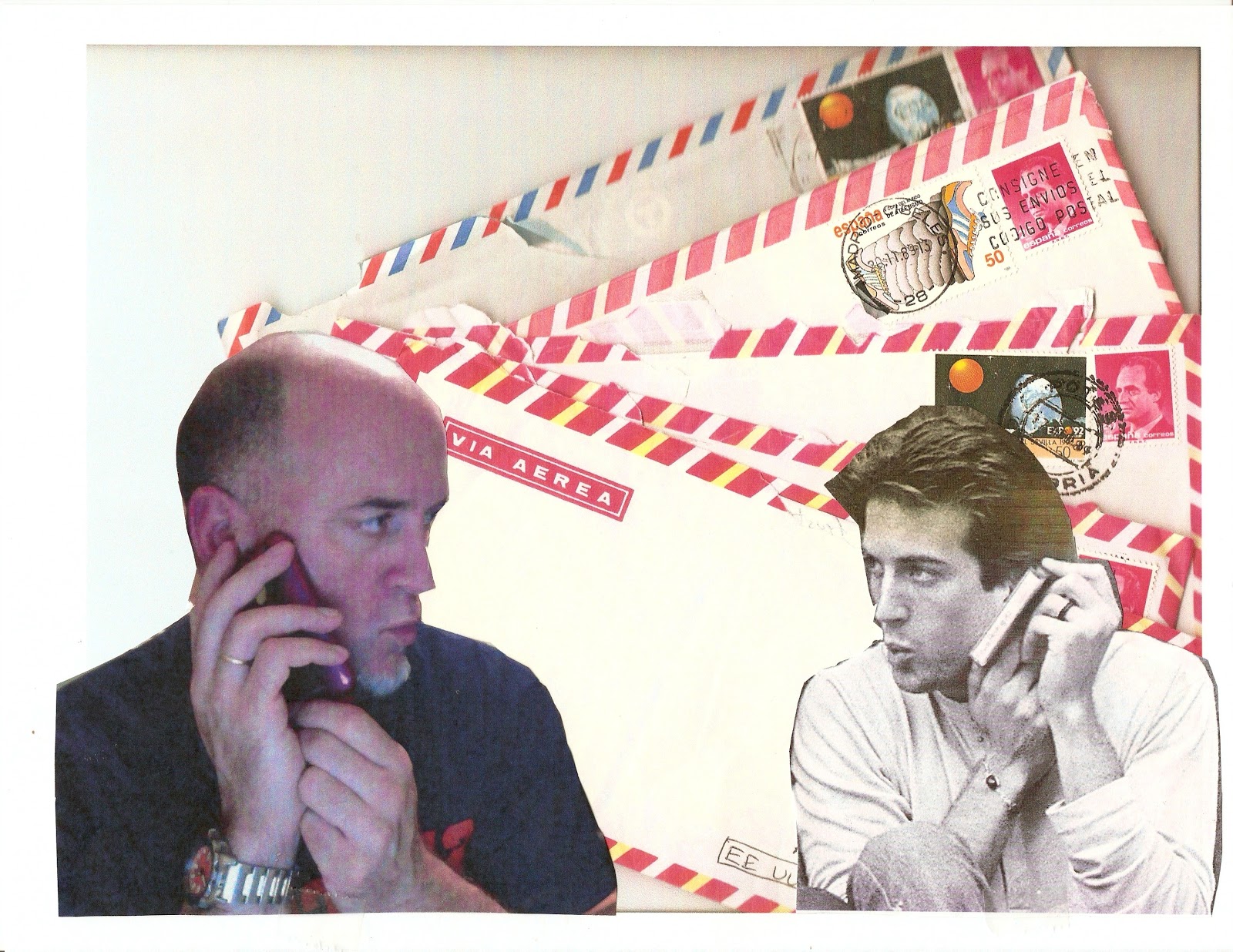
A few days ago, I received the following text from one of my oldest friends:  “Just found a stack of letters from you as far back as 1987.  Mostly letters from Madrid.”  My friend lives only a few miles from where I work, so I stopped by her house and picked them up on my way home yesterday.  Just seeing those 20-peseta stamps, emblazoned with King Juan Carlos’s handsome profile, brought back my Spanish adventure in striking detail.  I flashed on the ornate post office at Cibeles Square, where I would go to buy stamps and airmail envelopes.

I was a prolific letter writer back in those days.  I was trying hard to create a writer persona for myself, which included sitting in Madrid cafes, scribbling  journal entries, poems, short stories, or letters to my friends back in the States, among other, late-night activities.  (Anyone who’s ever visited that city knows there is no lack of those.)

If you’ve ever had the experience of reading letters you wrote 25 years earlier, you know it’s an odd sensation.  It’s kind of like turning a corner and looking your young self in the face.  In the words, you recognize bits of your identity, but it smacks of pretension, making you remember the discomfort of youth, when you tried so hard to convince those around you that you were comfortable in your own skin, all the while sure they would see through your flimsy disguise.   

My writing in the letters is embarrassingly overdone at times.  One, written in November of 1989, starts with, “Closing out the eighties, you and I’ve known each other more or less this whole sad and best-forgotten decade.  If you could collect all the proverbial water that’s passed under that ole bridge you’d have one hell of a reservoir…”

I have no choice but to forgive myself; ultimately, I couldn’t have written any other words but those.  That was who I was, and perhaps I’m kidding myself to suggest that I’ve changed much at all since then.  I still write the occasional letter, but mostly it’s emails and text messages, along with Facebook status updates and tweets.

Which is not the same.  There’s an intense intimacy in letters that you don’t find in those other forms of more modern communication.  My mother was a letter writer.  I got it from her.

The most jarring admission I can make to myself about these found letters is that they are a chronicle of unfulfilled dreams and desires.  I had the audacity at age 25 to imagine myself as a famous actor (“They will name diets after me!”), and brag about having met a literary agent who loved my writing and encouraged me to write a novel, a task I have not yet accomplished, nearly 25 years later.

Once again, forgiveness is due.  A young man is supposed to dream big dreams.  If I hadn’t been imagining big things for my future, something would have been amiss.  And besides, I’ve got another confession to make:

At age 49 I still dream of writing great novels and being a movie star.

And you know what else?  It just might happen, because I ain’t dead yet…..

I Am My Father's Son

My father was an ad man, so of course, I hate commercials.  There are still too many of them on TV, and the pitchmen come on at volume levels that should be prohibited by law, yelling at you about the same dumb products, over and over and over again.

Every once in a while, though, I find myself looking at the world through the eyes of an advertising man.  Recently, as I hugged a curve on my way to work, I clicked on the “Voice Note” app on my iPhone and said the following words, in a loud, confident TV pitchman’s voice:

“The guilt-free SUV.  The Highlander Hybrid.  From Toyota.”

Happy Anniversary…Compact Disc

Back in October, during my ride to work, NPR ran a brief, uninteresting story on the 30th anniversary of the advent of the Compact Disc.  Despite being forgettable, the piece did send me into one of my reveries, this time back to the corner of East First Street and First Avenue, where my friend Jem Aswad lived in a walk-up, split-level apartment.  It was small but interesting, with lots of exposed brick and an upstairs loft space with roof access.  
Jem has always been my music buddy.  The first time we met, he taught me how to play a few songs on the guitar in the lounge space on the third floor of Shaw Hall in Syracuse.  He was wearing a Psychedelic Furs t-shirt.  Although I knew nothing about the band in 1981, I could tell by looking at the shirt that they were cool, as was the dude wearing it.  Jem (who went by “Jim” back then) turned out to have an extensive record collection, and he worked part time in an indie record store called Desert Shore Records.  During our 30 year friendship, I’ve witnessed Jem’s complete immersion into the world of music, from LPs, to cassettes (he made some amazing mixed tapes for me and the rest of our crowd back then), to CDs to MP3s.  I’m sure he’s still got a warehouse full of vinyl records stashed somewhere, and lord knows how many songs are on his iPod at this point.
But yes, CDs entered the mix some time in the 1980s, and I will never forget my introduction to them.  One afternoon down there in the East Village, Jem happened to show me a cardboard box he had in the bottom of his closet.  The box was filled with CDs, which I’d never seen before.  Not in person, anyway.  My understanding was that they were significantly more expensive than records, which I still listened to at that time — in 1986 or ’87 — after Jem moved into 1st and 1st and before I snuck on over to Europe for my expat stint.  
“Come on,” Jem said, with that familiar twinkle in the eye that suggested impending mischief.  He grabbed the box, and I followed him up the iron spiral staircase that led to the loft and out onto the roof.  From six stories up, we had a good view of the block.  I’m not sure, thinking back on it, what time of the day it was; I’d like to think there weren’t too many people around.  
Remember now, the CDs in that box were like exotic treasure to me.  To Jem, however, they were nothing more than what probably amounted to an unending stream of freebies that awaited him daily at CMJ, where he had an entry-level editor’s job at the time.  He sent the first disc flying out into space, and I marveled at the way it dipped and dived, shining prismatically before smashing into the sidewalk below.  I threw one of my own, Frisbee style, and watched it crash as well.  
I’m sure it didn’t take long for us to realize that what we were doing — our little act of Keith Moonesque rebellion — was idiotic.  Rather than wait to get arrested or threatened with violence, we moved our party back inside the apartment.  We may have smashed two CDs that day, and for the sake of the story, I’m sure it would be better to contend that we tossed the whole lot off the roof.  Regardless of the number, I’ll never forget the sense of pure decadence I felt, as I watched what was still a technological novelty at the time, these shining flying saucers, crashing into shards down below.  

When Your Friends Become Your Family

Every once in a while, I steal a peak at my nephew’s Facebook page.  He’s in his early twenties, and the online life he’s leading is WAY different than mine.  For one thing, he’s got far more friends.  They write almost exclusively about what appear to be inside jokes.  In other words, they’re speaking a language I don’t quite understand.  I wonder, as I browse his page, how many of these 1,000 + individuals are his “actual” friends.  The reason I wonder this is because I remember, so fondly, my own friendships from that time in my life.  It’s a bit of a cliche to say it, but when you’re in your 20’s, your family — the one you grew up with — recedes into the background, while a select group of friends comes to the fore.  In essence, these folks become your family.

I was lucky enough to have a few special groups of friends.  In college, we lived first in dormitories, then in a collection of thin-walled, over-priced apartments off campus.  There was talk at one time of trying to rent an entire house together, a proposition that excited and intrigued me.  Doonesbury was one of my favorite comic strips at the time, and I liked the idea of having a “Walden” where my friends and I could regenerate in a kind of self-selected, co-ed fraternity.

For whatever reason, our commune never came to be, but it didn’t matter much:  Just because we lived in separate places didn’t make that group any less of a family.  In fact, I’m still in close contact with many of my college friends today.

And I did get to live my commune fantasy eventually, if only briefly, when I lived in a place I’ve written about before — the Cava de San Miguel apartment in Madrid, Spain.  Those friendships, with an international flair now (Spaniards, Italians, Americans, Germans and Dutch came together in that place), were part of what made that spectacular flat so special.  Granted, the relationship that brought me there was falling apart, and I was carrying around some pretty heavy grief at that time in my life, but I still enjoyed the sense of community in that sprawling old Madrid apartment.  I’ll never live anywhere like it again.

Fast forward a few years, and I am a young man waking up from a failed marriage, in need of a place to lick his wounds.  Other friends, in similar moments of their lives, have found a summer house in a place with the rather magical name of Big Indian, New York.  The drafty farm house provided a lovely sanctuary for all of us, and we had some wonderful times that summer of 1993.  The experience in the house in the Catskills was the closest I’ve come to a commune and to the Doonesbury Walden experience, complete with my own “puddle” (actually a little bend in the Esopus River, that provided a perfect soaking tub) in which I could luxuriate on hot days, thinking about nothing more than how much I was enjoying the time with my friends.

Of course, as with all things, I look at my two young sons and wonder what sorts of communal experiences they will have when they’re older.  Jackson is the social butterfly.  In a way, his entire life has been one big commune; the moment he walks in the door, anywhere he goes, it seems, the hellos start coming.  Diego might be less likely to want to share his space with others.

Who knows, though?  Like me, he may find himself one day surrounded by a small group of friends who, for that brief moment, become his family.  I could see myself visiting him — in my sixties now — smiling, and wondering, as I listen to their code-like banter, just what the hell my son and his friends are talking about.